
Building a Home Gym: Affordable Equipment and Setup Tips
Build a home gym that fits your space and budget. Practical equipment picks, setup tips, and workout guidance to help you train at home without a monthly membership.
4/25/20264 min read
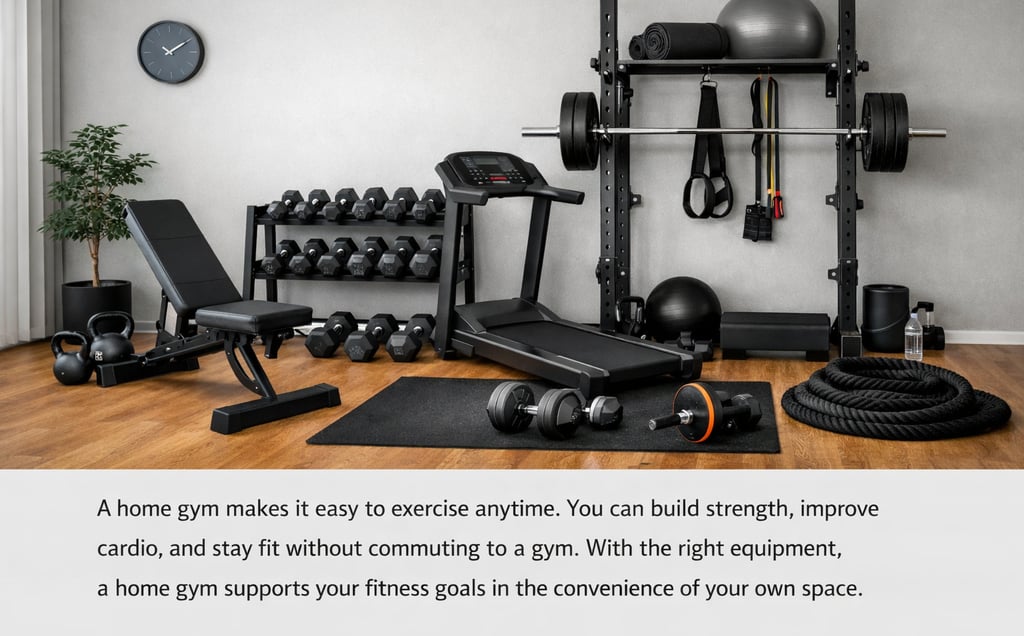
Best Home Gym Equipment for Small Spaces in 2026
Build a great home gym in a small space. These compact, versatile picks fit apartments, spare corners, and tight rooms.
You Don't Need a Dedicated Room
The number one excuse I hear for not working out at home is "I don't have the space." Not everyone has a spare room to convert into a home gym. But here's the thing: you don't need one. A corner of your bedroom, a section of your living room, or even a cleared-out closet is enough for a surprisingly effective workout setup.
The key is choosing equipment that's compact, versatile, and easy to store. Everything on this list earns its footprint by offering multiple exercise possibilities in a small form factor.
The Best Compact Equipment for Small-Space Home Gyms
Adjustable Dumbbells
Adjustable dumbbells replace an entire rack of weights with a single pair. Most sets let you go from 5 lbs to 50+ lbs per hand by turning a dial or moving a pin. When you're done, they sit on a small stand that takes up about two square feet of floor space. This is the single most important piece of equipment for a small-space gym.
Space footprint: ~2 sq ft on a stand. Best for: Full-body strength training.
Resistance Bands (Set)
A full set of resistance bands (light to heavy) fits in a drawer. They're versatile for strength training, mobility work, and rehabilitation. Loop bands, tube bands with handles, and mini bands each serve different purposes, and a complete set costs less than a single dumbbell.
Space footprint: Essentially zero. Best for: Versatile training anywhere, travel workouts.
Foldable Workout Bench
A workout bench opens up dozens of exercises (bench press, incline press, rows, step-ups, seated curls). A foldable bench collapses flat and slides under a bed or behind a door when not in use. Look for one that adjusts to flat, incline, and decline positions.
Space footprint: ~4 sq ft in use; folds to under 1 sq ft for storage. Best for: Expanding dumbbell exercises.
Door-Frame Pull-Up Bar
A door-frame pull-up bar installs in seconds with no screws or drilling. It gives you pull-ups, chin-ups, and hanging leg raises, exercises that are hard to replicate with other equipment. When you're done, take it down and lean it against a wall.
Space footprint: Zero when stored. Best for: Upper body and core strength.
Jump Rope
The humble jump rope is one of the most effective cardio tools per square foot. A speed rope provides an intense workout in 10–15 minutes, burns more calories per minute than jogging, and costs under $15. Just make sure you have enough ceiling clearance (about a foot above your head).
Space footprint: ~4x6 ft of open floor space while using. Best for: Cardio, coordination, warm-ups.
Yoga Mat
Even if you never do yoga, a good mat is essential. It's your floor for stretching, bodyweight exercises, core work, and cooldowns. Look for a non-slip mat with enough cushioning for comfort on hard floors (6mm thickness is the sweet spot). Roll it up and store it standing in a corner.
Space footprint: Rolls up to ~6 inches diameter. Best for: Floor exercises, stretching, yoga.
Compact Spin Bike or Mini Stepper
If jump rope isn't your thing and you want a dedicated cardio option, a compact spin bike or mini stepper fills the gap. Mini steppers are compact (about the size of a bathroom scale) and provide a solid low-impact cardio workout. Compact spin bikes are larger but many fold for storage.
Space footprint: Mini stepper: ~2 sq ft. Compact bike: ~4 sq ft (foldable). Best for: Low-impact cardio.
Suspension Trainer (TRX-Style)
A suspension trainer hangs from your door frame (or a ceiling anchor) and uses your body weight for hundreds of exercises. It's one of the most versatile single pieces of equipment you can own, and it stores in a small bag. Rows, push-ups, squats, lunges, core work, all from two straps.
Space footprint: Fits in a drawstring bag. Best for: Full-body functional training.
Foam Roller
Recovery is part of fitness. A foam roller helps release muscle tension, improve flexibility, and reduce soreness after workouts. It's simple, effective, and takes up the same space as a rolled-up towel. Use it for 5–10 minutes post-workout or on rest days.
Space footprint: ~6 inches diameter, 18–36 inches long. Best for: Recovery and mobility.
Kettlebell
A single kettlebell is versatile: swings, goblet squats, Turkish get-ups, cleans, presses. For most people, a 20–35 lb kettlebell is a good starting point. If space is extremely tight, an adjustable kettlebell lets you change weight without owning multiple bells.
Space footprint: ~1 sq ft. Best for: Full-body strength and cardio conditioning.
Storage Solutions for Small-Space Gyms
Over-the-door organizers work great for resistance bands, jump ropes, and small accessories.
A small rolling cart can hold dumbbells, a kettlebell, and a foam roller, and roll into a closet when not in use.
Wall-mounted hooks keep suspension trainers and resistance bands visible and accessible.
Under-bed storage is perfect for a folded bench, yoga mat, and foam roller.
The Math That Changed My Mind
A gym membership costs roughly $40–70 per month. That's $480–840 per year. Over three years, you're looking at $1,400–2,500, and you own nothing at the end of it. Meanwhile, a one-time investment of $300–500 in home gym equipment gives you a setup that lasts years, is always available, and has zero monthly fees.
I'm not anti-gym. If you love the social aspect or need specialized machines, a membership makes sense. But if you're consistently skipping the gym because of the commute, the crowds, or the schedule, building a home setup is the smarter financial move.
Here's how I'd allocate a budget across three tiers.
Tier 1: The Essentials
This is your foundation. With just these four items, you can do a full-body workout that covers strength, cardio, and flexibility.
Resistance Band Set (5 levels), Yoga Mat, Speed Jump Rope,Door-Frame Pull-Up Bar.
Tier 2: The Upgrade
Once you've outgrown bodyweight and bands (or you want to build more muscle), add weight training essentials.
Tier 3: The Complete Setup
Round out your gym with a cardio option and recovery tools.
Contact
Get in touch for questions or collaborations. Avi Cha
Phone
Maplefixpro.ca@gmail.com
+1-647-916-5573
© 2026 Smarteryouu. All rights reserved. Some images on this site are AI-generated for illustrative purposes