
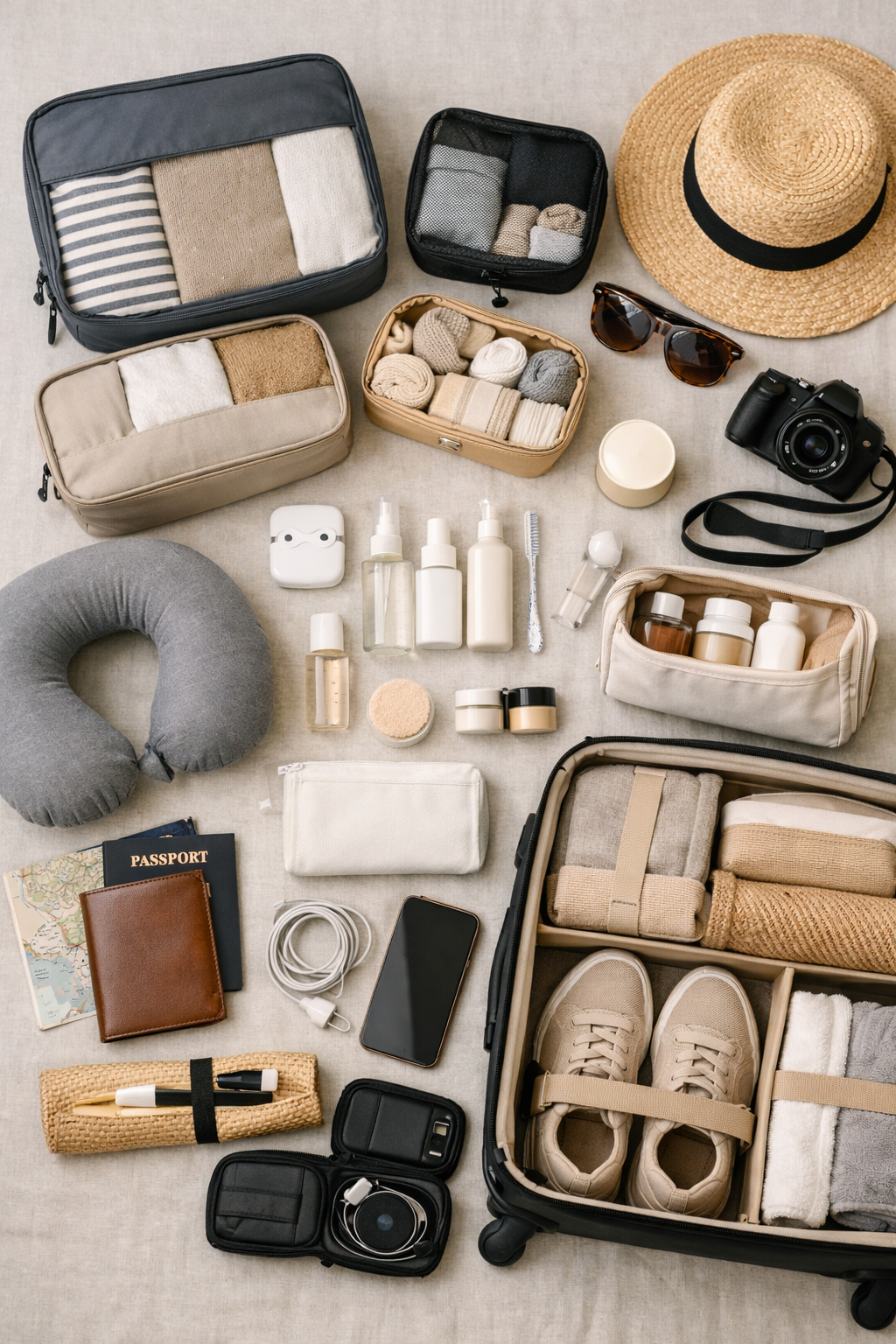
Smart Packing Tips: How to Fit More In Without Carrying More
As an Amazon Associate I earn from qualifying purchases. Some links in this post go to Amazon and may earn me a small commission at no extra cost to you.
Last Updated on September 13, 2026 by Smarteryouu
⭐ Smart Packing Tips: How to Fit More In Without Carrying More
There is a moment in most trips where you are looking for one specific shirt, and the only way to find it involves taking everything out of the case and putting it on a hotel bed. Ten minutes later the room looks like a jumble sale and you still have not found the shirt.
That moment is not a luggage problem. It is a method problem, and it is the thing these smart packing tips are aimed at. Not how to buy a better suitcase. How to use the one you already own so that it stays organized for the whole trip rather than the first day.
The good news is that almost none of this costs anything. It is a handful of habits, most of which take one trip to learn and then stay with you. The bag ends up lighter, things stay findable, and the whole business of packing stops being the part of traveling that you dread.

⭐ Start With the Bag, Not the Clothes
Most people pack by walking to the wardrobe and pulling out things they like. That is why cases end up full of outfits for situations that never arrive. The better order is to look at the bag first and decide what it is allowed to hold, then fill it.
A smaller bag is the single most effective packing technique there is, and nobody wants to hear it. If you take a large case you will fill it, regardless of trip length, because the space is there and everything seems like it might be useful. Take the smaller one and the decisions make themselves.
Lay everything out on the bed before anything goes in. Seeing it all at once is what makes the third sweater look silly, whereas packing item by item lets each one seem individually reasonable.
Then put a third of it back. That sounds glib and it is close to literally correct for most people on most trips.
⭐ Should You Roll or Fold?
Both, depending on the garment. Rolling suits soft items that do not crease badly, like t shirts, underwear, socks and casual trousers, and it genuinely saves space. Folding suits structured things that crease, like shirts, linen and anything you want to look presentable on arrival.
The blanket advice to roll everything is where people get caught. Roll a linen shirt and it arrives looking like it has been slept in, which is a poor trade for the centimetre of space you saved.
The reason rolling works at all is less about the roll and more about density. Rolled items sit tightly against each other with no air gaps, and air is what wastes space in a suitcase. Anything that increases density helps, which is also why a slightly overfilled bag holds its shape better than a half empty one where everything slides around.
Heavy things go at the bottom, near the wheels. A case packs better and pulls better when the weight is low.
⭐ What Do Packing Cubes Actually Solve?
Findability more than space. Cubes save a little room because they compress, but the real change is that your clothes stop being one shifting mass. You pull out one cube, find the shirt, and put the cube back, and the rest of the case never moves.
That difference compounds over a trip. A case that gets fully unpacked and repacked every day degenerates by about day three. A case organized into cubes is still organized at the end of the trip, because nothing ever had to come out except the one thing you wanted.
Sort by category rather than by day. Tops in one, bottoms in another, underwear and socks in a third. Packing by day sounds tidy and falls apart the moment plans change, which they always do.
Keep one empty bag for dirty clothes from the start, rather than improvising with a carrier bag on day four. This is the part of the system people skip and it is the part that keeps a case from turning into chaos halfway through. If this way of thinking appeals, it is the same principle behind our home storage and organisation guides, which is that everything works better when each thing has one place to live.
⭐ The Weight Limit Nobody Checks
Almost everyone finds out their bag is overweight at the airport, standing at a desk, with a queue behind them, deciding which shoes to put on and which book to abandon. It is an entirely avoidable situation and it happens constantly.
Weigh the bag at home. A cheap handheld scale takes ten seconds and removes the problem permanently. Bathroom scales work too if you weigh yourself, then yourself holding the bag, and subtract.
Check the actual allowance for your specific ticket rather than assuming. Allowances differ between airlines, between fare types on the same airline, and sometimes between the outbound and return legs if the trip involves two carriers. The cheapest fares are usually the ones with the tightest limits, which is exactly when people are least likely to check.
Leave room for the way home. You will bring back more than you took, and a bag that was exactly at the limit on the way out becomes a problem on the way back.
⭐ How Do You Pack Fewer Clothes Without Regretting It?
Pick one color family and make everything work with everything else. If every top goes with every bottom, six items produce far more combinations than eight items that only pair up two ways. That is the whole trick, and it is why experienced travellers look like they packed more than they did.
Plan to wash something. Almost every destination has a laundry, most hotels will do it, and a sink and a bar of soap handles underwear anywhere. Once washing is part of the plan, a fortnight needs barely more clothing than a long weekend.
Layers beat bulk. Three thin things adapt to more weather than one thick thing, and they pack far smaller. This matters most where the temperature swings, which includes anywhere with altitude and most places in spring and autumn.
Wear the heaviest items on the plane. The boots and the jacket take up a quarter of a case and weigh nothing at all when they are on you.
⭐ Toiletries, Where the Weight Hides
Liquids are heavy and people pack far too much of them. A full bottle of shampoo weighs more than several shirts and you will use a fraction of it. Small bottles are not about the liquids rule, they are about not carrying water around the world.
Most hotels supply the basics, and anything you run out of is buyable locally, often for less than at home. Buying shampoo abroad is not an emergency, it is a small errand.
Solid versions of things are worth knowing about. Bar shampoo and solid toothpaste do not count as liquids, do not leak, and weigh a fraction of the bottled versions, which makes them genuinely useful on a carry on only trip.
Whatever you carry, put it in a sealed bag. Pressure changes make bottles leak, and shampoo through a case of clean clothes is a bad start to a holiday.
⭐ Packing for Two, and Packing for a Family
Two people sharing one large case beats two people carrying one each, almost every time. It is lighter overall, because you stop duplicating the shampoo and the charger and the first aid bits, and it is one thing to move through an airport rather than two.
Split across bags rather than by person, though. If each of you has a cube in each case, a delayed bag leaves you both with clothes rather than one of you with everything and the other with nothing. It costs no extra space and it removes a whole category of problem.
With children the useful habit is one cube per child per few days, packed as complete outfits. It looks fussy written down and it saves a great deal of standing in a hotel room trying to find matching socks while everyone waits.
Give older children their own small bag and let them pack it. They will bring odd things and it will be fine, and it means one fewer bag you are carrying.
⭐ What Should You Do the Night Before?
Finish the bag and leave it alone. The night before should be a check rather than a packing session, because everything added late is added tired, and tired packing is where both the forgotten charger and the unnecessary fourth pair of shoes come from.
Run through the short list of things that genuinely cannot be replaced. Documents, medication, keys, wallet, phone and its charger. Everything else is buyable, so everything else does not need checking.
Set out what you are wearing and what goes in the small bag, so the morning is carrying rather than deciding. Early departures go wrong in proportion to how many decisions are left for the morning.
Trips where you carry everything on your back work by slightly different rules, and the camping guides cover that side, where weight is not a fee but a thing you feel all day.
⭐ Best Sellers
Top Products and Picks
Three cheap things that make the method above easier. None of them are necessary, which is rather the point.
Shoes go in one, worn clothes go in another, and neither touches anything clean for the rest of the trip. This is the part of the system most people skip and then improvise with a carrier bag from a hotel bin on day four. Four bags is about right for one person on a fortnight away.
Check price on AmazonThe cheapest thing here and the one that saves the most money. Ten seconds in your hallway removes the whole scene at the check in desk where you are repacking on the floor with a queue behind you. Worth weighing on the way home too, since that is the leg where bags quietly gain a few kilos.
Check price on AmazonDifferent from plain cubes. A second zip squeezes the air out, which genuinely helps with jumpers, fleeces and puffy jackets. It does almost nothing for shirts or anything structured, and squashing those only creases them. Use these for the bulky half of the case and ordinary cubes for the rest.
Check price on Amazon⭐ Final Thoughts
Packing well is not really about fitting more in. It is about needing less, and then knowing where it is. Those two things together are what turn a suitcase from something you fight with into something you barely think about.
It takes a few trips. Everyone overpacks at first, and most people overpack for years, because it feels safer. What changes is that you start noticing which things came home unworn, and the list quietly shortens on its own without you ever making a decision to be more disciplined.
There is a nice side effect too. A light bag changes what a trip feels like. You walk further, you mind a flight of stairs less, and you spend less of the day thinking about your luggage, which frees you up for the reason you went in the first place.
More on what is worth carrying at all is on the travel essentials hub, and the things that keep proving useful end up on the best sellers page.