
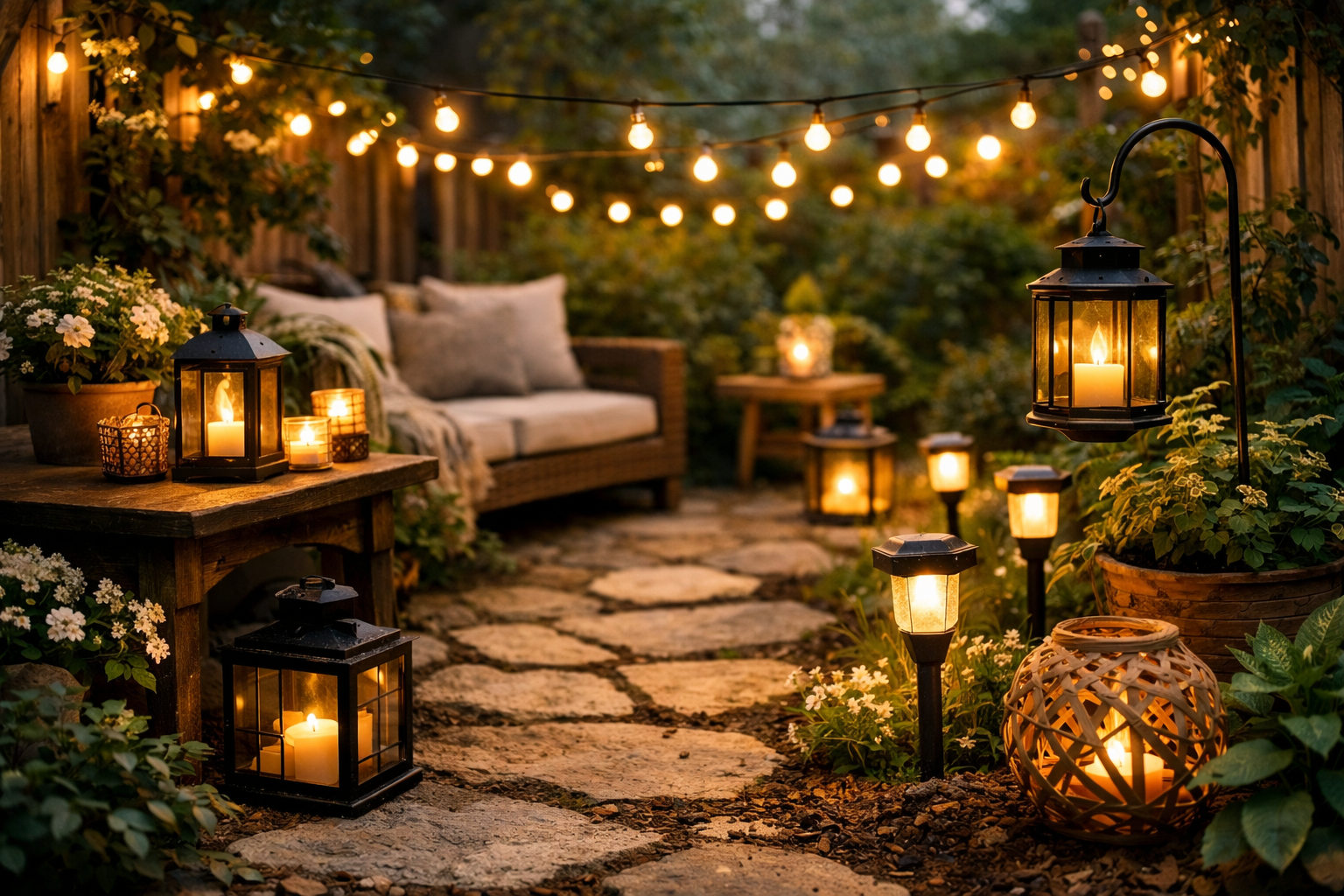
Outdoor Garden Lighting Ideas That Make Your Evenings Cozy
As an Amazon Associate I earn from qualifying purchases. Some links in this post go to Amazon and may earn me a small commission at no extra cost to you.
Last Updated on September 5, 2026 by Smarteryouu
⭐ Outdoor Garden Lighting Ideas That Make Your Evenings Cozy
Most outdoor garden lighting ideas fail for the same two reasons, and neither of them is the budget. The light is too bright, and it is the wrong color. A yard lit with cold blue white floodlights looks like a parking area no matter how much was spent on it, while the same yard lit with a few small warm lamps looks like somewhere you would sit. That difference costs nothing, it just has to be decided before anything is bought. This guide covers what actually makes an outdoor space feel warm after dark. Which bulbs to choose and why the number on the box matters more than the brand. Where to put light and at what height. What solar can genuinely do and where it quietly disappoints. And how to avoid the glare that makes a garden less pleasant rather than more.

⭐ Decide What You Want to See Before Buying Anything
The instinct is to light the whole space evenly. It is the wrong instinct, and it is why so many lit gardens look flat. Even light removes shadow, and shadow is what makes an outdoor space feel like it has depth.
Go outside after dark and pick three things worth seeing. A tree with an interesting shape. The step down from the door. A wall with texture. That is your lighting plan, and three points of light will do more for the space than a dozen spread evenly across it.
Then separate the two jobs light is doing. Getting safely from the door to the gate is one job, and it needs very little light in the right places. Making the space feel pleasant to sit in is a completely different job, and it needs less light than people expect, placed low. Trying to do both with one bright fixture is what produces the parking area effect.
⭐ Warm Light Is Most of the Difference
If you take one thing from this post, take this. Look for the Kelvin number on the box, printed as a figure followed by a K.
Anything around 2200K to 2700K is warm, the color of a candle or an old filament bulb, and it is what makes a space feel comfortable. Around 4000K is neutral and reads as functional. Anything at 5000K or above is daylight white, which is right for a workshop and wrong for a garden, and it is what most cheap outdoor floodlights come fitted with by default.
Brightness matters second, and less than people think. Outdoors, your eyes adjust to darkness, so a small amount of light goes a long way. A string of low output bulbs will light a seating area comfortably where a single bright lamp would leave you squinting at it and unable to see anything beyond it.
Mixing color temperatures is the other common misstep. Two warm fixtures and one cold one looks worse than three of either. If you already own outdoor lights and are not sure why the space feels off, that mismatch is the first thing to check. The same principle indoors is covered in the post on simple home upgrades that make life easier, which owns the bulb material for inside the house.
⭐ Where the Light Goes, and How High
Height is the decision that separates lighting that flatters a space from lighting that exposes it.
Low light, at ankle to knee level, is the friendliest. Path lights, lanterns on the ground, a strip along a step. It reads as welcoming and it never shines in anyone’s eyes.
Light at eye level is where care is needed, because that is where glare happens. String lights hung above head height solve this neatly, which is most of why they are so widely loved. Overhead light works when it is above the sight line and pointed down, and it fails when it is at face height and pointed outward.
Uplighting a tree or a wall is the one trick that reliably makes a small space look considered. A single low fixture at the base of a tree, angled up into the branches, gives you a feature after dark that costs one lamp. Aim it so the beam lands on the trunk rather than shooting past into the sky, which wastes the light and lands it in a neighbor’s window.
Space path lights further apart than the packaging suggests. Manufacturers illustrate them at close intervals because they would like you to buy more. Pools of light with dark between them look better than a continuous runway, and they read as a path just as clearly.
⭐ Solar, and Being Honest About What It Does
Solar is the obvious starting point because there is no wiring, no electrician and nothing to dig. It is genuinely good for some jobs and genuinely poor for others, and the marketing rarely distinguishes.
What it does well is gentle decorative light in a spot that gets real sun. Path markers, a string along a fence, a lantern on a table. Cheap, easy and pleasant.
What it does poorly is anything you are relying on. Output drops as the evening goes on, so a light that is bright at nine is dim by eleven. It drops further in winter, when the days are short and the panel spends the afternoon in shade, which is exactly when you want outdoor light most. And the panel needs several hours of direct sun to charge properly, so a solar light in a shaded corner will never work no matter how long you leave it.
Two practical notes. Wipe the panels a couple of times a season, since a film of dust cuts charging noticeably. And the rechargeable batteries inside are usually replaceable, which means a solar light that has stopped holding charge after two years is often fixable for a few dollars rather than being landfill.
⭐ Low Voltage and Wired, and When It Is Worth It
Low voltage systems are the middle option and the one most people end up at eventually. A transformer plugs into an outdoor outlet, a cable runs from it, and fixtures clip on wherever you want them. The cable carries a low voltage, so it can be pegged along the ground or under a shallow layer of mulch rather than buried deep.
The advantages over solar are consistency and control. The light is the same brightness in December as in June, it comes on when you want it, and you can put fixtures in shade. The cost is that you need an outdoor outlet to start from and you have to think about where the cable runs.
Full mains voltage wiring is a different matter and it is where this guide stops. Permanent outdoor circuits are electrical work with rules attached, those rules vary by province and state, and it is a job for a licensed electrician rather than a weekend. Getting that wrong outdoors, around water, is not the place to save money.
Whichever you choose, check that every fixture and connector is rated for outdoor use and that outdoor outlets have the correct protection fitted. Indoor rated equipment used outside is the single most common shortcut and it fails in the first heavy rain.
⭐ Glare, Spill and Not Annoying the Neighbors
Light that leaves your property is light you paid for and are not using, and it is the fastest way to make a garden less pleasant rather than more.
Shielding is the fix, and it just means the bulb itself is not visible from where people sit or walk. A fixture with a hood over it throws light downward where you want it. A bare bulb throws light everywhere including into your own eyes, which makes everything beyond it look darker than it is.
Motion sensors are worth using for security lighting rather than leaving it on all night, both because it is more effective and because a floodlight burning until dawn is a genuine nuisance to anyone whose bedroom faces it. Aim them at the ground near a door rather than out across a boundary, and turn the sensitivity down if a passing cat is setting it off.
The simplest test costs nothing. Once everything is installed, walk to the far corner of your own property, then out to the sidewalk, and look back. If anything is uncomfortable to look at from there, angle it down.
⭐ Winter, Weather and Keeping It Working
Outdoor lighting is bought in June and judged in January, and most of what goes wrong is predictable.
Water gets into connections, so any joint should sit above ground level rather than in a puddle, and empty bulb holders on a string should keep their caps on. Cables laid across a lawn meet a mower eventually, so run them along an edge or a bed rather than through the middle of grass.
Cold weather shortens the run time on anything battery powered, solar included, which is worth expecting rather than treating as a fault. Snow buries ground level fixtures completely, so anything you want to see in winter needs to sit higher than the snow usually gets.
A short pass each autumn covers most of it. Wipe the panels and lenses, check the connections, replace anything that has cracked, and bring in the fixtures you do not need until spring. If you want the space usable in cooler months more generally, the outdoor patio section covers the seating and shelter side, and the outdoor and garden section has the rest of this category.
⭐ Best Sellers
Top Products and Picks
- Weatherproof string lights with 2200K bulbs, hung above head height, which is the single change that does most for how a space feels.
- A low voltage starter kit with a transformer and a few fixtures, for anyone who has outgrown solar and wants the same brightness in December as in June.
- A pair of shielded uplights, aimed into a tree or along a wall, which is the cheapest way to give a small yard a feature after dark.
- A set of rechargeable table lanterns, which move with you, need no wiring, and come inside for the winter.
⭐ Final Thoughts
The gardens that feel best after dark are almost never the brightest ones. They are the ones where somebody picked two or three things worth seeing, lit those warmly and left the rest alone.
That is a relief, because it means this is not an expensive project. A string of warm bulbs and one lamp pointed at a tree will change an evening more than a full system chosen badly, and you can add to it slowly once you have lived with it for a season.
Start with one warm string and see whether you sit outside more often. If you do, you have your answer about what to add next. If you do not, you have saved yourself a great deal of digging, and you have a string of lights, which nobody has ever regretted owning.
⭐ Additional Resources
For the placement and shielding side, DarkSky International publishes five principles for responsible outdoor lighting. It is written around light pollution rather than around decorating, which is precisely why it is useful. Its advice to keep light useful, targeted, low level, controlled and warm in color is also, as it happens, the recipe for a garden that looks good.