
⭐ Best Racks and Organizers: A Room by Room Guide to Choosing Ones That Last
As an Amazon Associate I earn from qualifying purchases. Some links in this post go to Amazon and may earn me a small commission at no extra cost to you.
Last Updated on September 5, 2026 by Smarteryouu
⭐ Best Racks and Organizers: A Room by Room Guide to Choosing Ones That Last
Most storage advice tells you which rooms to organize. Very little of it tells you how to pick the thing you are about to screw into your wall. That gap is where the money goes. A shelf that sags in four months, a shower caddy that rusts by summer, a shoe rack that tips the first time someone leans on it. None of these fail because the idea was wrong. They fail because the wrong version of a good idea got bought.
This guide takes a different approach to the best racks and organizers for your home. It walks room by room, but the focus each time is on what to check before you buy. Weight capacity, depth, mounting hardware, and the material underneath the finish.
None of it is complicated. It is mostly a handful of questions worth asking while the product page is still open, rather than after the box is unpacked and the drill is already out.

⭐ What Separates Storage That Lasts From Storage That Sags
Two shelves can look identical in photographs and behave completely differently on a wall. The difference is usually in three places.
The first is the shelf material. Solid wood and steel hold their shape. Particle board with a laminate finish holds its shape until moisture or weight gets involved, then it bows in the middle and never recovers. If a listing describes the material vaguely, that is usually a sign.
The second is the bracket. A bracket with a diagonal support arm carries far more than a flat L shaped one of the same size, because the load transfers down the wall instead of trying to bend the metal.
The third is what comes in the bag. Many products ship with short plastic plugs that are close to useless in drywall. Buying a small pack of proper toggle anchors separately costs very little and is the single best upgrade you can make to almost any wall mounted item.
Depth matters too, and it is the thing people misjudge most. A shelf deeper than about ten inches puts a lot more leverage on the wall, and it also becomes the place where objects go to be forgotten at the back. If you are still working out what belongs where before shopping at all, the rest of our storage and organisation writing is a reasonable place to start.
⭐ How Much Weight Will That Wall Actually Hold
Weight ratings on packaging assume perfect installation into solid backing. Real walls are rarely that cooperative.
If you can find a stud and fix into it, you can generally trust the stated number. A cheap magnetic stud finder costs a few dollars and pays for itself the first time it stops you from hanging a loaded bookshelf into hollow plasterboard.
When there is no stud where you need one, a toggle or butterfly anchor spreads the load behind the board rather than gripping a small ring of it. These hold surprisingly well. The plastic expanding plugs that come free in the box do not, particularly under any kind of pulling or downward force.
Tile changes things again. Bathroom and kitchen tile needs a masonry bit and slow, patient drilling, ideally into the grout line where possible so the tile face stays intact.
For most people the practical rule is simple. Anything holding books, tools, pots, or a person’s body weight in a moment of grabbing it goes into a stud or a proper anchor. Anything holding towels or light decor can be more relaxed about it.
⭐ Choosing Entryway Storage That Survives Daily Traffic
The entryway is the hardest working storage in the house and the place cheap products fail fastest. Coats get thrown rather than hung. Shoes get kicked off rather than placed.
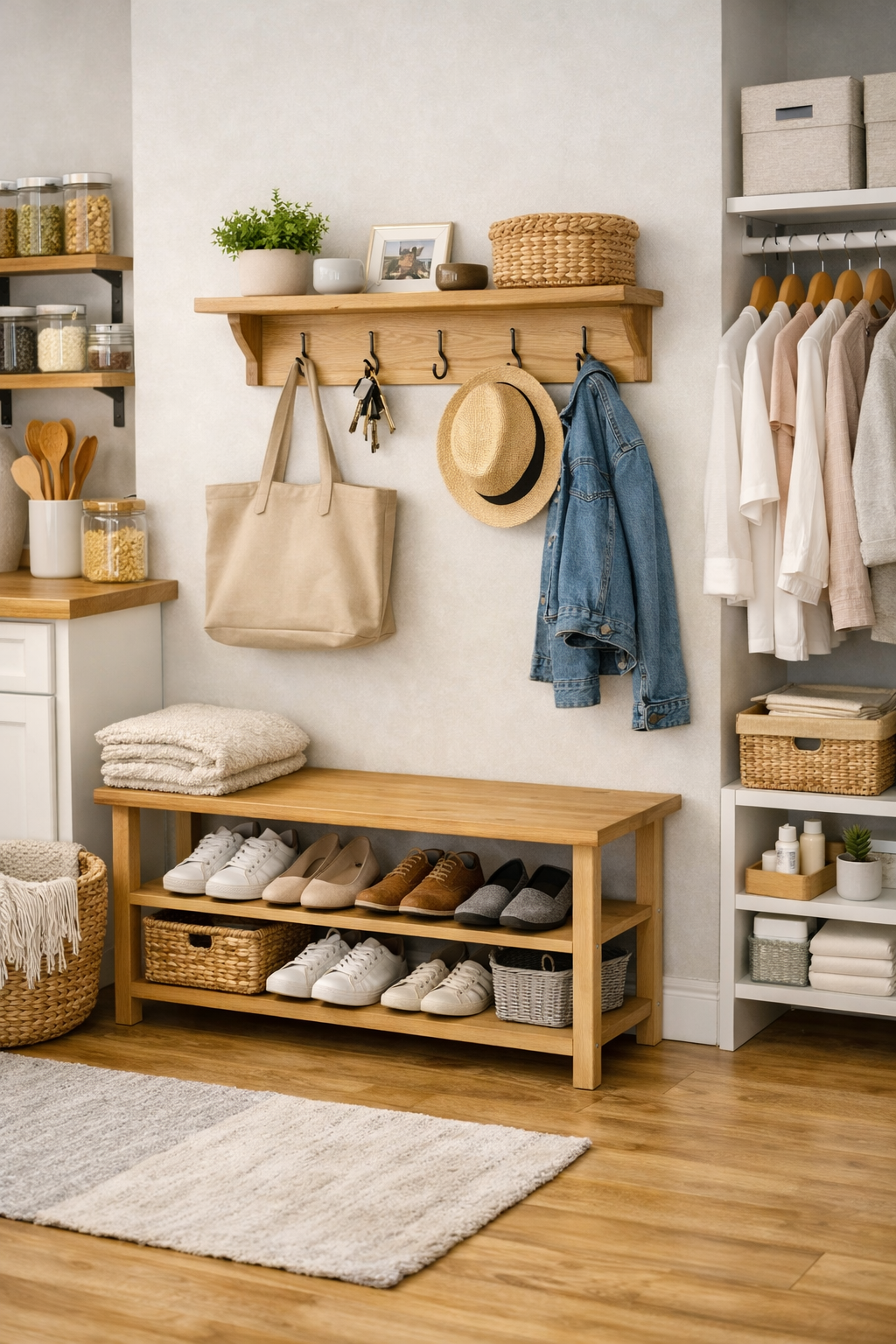
For hooks, look for a rail with a solid back plate that spans two fixing points rather than individual hooks fixed with one screw each. A single screw carrying a wet winter coat and a bag will work itself loose over a season.
For a shoe rack, the choice is between open metal frames and enclosed benches. Open frames dry wet shoes and let dirt fall through, which is either useful or annoying depending on your floor. Enclosed benches hide the mess but trap damp, so they suit dry climates and indoor shoes better.
Check the height of each tier against the shoes you actually own. Many racks are built for flat trainers and will not close over boots.
If your entryway is narrow, a wall mounted rail with a shelf above it usually beats anything freestanding, since it keeps the floor clear for sweeping. Our storage ideas for tight spaces covers more of these vertical approaches.
⭐ What to Look For in Kitchen Shelving and Cabinet Inserts
Kitchens punish weak storage because everything in them is heavy and most of it gets moved daily.
Shelf risers are the easiest win, and the ones worth buying are metal rather than plastic. Plastic risers flex under a stack of plates and crack at the joint. Measure your cabinet’s internal height before ordering, since a riser one inch too tall simply will not fit and there is no adjusting it.
Under sink organizers need to work around the plumbing, so look for the ones with a cutaway design or adjustable legs. A flat rectangular tray will not sit level around a drain pipe.
Drawer dividers come in spring loaded and fixed versions. Spring loaded ones adjust to any drawer but lose tension over time. Fixed sets are more stable if you can find a size that suits.
A wall mounted pot rack is the item where mounting matters most, because a full set of cast iron is a serious load. That one goes into studs, without exception. For more on arranging the room as a whole, we covered kitchen storage and organisation in a separate guide.
⭐ Why Bathroom Storage Rusts and How to Avoid It
Bathroom storage fails in a predictable way. It looks fine for three months and then orange streaks appear at every weld and screw head.
The cause is almost always the coating. Chrome plated steel is common and cheap, and once that plating is scratched or the humidity gets underneath it, rust follows. Stainless steel and powder coated aluminium hold up far better in a room that gets steamy twice a day.
Suction cup caddies are worth being honest about. They work on perfectly smooth tile and glass, they do not work on textured surfaces or grout lines, and they tend to let go at the least convenient moment. A tension pole caddy in the corner of the shower or a hanging caddy over the shower head is more reliable and needs no drilling either.
For over the toilet shelving, check the depth against your cistern. Many units assume a standard depth and will not sit flush against the wall if yours is larger.
Ventilation helps every product in the room last longer. Running the extractor fan for a few minutes after a shower does more for your storage than any coating.
⭐ Measure Twice Before You Buy Anything for a Closet
Closet organizers are returned more often than almost any other storage product, and the reason is nearly always measurement.
Before buying, note three numbers. The internal width of the closet, the height from the rail to the floor, and the depth from the back wall to the closed door. That last one catches people out, because a hanging organizer that fits the space perfectly can still stop the door from shutting.
Hanging shelf organizers should be judged on the stiffness of their shelves. Fabric ones with no internal board sag into a single sad column within weeks. Look for versions with removable rigid inserts.
For anything that hangs from the rail, check the rail itself first. An older wooden dowel rail will bow under the extra weight of a loaded organizer in a way a steel one will not.
Under bed storage is measured at the frame clearance, not the mattress, and wheeled versions are worth the small extra cost on carpet.
⭐ Garage and Laundry Storage That Takes Real Weight
Garages are where weight ratings stop being theoretical. Tools, paint tins, and sports equipment add up quickly.
Freestanding steel shelving is usually the better value here than wall mounted units, because it carries load through its own legs rather than through your wall. Look at the gauge of the steel if it is listed, and at whether the shelves sit in a boltless frame, which is far quicker to assemble.
Wall systems earn their place for the awkward items. Bikes, ladders, and long tools all suit a rail or hook system, and these need proper fixing into studs or masonry every time.
Pegboard is the most flexible option for hand tools, though the standard hardboard version sags under heavy tools. Metal pegboard costs more and stays flat.
In the laundry area, a wall mounted drying rack that folds flat is the item that gets used most. Check the arm length and the folded depth, since a rack that protrudes four inches permanently becomes a thing you walk into. Our guide to organizing a garage alongside home gym equipment goes further into laying out that space.
⭐ Good Options When You Cannot Drill Into the Walls
Renting does not rule out proper storage. It rules out permanent fixing, which is a smaller limitation than it sounds.
Over the door racks are the most useful category, and the thing to check is the bracket thickness against your door. Modern hollow doors are thinner than older solid ones, and a bracket that does not seat properly will scratch the paint and rattle every time the door moves.
Tension rods and tension pole systems work between two solid surfaces and carry a genuine amount of weight when installed tightly. They suit alcoves, shower corners, and the space under a sink.
Freestanding shelving, rolling carts, and storage ottomans handle everything else. A slim rolling cart in a kitchen gap or beside a desk is one of the most quietly useful purchases in this whole category.
Adhesive hooks have improved a great deal, though they still need a clean, dry, smooth surface and a full day to cure before you load them. Read the weight rating and then assume it is a little optimistic.
⭐ Best Sellers
Top Products and Picks
Four items cover most of what this guide describes, and all are widely available on Amazon.
A toggle and anchor assortment pack, which quietly improves almost every wall mounted product you own and costs a fraction of the shelf it is holding up.
A boltless steel shelving unit for a garage, basement, or laundry area, sized to the wall you have rather than the one you wish you had.
A stainless steel or powder coated shower caddy, either the tension pole or over the head style, since both outlast the suction cup versions in a humid room.
A folding wall mounted drying rack with arms that sit flush when closed, which is the laundry item people say they use daily.
⭐ Final Thoughts
A tidy home is rarely the result of one big organizing weekend. It is the result of a few things being in the right place, holding steady, for years.
That is why the choosing matters more than the arranging. A shelf that stays level, a hook that does not loosen, a rack that fits the shoes you actually wear. These are small things, and they are also the difference between a system you maintain and one you quietly give up on.
Start with one room, and start with the thing that annoys you most. The wet coats with nowhere to go, the pans stacked three deep, the shower shelf that has been rusting since spring. Fix that one properly, with something built for the job, and the rest tends to follow at its own pace.
There is no finished state to reach here. Only a home that works a little more easily than it did last month, which is a good enough reason to begin.
⭐ Additional Resources
For guidance on fixings and wall types before drilling, the United Kingdom Health and Safety Executive publishes general safety information on working with power tools that applies to home use as well.
Readers dealing with persistent damp or condensation, which shortens the life of any bathroom storage, may find the United States Environmental Protection Agency guide to moisture and mould control in the home useful background.
For general product testing and durability comparisons across household categories, Consumer Reports maintains an independent home and garden testing section.