
Outdoor Furniture Guide: How to Choose the Best Patio Pieces for Your Space (2026)
As an Amazon Associate I earn from qualifying purchases. Some links in this post go to Amazon and may earn me a small commission at no extra cost to you.
Last Updated on September 6, 2026 by Smarteryouu
⭐ Outdoor Furniture Guide: How to Choose Patio Pieces That Last More Than One Summer
Outdoor furniture is one of the few things in a house that has to survive weather, and almost nobody shops for it that way. We shop for it the way we shop for a sofa, by sitting on it for thirty seconds in a bright store and looking at the price. Then it spends nine months a year outside, and the honest test of any set is not how it looks in May but how it looks in the second April. This outdoor furniture guide is built around that longer test. It covers measuring before you shop, the frame and fabric materials that actually hold up, where a little more money genuinely comes back to you and where the cheap version is completely fine. Nothing here is about style, because a set that has gone soft in the joints looks bad in every style. It is about buying once and being pleased about it three summers later.

⭐ Measure Before You Shop, Not After It Arrives
The most expensive mistake in this category is not buying the wrong style. It is buying the right style in the wrong size, and it happens because furniture is photographed in spaces roughly twice the size of a normal backyard.
Two numbers prevent almost all of it. Allow about three feet behind every dining chair, so a person can push back and stand up without hitting the barbecue or stepping off the slab. And allow about eighteen inches between a sofa and a coffee table, close enough to reach a drink without leaning forward.
Take those two numbers, mark the outline of the set on the ground with a hose or some chalk, and then walk the route you take carrying a tray. You will know within a minute whether the set fits. It is a ten minute job that saves a return, and returns on outdoor furniture are miserable because the boxes are enormous and the shipping is rarely free.
Measure the doorway and the side gate too. A great many sets arrive flat and go together outside, but plenty do not, and a bench that will not turn the corner of a side return is an expensive afternoon.
⭐ How Should You Lay Out a Patio?
Give the space two jobs and mark them separately. One area for eating, with a table and a clear route from the kitchen door, and one for sitting, facing whatever is nicest to look at. Even a small slab reads better as two small zones than as one ring of chairs.
The ring of chairs around the edge is the default everybody falls into, and it is the layout that makes a patio feel like a waiting room. Furniture pushed against the boundary leaves a hole in the middle that nothing fills, and it puts everyone too far apart to talk comfortably.
Pulling seating in from the edges feels wrong for about a day and then feels obviously right. It also makes the space behind the furniture into a walking route, which is what stops people squeezing past the table with plates.
If your space is genuinely tight, a balcony or a narrow corner, the rules change enough that it is worth reading the guide to small patios and backyard corners before buying anything at all.
⭐ Which Patio Furniture Material Lasts the Longest?
Powder coated aluminum lasts longest with the least effort, because it does not rust and it does not need oiling. Acacia and teak last well but only if you accept either annual oiling or a silver gray weathered look. Steel is strong until the coating chips. Woven resin depends entirely on the frame underneath it.
Aluminum is the quiet winner for most people. It is light enough to move when you want to sweep, it survives being left out through a wet winter, and the powder coating is what you are really buying, so it is worth looking at how thick and even it is around the welds rather than only at the color.
Wood is the one people misunderstand. Acacia and teak do not fail outdoors, they change color. Left alone they go a soft silver gray, which many people prefer. Oiled once a year they keep the warm brown tone from the showroom. Neither is wrong, but nobody tells you at the till that the brown is a maintenance decision rather than a permanent state.
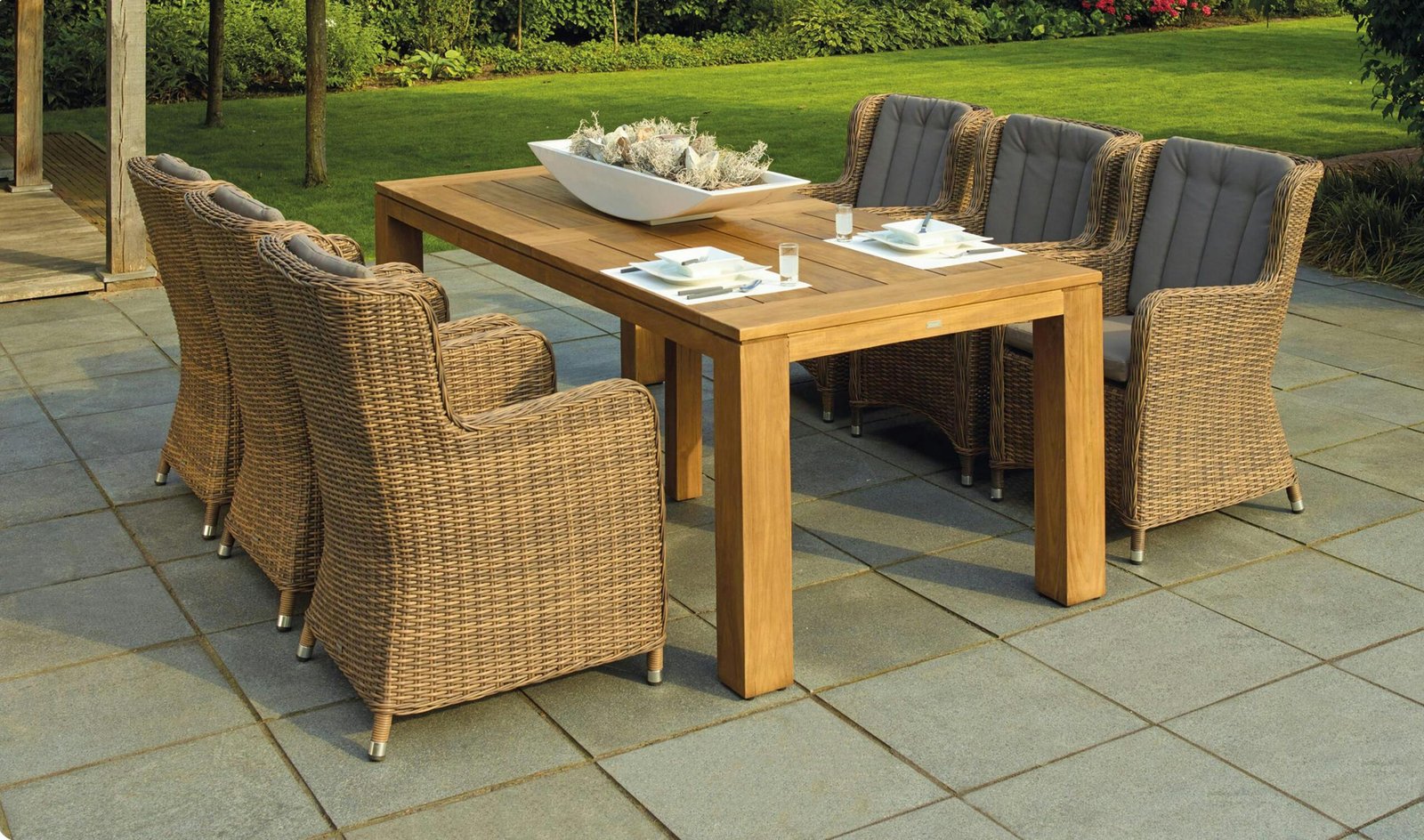
Woven resin, usually sold as rattan, is only as good as its skeleton. The weave itself is fine. What fails is a hollow steel frame under it that rusts from the inside where you cannot see it, which is why two sets that look identical online can behave completely differently. Turn a chair over in the store if you can, and look for aluminum rather than unnamed metal.
⭐ Cushions Are Where Sets Quietly Fail
Frames rarely disappoint people. Cushions do, and they do it in year two, which is late enough that most reviews never mention it.
Two things decide how a cushion ages. The first is whether the cover comes off. A removable cover with a real zip can be washed when something is spilled on it, and washed covers are the difference between a set that looks cared for and one that looks tired. A sewn shut cushion cannot be rescued.
The second is what is inside. Ordinary upholstery foam behaves like a sponge outdoors. It takes on water, holds it in the middle for days, and that is where the musty smell and the dark blotches come from. Open cell foam made for outdoor use lets water pass straight through and dries in hours, which is the entire difference between a cushion you leave out during a shower and one you carry indoors every time the sky changes.
Fabric matters less than people assume, as long as it is solution dyed. That means the color goes through the fiber rather than sitting on the surface, so it fades slowly and evenly instead of going patchy on the side that faces the afternoon sun.
⭐ What Ruins Outdoor Furniture Fastest?
Trapped damp, not rain. Furniture left under a sealed cover through a mild wet winter often fares worse than furniture left in the open, because the cover holds moisture against the frame and the cushions for months with no airflow at all.
That single fact changes how you should store things. A cover needs vents or it needs to come off on dry days. A cushion needs to go somewhere with air rather than into a sealed bag. And anything wooden benefits from sitting on feet or pads rather than directly in a puddle on the slab, because the end grain drinks water upward.
Sun does the other half of the damage, and it works slowly enough that you only notice by comparison. The side of a cushion that faces west will be a shade lighter within two summers. Rotating cushions occasionally, the way you would rotate a mattress, evens it out for free.
Somewhere dry to put things is the piece most people are missing, and the storage and organization section covers boxes and enclosures that are worth the space they take.
⭐ Where to Spend and Where Cheap Is Completely Fine
Spend on the frame and on the cushions, in that order. Those are the two parts you cannot upgrade later without effectively rebuying the set, and they are the two parts that decide whether you are still happy in year four.
Save on everything that touches the floor or the table. Side tables, planters, the rug, lanterns and cushion covers are all replaceable, all cheap, and all easy to change when you get bored, which means they are the right place to put whatever look you are currently enjoying.
There is also a strong case for buying in two stages rather than one. A set bought all at once in April is a guess about how you will use the space. A seating piece bought first, lived with for a month and then added to is a decision based on evidence. The patio essentials guide lays out that buying order in detail, including the things that can safely wait until year two.
⭐ The Four Mistakes That Cost the Most Money
Buying for the maximum number of guests is the first and the most expensive. People size a set for the two barbecues they host a year rather than the four evenings a week they actually sit outside, and end up with a table nobody uses and no room to walk around it.
Buying before you have shade is the second, and it is covered properly in the guide to making a patio comfortable. Furniture in full afternoon sun does not get used, and no cushion fixes that.
Buying with no plan for where things go in winter is the third. It is what turns cushions into a chore and a chore into a patio that gets abandoned in September.
And choosing looks over comfort is the fourth. A chair with a hard flat seat and an upright back photographs beautifully and empties a patio by half past eight. Sit in it properly before buying, for longer than feels polite. If you would not read a book in it, you will not sit in it. The outdoor patio section covers the rest of the decisions around it.
⭐ Best Sellers
Top Products and Picks
- A powder coated aluminum bistro set, the right first purchase if you are furnishing from scratch and are not yet sure how you will use the space, since two chairs and a small table get used far more often than a dining set does.
- A deep seat cushion set with removable zip covers, worth buying the moment you notice you are getting up after twenty minutes. Removable covers are the whole point, since fixed covers cannot be washed and are what makes a set look tired by the second summer.
- A vented furniture cover rather than a sealed one, for anyone leaving a set outside over winter. The vents are not a detail, they are what stops the cover holding damp against the frame for four months.
- A weatherproof deck box, which earns its place the week carrying cushions indoors starts to feel like a chore. Buy it before winter rather than after, because that is the point where patios get packed away and stay packed away.
⭐ Final Thoughts
Furnishing a space outside is slower than furnishing a room, and it is worth letting it be slow. The weather gives you a new piece of information every few weeks, and most of it contradicts whatever you assumed in the shop.
So buy the piece you are sure about, live with it for a month, and let the space tell you what it needs next. You will find you sit in one particular spot far more than the others, that one corner is windier than it looked, and that the thing you thought you wanted a table for never happens. All of that is easier to act on when you have not already spent the whole budget.
The sets that still look good years later almost never belong to people who planned the hardest. They belong to people who bought slightly less than they meant to, kept it out of the worst of the weather, and washed the covers now and then. That really is most of it.
⭐ Additional Resources
Before committing to a large set, it is worth a minute on the official recall and product safety database, which is searchable by product type. Outdoor furniture appears there more often than people expect, usually for glass table tops and folding mechanisms.