
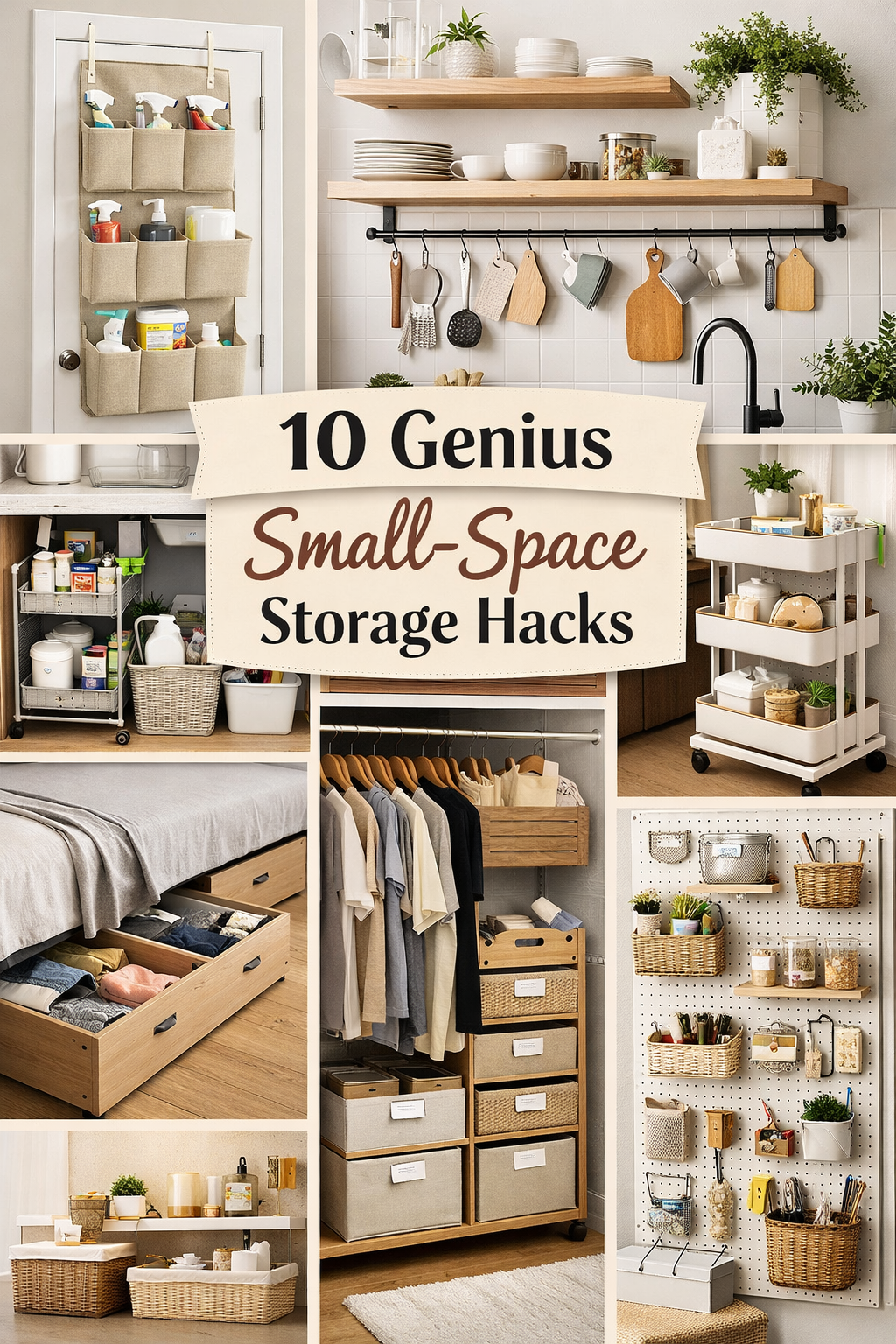
Small Space Storage: Ten Genius Hacks You Can Do in One Weekend
As an Amazon Associate I earn from qualifying purchases. Some links in this post go to Amazon and may earn me a small commission at no extra cost to you.
Last Updated on September 5, 2026 by Smarteryouu
⭐ Small Space Storage: Ten Genius Hacks You Can Do in One Weekend
A small home can be one of the calmest places to live once everything in it has somewhere to go. The trouble is that surfaces fill quickly, cupboards reach their limit, and the pile by the door grows a little every week. None of that means you need more room. It usually means the room you already have is being used flat instead of tall.
Good small space storage is mostly about noticing the gaps. The back of a door, the eight inches under a bed, the wall above a washing machine. These are places that hold a surprising amount once something is fitted into them.
What follows is ten changes you can make over a weekend. Most need no tools at all, and almost all of them can be undone if you rent. The aim is not a showroom. It is a home where the things you use every day are easy to reach and everything else is quietly out of the way.

⭐ Why the Back of a Door Is the Easiest Place to Start
Every door in your home has a whole vertical surface doing nothing. An over the door organizer turns it into shelving in about two minutes, with no drilling and nothing left behind when you move out.
The pantry door suits jars, packets and snacks. A bathroom door handles bottles, spare rolls and hair tools. A bedroom door takes shoes or bags. The pocket style versions are best for anything soft or small, while the wire rack versions hold heavier tins and bottles without stretching.
One thing worth checking before you buy. Modern doors are thinner than older ones, so measure the top edge and compare it to the bracket depth. A bracket that does not seat properly will rattle every time the door swings and mark the paint over time.
⭐ Floating Shelves That Make a Room Feel Taller
Shelves fixed to the wall give you storage without giving up any floor, and they draw the eye upward, which is part of why a room feels more open afterwards.
In a kitchen they suit everyday mugs, oils and spices. In a bathroom they hold folded towels and the products you reach for daily. In a bedroom or living room they carry books, a plant and a couple of frames.
Depth is the thing people misjudge. Anything deeper than about ten inches puts real leverage on the wall and turns into the place where objects go to be forgotten at the back. Shallower shelves look lighter and stay tidier on their own.
Fix into a stud where you can. Where you cannot, a proper toggle anchor costs very little and holds far better than the plastic plugs that come in the box. Our wider storage and organisation writing goes further into choosing shelving that lasts.
⭐ Turning the Cupboard Under the Sink Into Something Usable
The cupboard under a sink is awkward by design. A drain pipe runs through the middle of it, the opening is narrow, and anything at the back is invisible until you kneel down and start moving bottles.
A sliding drawer insert fixes most of that. Two tiers on runners let you pull the whole contents forward instead of reaching past them. Cleaning sprays sit on top, refills and cloths underneath.
Look for a design with a cutaway or adjustable legs so it sits level around the plumbing. A flat rectangular tray will simply not fit around a drain pipe, which is the most common reason these get returned.
Measure the internal width at the narrowest point, not at the door opening. Cabinets often taper slightly inside.
⭐ A Rolling Cart for the Gaps You Cannot Use Otherwise
Most homes have a narrow gap somewhere that nothing fits into. Beside the fridge, between the washer and the wall, at the end of a desk. A slim rolling cart is built for exactly that shape.
Because it moves, it can also change jobs. The same cart holds pantry overflow during the week and craft supplies at the weekend, then rolls out of the way when you need the floor.
Measure the gap first and allow an inch of clearance so you can actually pull it out. Locking wheels are worth having if the cart sits anywhere it might get knocked.
Metal frames hold their shape better than plastic ones under tins and bottles, and they tend to roll more smoothly on carpet.
⭐ Claiming the Eight Inches Under Your Bed
Under a bed is often the largest unused area in a small home, and it is usually holding nothing but dust.
Shallow wheeled drawers or fabric bins turn it into seasonal storage. Winter coats in summer, spare bedding, shoes you wear occasionally, luggage. Anything you need a few times a year rather than a few times a week.
Measure the clearance from the floor to the underside of the bed frame, not to the mattress. That gap is often two or three inches smaller than it looks.
Wheels matter more than you would expect on carpet, where a plain box drags and eventually stops being pulled out at all. Lids keep dust off anything fabric.
⭐ Bins on the Closet Shelf Instead of Loose Piles
The shelf above a hanging rail is usually a soft mountain of folded things that collapses the moment you take something from the middle.
Fabric bins solve this by giving every category a wall. Knitwear in one, bags in another, spare towels in a third. Because each bin is a box, the pile stops behaving like a pile.
Label them, even if the contents seem obvious. Six months later they will not be, and an unlabelled bin quietly becomes a bin nobody opens.
Choose bins with a rigid base or a removable insert. The very soft ones sag once they are half empty and lose the shape that made them useful.
⭐ Pegboard for Anything You Reach For Constantly
Pegboard is the most adaptable wall system you can put up in a weekend. Hooks, small shelves and cups move around freely, so the layout can change as your habits do.
It works hardest in a home office, a craft corner, an entryway or a kitchen wall where pans and utensils live. Everything stays visible, which means drawers and counters stop being the default resting place.
Standard hardboard is fine for light items but bows under heavier tools. Metal pegboard costs more and stays flat, which is worth it in a garage or workshop.
Mount it on spacers so the hooks have room to hook. Most kits include these, and a board fixed flat against the wall will not accept anything.
⭐ Furniture That Quietly Holds Things Inside It
In a small home every large object should be doing at least two jobs. Furniture with storage inside is the least visible way to add capacity, because nothing new appears in the room at all.
An ottoman swallows blankets and controls. A bench by the door holds shoes and takes the weight of someone putting them on. A bed frame with drawers replaces an entire chest. A coffee table with a lower shelf keeps magazines and chargers off the top surface.
Check the hinge on anything with a lift up lid. A soft close hinge is the difference between a piece you use daily and one you stop opening.
Ideas like this sit at the heart of our guide to building a calmer everyday home, where fewer and better usually beats more.
⭐ The Forgotten Wall Above Your Appliances
Above a fridge, a washing machine or a dryer there is usually a full metre of wall that nobody has looked at properly.
A shelf or a shallow cabinet there takes detergent, softener, spare pantry stock and the appliances you use twice a month. It is not everyday storage, which is exactly why it suits a high spot.
Keep anything heavy at the front where you can reach it without stretching, and keep glass off high shelves entirely.
A folding drying rack on the laundry wall belongs in the same category. It stays flat against the wall until the day you need it, then disappears again.
⭐ Hooks Are the Cheapest Fix in the House
Most of the clutter in a small home is a handful of items that have no assigned place. Keys, a bag, a coat, a towel, the dog lead. They end up on chairs and counters because there is nowhere else.
Hooks take up no floor at all and cost very little. A rail with a solid back plate fixed at two points is far better than individual hooks on a single screw each, which work themselves loose over a winter of wet coats.
Adhesive hooks have improved a great deal for lighter items. They need a clean dry surface and a full day to cure before you load them, and it is sensible to treat the stated weight as slightly optimistic.
Put them where the item is dropped, not where you think it should live. That is the whole trick.
If your rooms are especially tight, our ideas for organizing a compact home covers more of these vertical approaches in detail.
⭐ Thinking Upward Instead of Outward
The hacks above share one habit of mind. Before buying anything new, look up.
Four questions cover most situations. Can this be stored vertically rather than spread across a surface. Is there a door back going unused. Is there room for a shelf above this area. Would a bin or basket stop these items from spreading.
Answering those honestly usually reveals more room than a new piece of furniture would have added. It also stops the common trap of solving a storage problem by buying more storage, then needing somewhere to keep it.
Work one room at a time and start with whatever irritates you most. The entryway pile, the cupboard you dread opening, the counter that never stays clear. Fix that one properly and the rest tends to follow at its own pace.
⭐ Best Sellers
Top Products and Picks
Four items cover most of what this guide describes, and all are easy to find on Amazon.
- An over the door organizer, in the pocket style for soft items or the wire rack style for tins and bottles, which is the fastest change in the whole list.
- A two tier sliding under sink drawer with a cutaway for the plumbing, sized to the narrowest point inside the cabinet.
- A slim rolling cart with locking wheels, measured to the gap you actually have beside the fridge, the washer or a desk.
- A set of wheeled under bed drawers with lids, chosen against the frame clearance rather than the mattress height.
⭐ Final Thoughts
A home does not feel calmer because everything has been hidden. It feels calmer because the things you use are easy to reach and the things you do not use are somewhere sensible.
That is why a weekend is usually enough. None of these changes are large. A door organizer, a shelf, a cart in a gap. What they share is that they take something you were already doing badly and make it easy to do well.
Pick one room and one problem rather than trying to reset the whole house. The cupboard you avoid opening, the counter that never clears, the shoes by the door. Fix that one properly and you will notice it every single day afterwards, which is what makes the next one easier to start.
There is no finished state here, and there does not need to be. Only a home that works a little more easily than it did last month.
⭐ Additional Resources
Before fixing anything into a wall, the Government of Canada publishes general home safety guidance that is useful background for weekend projects.
For readers dealing with damp in cupboards or bathrooms, which shortens the life of anything stored in them, the United States Environmental Protection Agency has a plain guide to moisture and mould in the home.
For independent durability testing across household categories, Consumer Reports maintains a home and garden testing section.