
Kitchen Essentials: What to Buy First for a New Kitchen
As an Amazon Associate I earn from qualifying purchases. Some links in this post go to Amazon and may earn me a small commission at no extra cost to you.
Last Updated on September 7, 2026 by Smarteryouu
⭐ Kitchen Essentials: What to Buy First for a New Kitchen
Standing in an empty kitchen is stranger than most people expect. There is nothing to cook with, no obvious place to begin, and the internet answers the question with a list of forty items and a total that looks like a month of rent.
It does not work that way in practice. A kitchen becomes usable long before it becomes complete, and the gap between those two things is almost entirely about sequence. Buy in the right order and you are cooking properly within a week on very little money. Buy in the wrong order and you can spend three times as much and still be waiting on the one thing that would have made the rest work.
So this is what to buy first for a new kitchen, written as an order rather than a list. What comes home on day one, what waits until month two, where it is perfectly safe to buy cheap, and what you can skip for years without ever once missing it.
If you only buy one thing this week, buy the pan. It sears, roasts, bakes and moves from the stovetop straight into the oven, and it gets better with age instead of peeling inside a year the way a cheap coated pan does. Linked here is the 10.25 inch, which comes with the red silicone handle cover.
Check price on Amazon⭐ Why the Order Matters More Than the Budget
Two people can spend exactly the same money setting up a kitchen and end up in completely different places. One buys a fifteen piece cookware set and a knife block, because both feel like finishing the job in a single decision. The other buys one heavy pan and one good knife, then waits.
A month later the second person is cooking most nights. The first is using three pieces out of fifteen, none of which are particularly good, because the money got spread so thin that every item ended up mediocre. That is the whole argument for sequence in one sentence.
Order works because each purchase either unlocks something or it does not. A pan unlocks nearly every meal. A knife makes those meals fast enough that you actually cook them on a weeknight. A big pot turns cooking into something you do once and eat from three times. A garlic press unlocks nothing, which is why it lives at the back of the drawer.
The rest of this is simply that idea applied week by week. If you would rather see the short version, the kitchen essentials page lays out the same three starting pieces without the detail.
⭐ What Should You Buy on Day One?
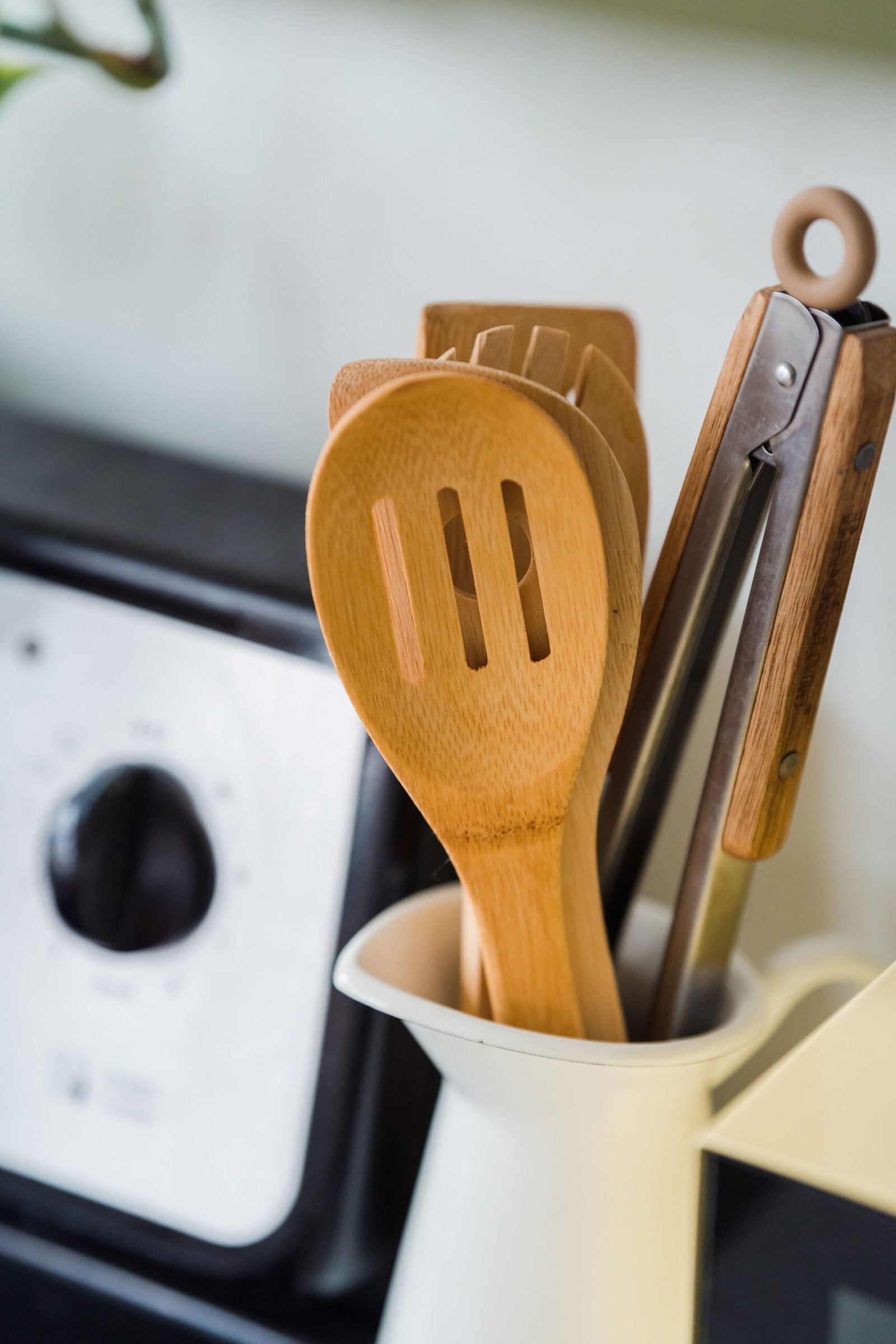
One pan, one knife, one large board and a wooden spoon. That is genuinely the whole day one list. Those four let you cook almost any everyday meal, and everything you add afterwards makes cooking faster or more comfortable rather than making it possible.
People resist this because four items feels like an unfinished kitchen. It is not. It is a working kitchen with nothing decorative in it. You can roast a chicken, fry eggs, build a stir fry, brown mince for a sauce and cook almost any vegetable with exactly those four things and a hob.
The board is the piece people underrate. A small board forces you to chop in batches, tip things into a bowl to make room, and generally work in a cramped way that makes cooking feel harder than it is. A large board is the cheapest upgrade to how cooking feels that exists.
The wooden spoon barely needs saying, but it is worth noting that it should be wood or silicone rather than metal, because metal will scratch almost anything you cook in.
⭐ How Much Should a First Kitchen Cost?
Think in proportions rather than a total. Roughly half of a first budget belongs in the pan and the knife together, because those two are used daily and are the two items where the cheap version genuinely holds you back. The rest spreads thinly across everything else.
That split feels wrong when you are staring at an empty cupboard, because half your money is going on two objects while you still own no plates. It stops feeling wrong about a week in, when the pan turns out to be the thing you touch every single evening.
The other useful way to think about cost is per use. A pan you use five nights a week for a decade costs almost nothing per meal, even if it looked expensive on the day. A bread maker used twice costs a fortune per loaf. Nobody thinks about kitchen purchases this way and almost everybody should.
Secondhand deserves a mention too. Cast iron in particular is close to indestructible, so an old pan from a family member or a charity shop is often better than a new budget one, and it can be brought back with nothing more than a scrub and a wipe of oil.
⭐ Where It Is Safe to Buy Cheap
Plenty of the kitchen does not reward spending. Mixing bowls, colanders, measuring spoons, baking trays, a can opener, tongs, a peeler and a wooden spoon all work exactly as well at the cheap end. Buy the inexpensive version of every one of those and put the difference into the pan.
Where spending does pay off is anywhere heat, sharpness or daily handling is involved. Pans, knives and boards. Those three take the most abuse, get touched the most often, and are the places where a cheap version is genuinely worse to use rather than just less pretty.
There is one honest exception in the other direction. A cheap small non stick pan for eggs is fine, because non stick coatings wear out no matter what you pay, so buying an expensive one simply means throwing away more money in three years. Treat it as a consumable.
⭐ Do You Need a Knife Set or Just One Knife?
One knife, almost always. A single eight inch chef’s knife does perhaps ninety percent of home cooking, and a small paring knife covers most of the rest. A block of twelve knives means eleven of them sit unused while the money that could have bought one excellent knife bought twelve average ones.
Eight inches is the length worth learning on. Shorter feels safe but makes you work harder on anything large, and longer feels unwieldy until you have some practice. Eight handles an onion and a squash equally well, which covers most of what a home kitchen actually cuts.
The other half of this is keeping it sharp. A dull knife is more dangerous than a sharp one, because it slips instead of biting, and it is also the main reason people decide they dislike cooking. A cheap sharpener used every few weeks matters more than the knife you started with.
⭐ What to Buy in Month Two
Once the first four items have been used for a few weeks, you will have noticed your own gaps rather than guessing at them. That is exactly the point of waiting. Most people find the same three things missing, and it is rarely what they would have predicted on day one.
The first is a large pot. Not for anything fancy, simply because cooking one big batch on a Sunday changes weeknights more than any gadget will. Soups, stews, chilli and pasta all need volume more than technique.
The second is a medium saucepan, which quietly does rice, grains, sauces and vegetables and is used more often than anything except the main pan. The third is a thermometer, which is the least interesting item in any kitchen and the one that most reliably stops chicken being overcooked out of caution.
Somewhere in month two you will also want somewhere for all of it to live. That is a different problem from buying, and it is covered over in storage and organisation.
⭐ What to Skip Entirely
Single purpose gadgets are the easiest money to waste, because each one solves a real annoyance and none of them solve it often enough. Avocado slicers, egg separators, garlic presses, strawberry hullers and banana slicers all exist, and all of them are a knife you already own.
Knife blocks and cookware sets belong in the same category for the reason above. So does anything that needs its own shelf and gets used seasonally, which is most bread makers, pasta machines, ice cream churns and deep fryers. Buy those later if the interest turns out to be real, and only then.
Connected kitchen gear is worth being careful with too. Some of it genuinely helps and some of it adds an app to a task that never needed one. If you want to go that way, it is worth reading the smart home section first rather than buying on impulse.

⭐ Best Sellers
Top Products and Picks
Get this the week you notice that prep is the part of cooking you put off. Eight inches handles an onion and a squash equally well, so it covers nearly everything a home kitchen cuts. It is dishwasher safe, which knives at this level often are not.
Check price on AmazonGet these once raw meat and salad start sharing one small surface, which is the point at which a single board stops being safe. Three sizes at 17, 15 and 13 inches with juice grooves and a stand, so the large one is genuinely big enough to work on.
Check price on AmazonGet this once you have started cooking on Sundays for the week ahead, because that is when one big pot saves the most time. Soups, stews, chilli and no knead bread all come out of it. Linked here is Storm Blue, and it is hand wash only.
Check price on Amazon⭐ Final Thoughts
An empty kitchen is not a problem to be solved in one afternoon. It is closer to a room you furnish slowly, where the pieces you choose deliberately end up being the ones you still like years later, and the ones bought in a panic end up in a box.
The people who enjoy cooking are almost never the ones with the most equipment. They are the ones whose few tools are pleasant to pick up, sit where they can reach them, and do not need working around. That is a much cheaper thing to build than it looks from the middle of an empty room.
So buy the pan this week and cook something simple in it. Then buy the knife, and cook something else. Let the gaps show themselves rather than trying to guess at them in advance, and the kitchen will fill in around how you actually cook rather than how you thought you might.
⭐ Additional Resources
If you do pick up a thermometer, Health Canada publishes a short reference table of safe cooking temperatures for meat, poultry, fish and eggs. It is one page, it is free, and it settles the guesswork that leads to most overcooked chicken.
More equipment guidance, including what to add once the basics are covered, sits on the kitchen essentials page, and the best sellers page collects what has been most popular across the rest of the site.