
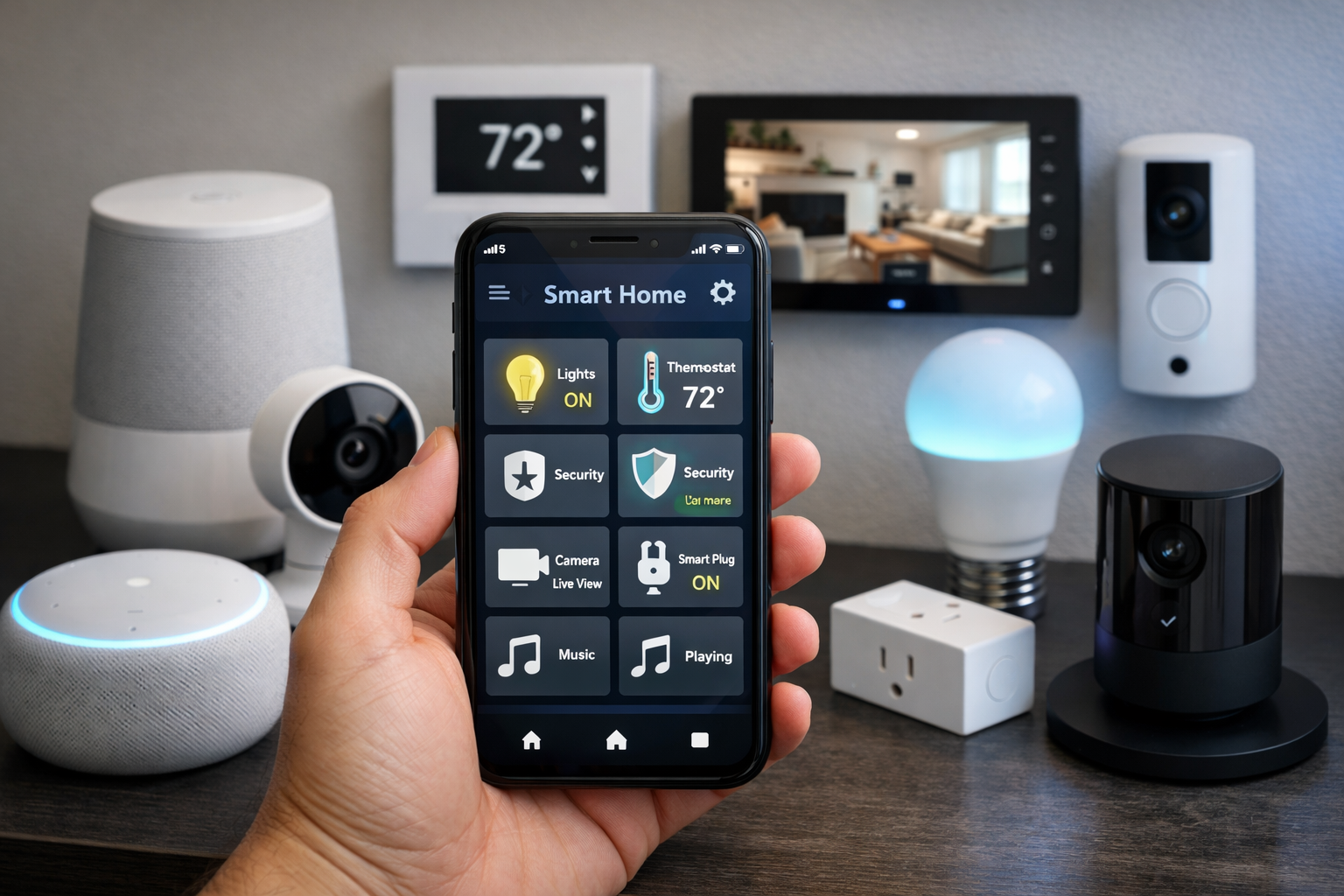
Home Automation Guide: The Network and Ecosystem Decisions to Make First
As an Amazon Associate I earn from qualifying purchases. Some links in this post go to Amazon and may earn me a small commission at no extra cost to you.
Last Updated on September 11, 2026 by Smarteryouu
⭐ Home Automation Guide: The Network and Ecosystem Decisions to Make First
Every home automation guide starts with devices, and the devices are the part that does not matter much. Almost all of them work. What decides whether the next three years are pleasant or quietly irritating is a set of duller choices made before anything is bought, and those are the ones that are expensive to reverse. Which router the whole thing sits on. Which ecosystem you commit to, since moving later means replacing things that still work. Whether a device talks over WiFi, over a hub, or over a cable, and what that means when the connection wobbles. And what the whole project realistically costs, which is never the number on the first box. None of this is exciting and all of it is cheaper to get right at the start than to fix at device number twenty.

⭐ What Should You Sort Out Before Buying Anything?
Your WiFi coverage and your choice of ecosystem. Everything else can be changed cheaply later. Those two cannot, because one decides whether devices stay connected and the other decides which devices you can buy at all without ending up with several apps.
It is worth spending an evening on both before spending anything on hardware. That sounds like over planning for a smart bulb, and it is not, because the household that has to redo this at device fifteen usually just stops instead.
The good news is that neither decision is difficult once you know what you are actually choosing between, and the rest of this post is those two decisions plus the money.
⭐ Your Router Is the Real Ceiling
The router supplied by an internet provider is built for a few phones and a laptop. It is not built for thirty small devices spread to the corners of a house, and that is the wall almost everybody hits.
Two things matter and neither is the headline speed. The first is coverage, because a device at the edge of the signal is the one that drops off and does not come back, and no amount of megabits fixes a weak corner. The second is how many connections the router can hold at once, which is rarely printed anywhere and is the actual ceiling on how far you can take this.
A mesh system is the usual answer, because it puts several units around the house rather than one shouting from a cupboard. Do it before you pass roughly a dozen devices rather than after, since the symptom people notice first is a device failing and the instinct is to replace the device.
That misdiagnosis is the most common and most expensive mistake in this whole category, and it is covered from the living with it side in the guide to actually living with a connected house.
⭐ Choosing an Ecosystem, and Why It Is Hard to Undo
An ecosystem is whichever assistant and app your devices answer to. The practical effect is that everything lives in one place and works together, and the cost is that leaving means replacing things that are still perfectly good.
The honest position is that the differences between the major ones are much smaller than the arguments about them suggest. All of them turn lights on. What actually decides it for most households is which phones people already carry and which speaker is already in the kitchen, and that is a reasonable way to choose.
What matters far more than which one you pick is picking one. A house with devices from four ecosystems has four apps, and four apps is how households give up. If you are genuinely unsure, or you have already lived on one side and wondered about the other, the post on choosing and changing ecosystems covers what moving actually feels like.
⭐ What Does Matter Actually Change?
It makes the ecosystem choice less permanent. A device built to the shared standard should work with any of the major systems, so buying one is a bet you can change your mind about later. That is genuinely useful and it is not the revolution the packaging implies.
The practical advice is simple. Where a device supporting the shared standard costs about the same, buy it, because it protects you. Where it costs noticeably more for the same job, the premium is insurance against a decision you may never make.
What it does not do is make everything work perfectly together. Basic functions travel well across systems and the more interesting features often stay inside the manufacturer’s own app. Expect the light to turn on anywhere and expect the clever bit to need the original app.
⭐ WiFi, Hubs and Cables
Devices connect in one of three ways and the difference shows up on the day something goes wrong rather than on the day you install it.
WiFi devices are the simplest to set up and the most demanding on your network, since each one is a separate connection. Fine for a handful, harder as the number grows, which is exactly why the router decision comes first.
Hub based devices use their own low power network and only the hub touches your WiFi. That is steadier at scale and adds a box and a cost, and it is the upgrade worth making when things start feeling slow rather than on day one.
Wired is the third and it is the most reliable by a distance, which is why my outdoor cameras run on cable rather than WiFi. It costs a weekend of installation and then asks nothing forever, and the full argument is in the ten year review of a wired system.
⭐ How Much Should You Budget?
Less than you think to start and more than you think to finish. A useful starting setup is a pack of plugs and some bulbs, which is a small amount of money. A house with cameras, a thermostat, a hub and decent WiFi is a different order of spending, and almost nobody plans for the network part.
Two costs get missed consistently. The network upgrade, which arrives around device twelve and is not optional, and any subscription attached to cameras, which is small monthly and substantial over three years. Work out the three year total rather than the shelf price for anything with a plan attached.
There is one place not to economize, and it is the network. Everything else in a connected house can be bought cheaply and replaced later without much regret, because a plug is a plug. A weak network makes every device you own behave unreliably, and the frustration gets blamed on the devices rather than on the cause, which is how households spend twice.
The way to keep it sane is to spend in stages, with each stage useful on its own, which is what the buying order guide lays out.
⭐ The Order to Build In
Network first, then ecosystem, then cheap devices, then expensive ones, then automations. That order exists because each step makes the next one easier and none of them has to be redone later.
The order people actually follow is the reverse. A device gets bought because it was on offer, an ecosystem gets chosen by accident because that device came with an app, and the network gets looked at only once things stop working. Every step of that is fixable and each one costs money that did not need spending.
Automations belong last for a good reason, which is that useful ones come from noticing your own patterns rather than from copying somebody else’s. That is covered in the guide to automations that actually save time.
⭐ Best Sellers
Top Products and Picks
- A mesh WiFi system, the foundation purchase and the one to make before adding more devices. Buy it when the far corner of the house is unreliable, not after you have replaced a device that was never broken.
- A Matter compatible hub, worth adding once you pass roughly a dozen devices. It keeps your ecosystem options open and takes load off your WiFi at the same time.
- An entry level smart speaker or display, which is the cheapest way to commit to an ecosystem without committing much money. Find out how your household behaves before buying anything expensive.
- A network cable and a small switch, for anyone whose home office, television or camera recorder sits near the router. Anything that can be wired should be, and it costs very little.
⭐ Final Thoughts
None of this is the fun part, which is exactly why it gets skipped and exactly why so many households end up frustrated by technology that works perfectly well.
An evening spent on coverage and one decision about which ecosystem to live in will save more annoyance over three years than any amount of care choosing between two bulbs. The devices are interchangeable. The foundation is not, and it is the thing you cannot swap out on a Saturday afternoon.
It also gets easier from here, which is worth knowing. The foundation is the only part of this that requires you to think about infrastructure rather than about your own house. Once the coverage is good and the platform is chosen, every decision afterwards is a small one about a room and a problem, and none of them can go badly wrong.
So do the dull part first. Then buy a pack of plugs, and enjoy the fact that everything you add afterwards will simply work.