
Five Must Have Dumbbells for a Minimalist Home Gym: A Beginner Friendly Guide
Last Updated on October 3, 2026 by Smarteryouu
⭐ Five Must Have Dumbbells for a Minimalist Home Gym: A Beginner Friendly Guide
Choosing dumbbells for a minimalist home gym is mostly an exercise in restraint. The temptation is to buy a full rack and feel properly equipped, and the result is usually a corner of the room you start walking around.
Five pieces cover almost everything a person training at home will do for the first couple of years. One adjustable set or one weight you can change, a light pair, a medium pair, a heavier pair, and somewhere sensible to put them.
What follows is how to pick each of those without guessing, including the parts that are rarely mentioned, such as what the coating actually changes and why the storage decides whether any of it gets used.
None of it needs buying at once. Most people are better off starting with one pair and adding the rest over a few months, once they know what they actually reach for.

⭐ One Adjustable Set or Three Fixed Pairs
This is the first decision and it shapes everything after it. An adjustable dumbbell replaces a rack in one footprint. Fixed pairs take more room and cost less per pound.
Adjustables win on space, which is usually why people are reading a page like this. One handle covering five to fifty pounds sits where a single pair would, and it lets you go up in small steps rather than jumping to the next pair you happen to own.
They lose on two things worth knowing before you buy. Changing weight takes a few seconds, which interrupts circuits where you switch loads constantly. And the mechanism is the part that fails, so a cheap adjustable is a worse buy than a cheap fixed pair, which has nothing to go wrong.
Fixed pairs suit anyone with a little more room who mostly repeats the same handful of movements. If you already know you do three exercises twice a week, three pairs will serve you better and cost less than an adjustable set.
⭐ How to Pick Your Starting Weight Without Guessing
Weight is chosen per movement, not per person, and that is where most first purchases go wrong. The same person might press ten pounds and row twenty five comfortably.
A simple test works better than any chart. Pick a weight you can lift with good control for about ten to twelve repetitions, where the last two are hard but your form does not fall apart. If you could do twenty, it is too light for strength work. If you cannot reach eight, it is too heavy for now.
Shoulders and arms need less than legs and back, usually by a wide margin. That is normal, not a sign of weakness, and it is the reason a single pair never covers a whole routine.
If you are unsure, start lighter than you think. Technique built at a manageable weight transfers upward easily. Technique built while straining does not. There is more on the movements themselves in our beginner guide to using dumbbells at home.
⭐ The Light Pair, and What It Is Really For
Somewhere around three to eight pounds each. This is the pair people assume they will outgrow, and the one that quietly gets used most often.
It covers warm ups, shoulder work, side raises, rotator cuff movements and anything where the muscle involved is small. It also covers the days when a full session is not happening and ten minutes of something is better than nothing.
Neoprene suits this pair particularly well. The coating is comfortable in the hand for higher repetitions, it does not mark a floor, and the flat sides stop it rolling under the sofa.
Do not spend much here. A light pair is a simple object and the expensive ones are not meaningfully better than the plain ones.
⭐ The Medium Pair That Does Most of the Work
Roughly fifteen to twenty five pounds each, and if you only ever buy one pair, this is it. Chest presses, rows, goblet squats, lunges and carries all live in this range for most beginners.
Buy it slightly heavier than feels comfortable on day one. You will grow into a medium pair within a couple of months, whereas you will never grow back down into one that was too light.
Hex shaped rubber coated dumbbells are the sensible choice at this weight. They sit flat on the floor for push ups and renegade rows, they do not roll, and the rubber protects both the weight and the floor when you set them down tired.
Check the handle before buying. A knurled metal handle grips well when your hands are damp, where a smooth painted one does not, and that matters more as the weight goes up.

⭐ The Heavier Pair for Legs and Longer Term Progress
Thirty pounds and up, and this is the pair to buy last. Bought too early it sits in the corner as a reproach, bought at the right time it opens up the movements that were getting easy.
Legs are what justify it. A goblet squat or a set of lunges with a light weight stops being training long before your upper body catches up, and the lower body is where a home setup usually runs out of road first.
If you live above someone, think about noise and floors before this pair arrives. A dropped thirty pound dumbbell is a different event to a dropped five pound one. A dense mat under the training area handles most of it.
This is also the point where an adjustable set starts to look better value, since one handle covers the whole climb rather than a new pair every time you get stronger.
⭐ A Rack or Tray, the Piece Everyone Skips
The fifth item is not a weight at all, and it is the one that decides whether the other four get used. Weights that live on the floor become obstacles, and obstacles get tidied into a closet, and things in closets do not get trained with.
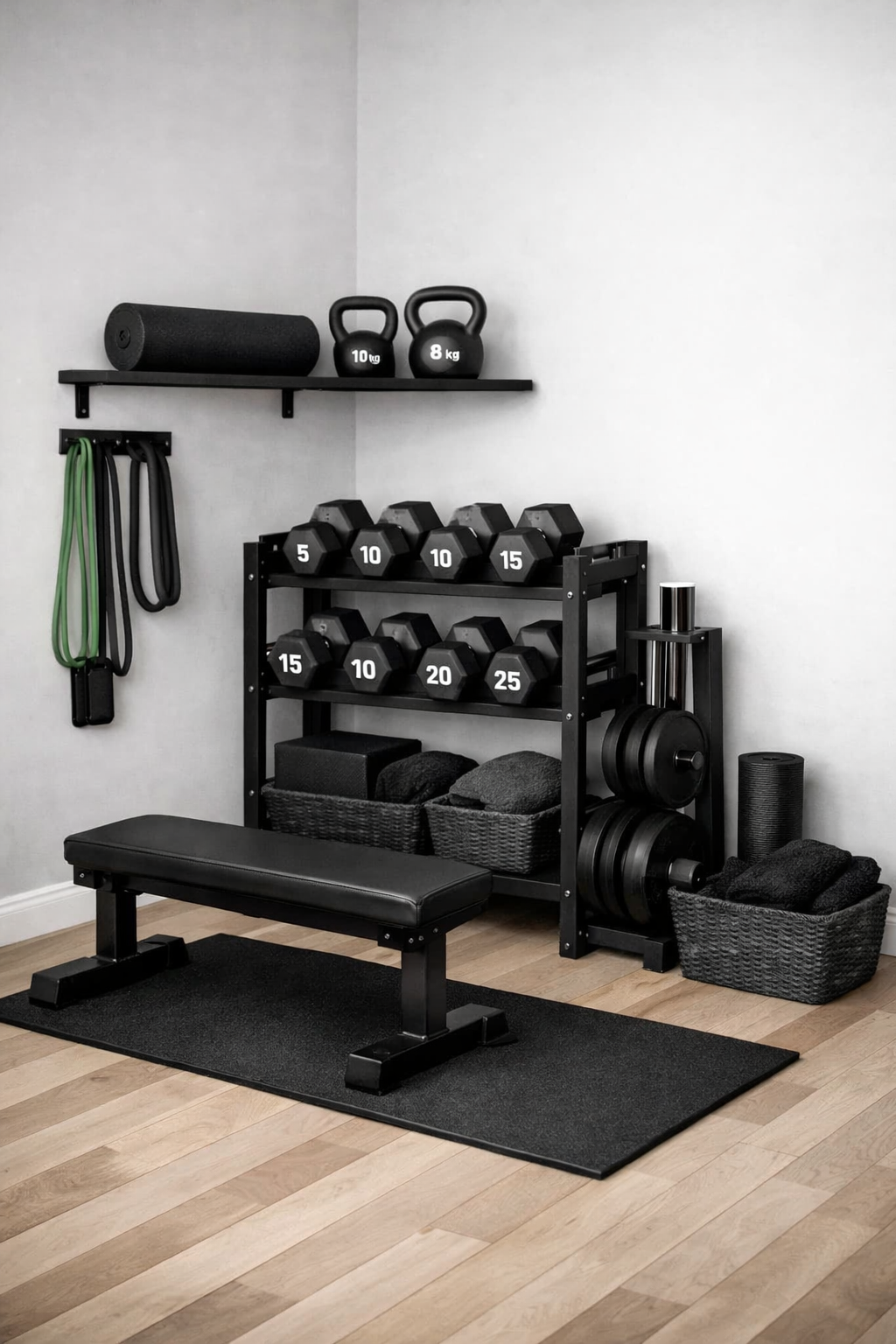
A small A frame rack holds three pairs in about the footprint of a shoebox and keeps everything visible. A flat tray works just as well for lighter sets and slides under a sofa or a bed.
Visible matters more than tidy here. A rack in the corner of the room you actually sit in gets used far more than a neat one in a spare bedroom you never enter.
Sets that arrive with a matching rack solve this in one purchase, such as the Amazon Basics neoprene set in three, five and eight pounds with its A frame stand, which is about as small as a complete starter setup gets. If space is the whole problem, our guide to equipment for a small space goes further.
⭐ Coatings and Shapes, and Which Ones Last
Three types cover almost everything sold for home use, and the differences are practical rather than cosmetic.
Neoprene is soft, quiet and kind to floors, which makes it ideal for light weights. It can pick up marks over time and it is rarely made above about twenty pounds, so it is a starter material rather than a lasting one.
Rubber coated hex is the workhorse. It protects the floor, sits flat, and survives being put down carelessly for years. Cheap rubber can carry a smell for the first few weeks in a warm room, which is worth knowing if the setup lives in a bedroom.
Bare cast iron is the cheapest per pound and the least forgiving. It marks floors, it is loud, and it rusts in a damp garage. It is a fine choice if you have a hard wearing floor and no neighbors below, and a poor one otherwise.
⭐ Mistakes That Cost Money in the First Month
The most expensive one is buying the full set before the habit exists. Four consistent weeks first, then buy. It sounds slow and it saves most people a few hundred dollars.
The second is buying one middle weight and expecting it to cover everything. It will be too heavy for shoulders and too light for legs, and it usually ends with the whole idea being abandoned rather than the weight being blamed.
The third is choosing an adjustable set on price alone. The mechanism is the whole product, and the cheapest ones stick, rattle or fail to lock, which is unpleasant at thirty pounds.
The last is buying for the training you imagine rather than the training you do. Be honest about the three or four movements you will actually repeat, and buy for those. Everything else can wait until you miss it. The rest of a pared back setup is covered in our post on minimalist home gym essentials.
⭐ Best Sellers
Top Products and Picks
As an Amazon Associate, I earn from qualifying purchases.
- A HAKENO adjustable dumbbell, 15 settings up to 52.5 pounds. One handle in place of a rack, and the option that makes the most sense when floor space is the binding constraint.
- A HolaHatha neoprene set in five, ten, fifteen, twenty and twenty five pounds with a rack. A complete fixed weight starting point that covers light through medium in one purchase.
- An Amazon Basics neoprene set in five, ten and fifteen pounds with a rack. The smaller version of the same idea, and enough for most people’s first few months.
- A pair of RBX neoprene dumbbells at five pounds each. The light pair that gets used far more than anyone expects, for warm ups and shoulder work.
⭐ Final Thoughts
A home setup does not get better by growing. Past a certain point it only gets harder to walk through, and the equipment that made you feel serious in January is what you are moving out of the way in June.
Two or three pairs, or one adjustable set, and somewhere to put them. That is enough for years of ordinary training, and it leaves the room still looking like a room.
Buy the pair you will use this week rather than the one that suits the version of you who trains every day. That person tends to arrive later, and they arrive faster when the weights are already sitting somewhere easy to reach.
Start with one pair, keep it visible, and add the next only when the first genuinely feels light. There is no prize for owning more of them.