
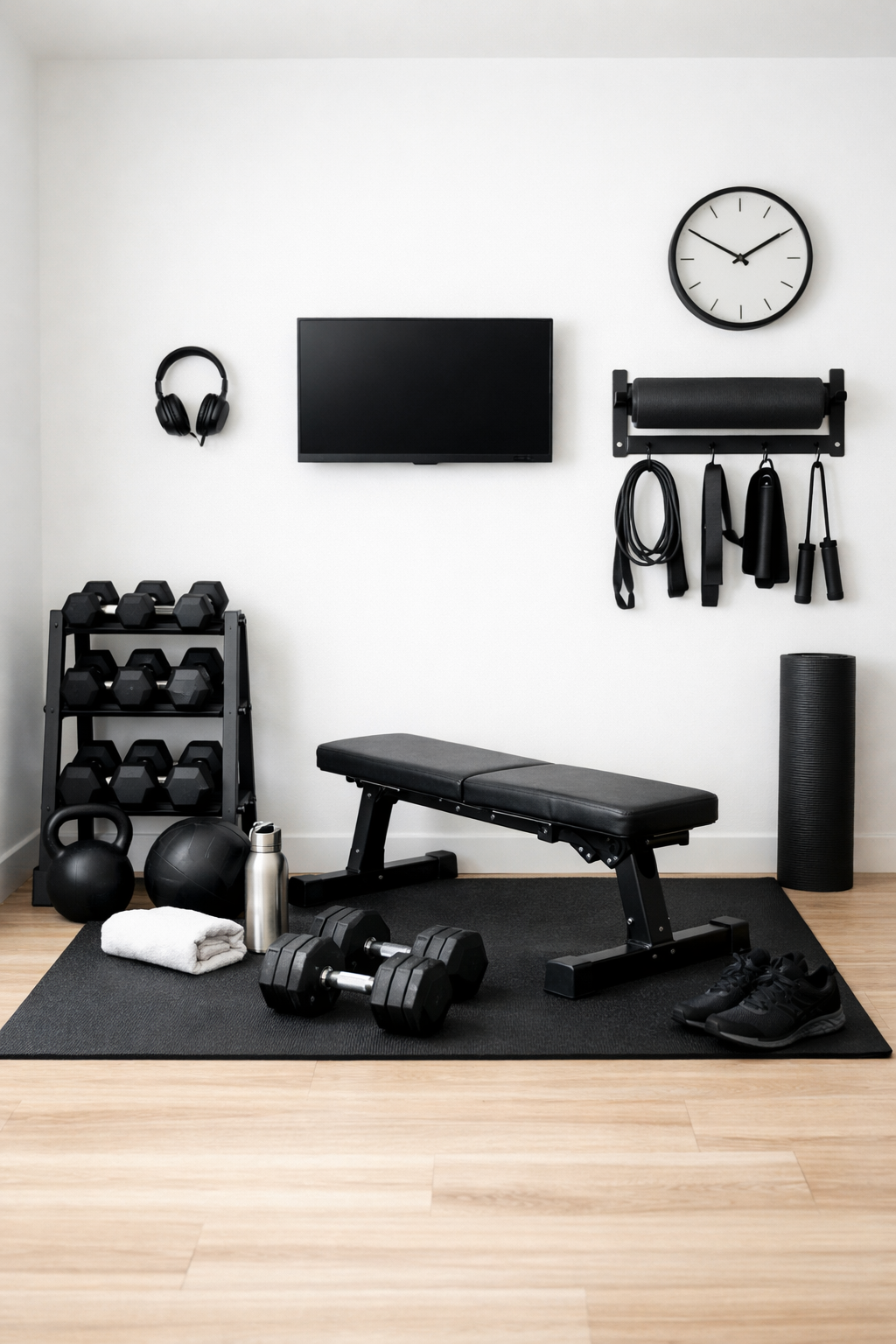
Minimalist Home Gym Essentials, and What to Get Rid Of
As an Amazon Associate I earn from qualifying purchases. Some links in this post go to Amazon and may earn me a small commission at no extra cost to you.
Last Updated on October 3, 2026 by Smarteryouu
⭐ Minimalist Home Gym Essentials, and What to Get Rid Of
Most articles about minimalist home gym essentials give you a list of eight things, which is a strange definition of minimal. This one goes the other way. Three items cover a complete home routine, and the more useful question is what to remove from the corner you already have. I have been exercising at home for over a decade, and the two large things I own are there because they get used most weeks. Everything else I have owned at some point and let go of, usually because it was doing a job something cheaper already did. If your corner has more in it than you use, this page is about fixing that rather than adding to it.

⭐ What Does a Minimalist Home Gym Actually Need?
A mat, a set of graded resistance bands with a door anchor, and one pair of adjustable dumbbells. Those three cover pushing, pulling, legs and core, which is every movement pattern a home routine needs. Everything beyond them adds variety rather than capability.
Variety is not worthless. It keeps sessions interesting and it stops you getting bored, and boredom is a real reason people stop. But variety is a comfort rather than a requirement, and it is worth knowing which you are buying.
The three fit in a basket and a corner. That is the actual test of minimal, rather than a number on a list.
It is worth saying what those three replace. Bands replace a cable machine, a mat replaces a padded floor, and one adjustable pair replaces a rack of fixed weights. Each of them is standing in for something considerably larger, which is why so little covers so much.
If you own nothing yet, buy them in that order with weeks in between. Our guide to equipment for a small space covers the timing.
⭐ The Test for Whether Something Stays
Have you used it in the last month. That is the whole test, and it is more honest than any argument you can make about future intentions.
The usual defence is that you will use it once you get back into things. That sentence has been said about every unused item in every spare room, and it is almost never followed by using it.
A second question helps. If it vanished tonight, would you buy it again tomorrow. If the answer is no, it is taking up space you could be moving in.
Apply the test to the room rather than to each item in isolation. Floor space is the resource, and something used monthly may still not be worth the metre it occupies in a small room.
Be careful with the item you keep for one specific exercise. A piece of equipment that does exactly one thing has to earn its space on that one thing alone, and it almost never does unless you genuinely do that exercise every week.
⭐ What Should You Get Rid Of First?
Start with the largest thing you have not used this month, because it is costing you the most space per session. After that, get rid of duplicates, then anything that needs assembling before use, then anything with a subscription attached.
Large and unused is the obvious first cut and the hardest emotionally, because it was usually the most expensive. The money is gone either way, and keeping the object does not bring any of it back.
Anything requiring assembly before each use is next. That step is why it goes unused, and no amount of intention overcomes a ten minute setup at seven in the morning.
Subscriptions attached to equipment deserve a look too, since they turn a one off purchase into a recurring cost that usually outlives the enthusiasm.
Work through the room in one sitting rather than deciding item by item over months. Spread out, every individual decision looks like a small thing to keep, and the corner never actually empties.
⭐ The Duplicate Problem, Two Things Doing One Job
Most cluttered home setups are not full of unnecessary items. They are full of pairs of items doing the same job, bought at different times for different reasons.
Fixed dumbbells and adjustable dumbbells. A kettlebell and a dumbbell for swings. A step platform and a bottom stair. A foam roller and a massage ball. In each case one of them is doing nothing that the other does not.
Keep whichever you reach for without thinking, not whichever cost more. Cost is not a reason to keep something, and it is the reason most duplicates survive.
Bands and light dumbbells are the most common pair. Both add resistance, and if you have a graded band set you almost certainly do not need the lightest dumbbells as well.
Mats are the quiet second offender. Most people who have trained at home for a few years own two or three, bought at different times, with only one of them ever unrolled.
⭐ Why One In, One Out Works
Decide that nothing new arrives unless something leaves. It sounds restrictive and it mostly just makes you think for thirty seconds before buying, which is enough to prevent most of the accumulation.
The rule forces the useful question, which is what this replaces rather than what this adds. If nothing is leaving, you are adding variety rather than capability, and that is worth knowing before the parcel arrives.
It also keeps the room usable, which is the actual point. A corner with three things in it that you use is worth more than a room with nine that you edge around.
Where things live matters as much as how many there are. Our storage and organisation ideas cover keeping a small setup tidy without hiding it, since hidden equipment gets used least.
⭐ Is It Worth Selling Old Fitness Equipment?
Metal equipment holds its value well and is worth selling. Dumbbells, kettlebells, benches and frames find buyers quickly, particularly in January. Mats, bands and anything with a worn motor are usually not worth the effort of listing.
Do not let the sale become the obstacle. If listing something is what stops you clearing the room, give it away instead. The space is worth more than the twenty pounds you were holding out for.
Sell in late winter if you can wait. That is when people are buying, and the same item often fetches noticeably more in January than in July.
Whatever you decide, set a date. Equipment waiting to be sold occupies exactly as much floor as equipment being used, and it tends to wait for years.
⭐ What Minimal Does Not Mean
Minimal does not mean training with nothing. Bodyweight alone leaves the back untrained, and that is a real gap rather than a purist virtue.
It does not mean refusing to own anything large either. One big item that gets used most weeks is entirely consistent with a minimal setup. One big item used monthly is not.
It does not mean buying the cheapest version of everything. Something you get under or hang from should be sturdy, and replacing a wobbly bench twice is not minimal.
What it means is that everything in the room is used. That is the only definition worth having, and it is why a routine like our home exercises that actually work circuit runs on so little.
⭐ How Do You Stop Accumulating Again?
Wait four weeks before any purchase and see whether you still want it. Most equipment is bought to create motivation rather than to solve a problem, and four weeks is long enough for that impulse to pass while a genuine need survives.
Buy in response to a gap rather than in advance of one. If your routine has stopped being hard, that is a reason. If a video was persuasive, that is not.
Watch for January and for sales, which are when most unused equipment is bought. A discount on something you were not going to buy is not a saving.
And spend on the room before the fourth item. Light, flooring and a place to keep things do more for whether you train than any additional piece of kit, as our guide to setting up the room goes into.
⭐ Best Sellers
Top Products and Picks
Three items, deliberately. A page arguing that people own too much equipment should not finish by recommending eight things.
- A set of graded resistance bands with a door anchor. The one item to own if you own only one, because pulling is the movement nothing else at home covers and a graded set has months of progression built in.
- A non slip exercise mat around 6mm thick. It decides whether floor work happens at all on a hard or cold floor. Grip on the underside matters more than padding.
- A pair of adjustable dumbbells. The only large purchase a minimal setup needs, and only once bands stop being hard. One adjustable pair replaces a rack, which is the whole point.
⭐ Final Thoughts
Three things cover a complete home routine. Everything else in the corner is variety, and variety is worth having only once it is being used.
Apply the one month test to what you already own. It is quicker than any decluttering method and considerably harder to argue with.
Clear the largest unused thing first. The money is already spent, and the space it frees is the part you can still get back.
Then train in the emptier room for a month before buying anything at all. You will find you need less than you thought, which is the only honest version of this article. There is more across home exercising and the rest of Smart Living Essentials.
⭐ Additional Resources
For how much activity is generally recommended by age group, the World Health Organization publishes a fact sheet on physical activity that gives the numbers without prescribing a program.
The Canadian Society for Exercise Physiology takes a wider view across the whole day in its 24 hour movement guidelines, which cover activity alongside sitting time and sleep for each age group.