
Optimal Indoor Humidity Levels, Season by Season
As an Amazon Associate I earn from qualifying purchases. Some links in this post go to Amazon and may earn me a small commission at no extra cost to you.
Last Updated on September 25, 2026 by Smarteryouu
⭐ Optimal Indoor Humidity Levels, Season by Season
Optimal indoor humidity levels get discussed as though there were one correct number, and in a Canadian house there is not. The right figure in January is not the right figure in July, and the gap between them is wider here than in almost any climate.
What makes this worth a page of its own is that almost nobody knows what their own reading is. Temperature is on the thermostat and gets adjusted constantly. Humidity swings from one extreme to the other across a year and goes entirely unmeasured.
So this page is the numbers, what a window covered in condensation is telling you, the free adjustments that come first, and honest guidance on when a machine is actually warranted.
This page contains affiliate links. If you buy through one of them we may earn a small commission at no extra cost to you.

⭐ The Numbers to Aim For
The broad target most guidance settles on is somewhere between thirty and fifty percent relative humidity.
Within that, the useful version is seasonal. Aim for the lower end through a deep winter, around thirty to forty, and the upper end the rest of the year, around forty to fifty. Above sixty for any length of time is where problems start. Below about twenty five is where a house starts feeling like an aeroplane.
The reason winter needs a lower target is not comfort, it is condensation. Cold outdoor air holds very little moisture, so the colder it gets outside, the lower the indoor level at which water starts forming on your windows. At minus twenty, even forty percent indoors can be too much for an older window.
Relative is the word doing the work. The same amount of water in the air reads differently at different temperatures, which is why a cold basement can be damp at the same reading that leaves the upstairs dry.
⭐ Measure It Before You Buy Anything
This is the whole argument of the page and it is twenty three dollars.
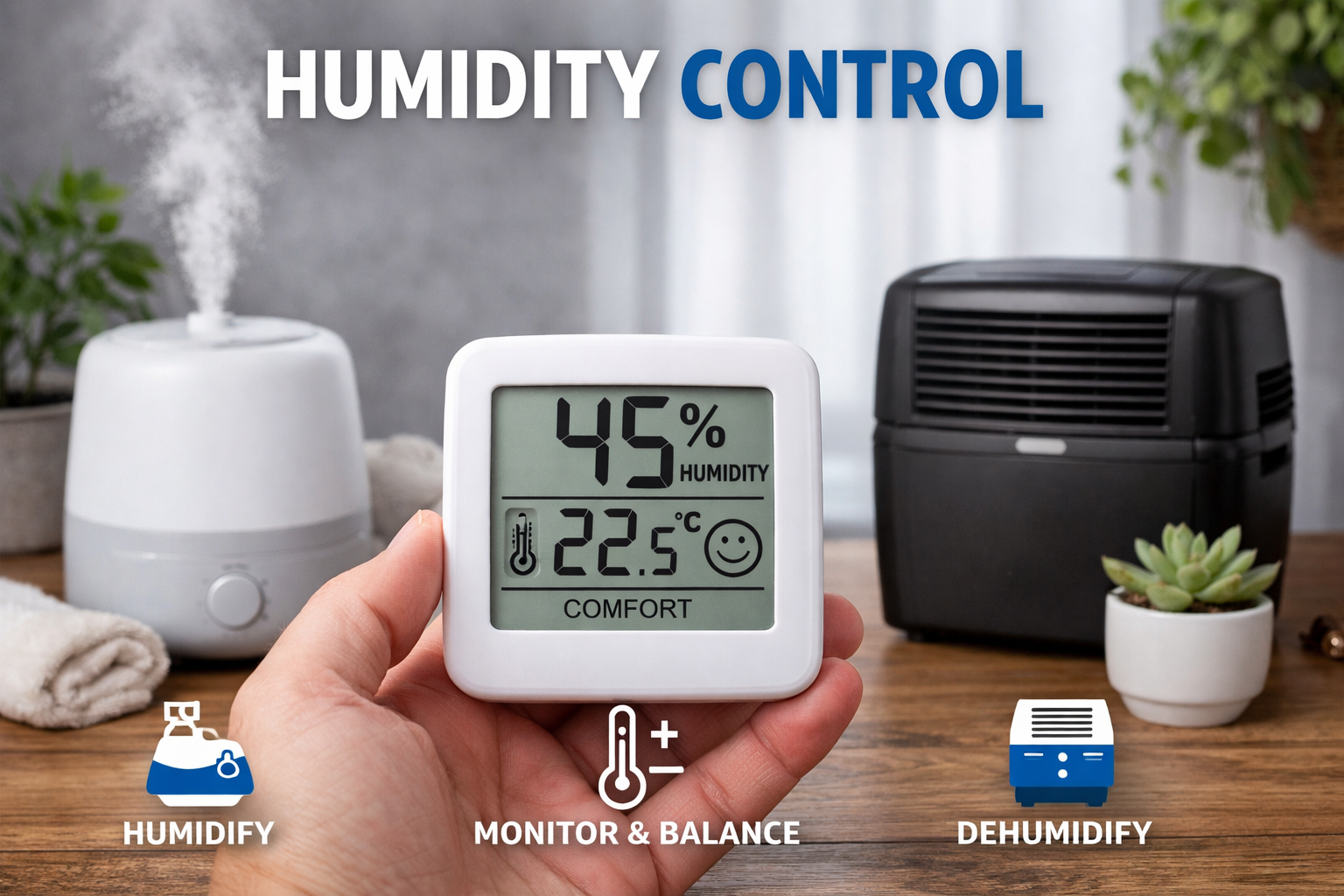
A hygrometer is a small digital display that tells you the humidity in the room it is sitting in. Without one you are guessing, and people guess badly in both directions. Plenty of households run a humidifier all winter in a house that was already fine, and plenty run nothing in a basement sitting at seventy percent.
Put it in the room you spend most time in, leave it a week, and look at it morning and evening. Houses are not uniform, so a second one in a bedroom or a basement is often worth it and still cheaper than any machine.
Only after that week does buying anything make sense. This is the same order we recommend for everything else about the air in a room: measure, adjust the free things, then spend.
⭐ Why Winter Air Goes Dry
The dryness of a Canadian house in February is not caused by the heating, despite what almost everybody assumes.
What happens is that very cold outdoor air is carrying almost no moisture. That air leaks into your house constantly through every gap, and then you warm it up. Warming air does not add water to it, so the same small amount of moisture is now spread through air that could hold far more, and the relative reading collapses.
Which is why a draughty house is drier in winter than a well sealed one, and why sealing gaps around windows and doors helps with dryness as well as with the heating bill.
It is also why the dry skin, the static and the split lips all arrive in the same week every year. That is a house problem rather than a skin problem, and it is worth fixing at the house end.
⭐ What Condensation Is Telling You
Water on the inside of a window is the most useful signal in the whole subject and almost nobody reads it correctly.
It means the air in the room is holding more moisture than the coldest surface in that room can tolerate. It is not telling you the window is broken, although a single glazed or badly sealed window will show it far sooner than a good one.
A little in a corner on the coldest morning of the year is ordinary. Running water down the glass most mornings is not, and that water is going somewhere, which over a winter means into the frame and the wall below it.
The fix is almost always to add less moisture rather than to buy a machine. Turn a humidifier down, run the bathroom fan for longer, put lids on pans, and stop drying laundry indoors on the coldest days.
⭐ Where the Honest Answer Stops
Humidity gets attached to a long list of health outcomes and the confident version goes well past what is established.
What is not seriously disputed is that persistently high indoor humidity encourages mould and dust mites, that mould is a genuine problem in a home, and that very dry air is uncomfortable. Health Canada covers the mould side properly and its page is linked at the foot of this one.
What this page will not tell you is that setting a particular number will prevent illness, improve your sleep by a measurable amount, or do anything for immunity. Those claims appear on plenty of humidifier listings and they are doing marketing work rather than describing evidence.
If there is visible mould in your home, that is a remediation question rather than a humidity question, and a large patch is a job for somebody who does it for a living.
⭐ The Free Adjustments Come First
Most houses can move their reading by ten points without buying anything, and it is worth trying that before spending two hundred dollars.
To raise it, dry laundry on a rack indoors, leave the bathroom door open after a shower instead of running the fan, cook with lids off occasionally, and keep a few houseplants, which do release a small amount of moisture even though they will not clean your air.
To lower it, run the bathroom fan for twenty minutes after a shower rather than two, use the kitchen extractor when boiling anything, keep furniture a few inches off exterior walls so air can move behind it, and open windows for ten minutes even in the cold.
Ventilation is the most underused of those, and it helps with more than moisture, which is a point we make in our notes on what ends up in the air of a closed house.
⭐ When a Humidifier Is Warranted
If your reading sits below thirty for weeks at a time and the free adjustments have not moved it, a humidifier is a reasonable purchase.
One room is the sensible scale. Whole house units exist and are a plumbing job. A single unit in the bedroom, running overnight, covers the eight hours that matter most and is what most people actually need.
The maintenance is the part nobody mentions at the till. A humidifier is a warm tank of standing water, it needs emptying and cleaning properly every few days, and a neglected one is worse than not having one. Buy the model you can take apart, not the one with the most settings.
Cool mist is the usual recommendation over warm mist, particularly in a house with children, since there is no hot water involved.
⭐ When a Dehumidifier Is Warranted
The opposite case, and in this country it is usually a basement and usually a summer.
If a basement sits above sixty percent through July and August, or smells of damp, a dehumidifier is warranted and a machine is genuinely the answer rather than a habit. Ventilation alone does not fix a basement, because the outdoor air you are letting in is itself humid in a Canadian summer.
Size it by the space rather than by the price. An undersized unit runs constantly and never gets there. Look for a built in humidistat so it stops when it reaches the target instead of running all day, and put it where the hose can drain rather than emptying a tank twice daily.
Upstairs in summer, the cheaper move is usually to keep the sun out in the first place, which we cover in our notes on keeping a home cool. And a bedroom that feels clammy at night is often a bedding problem as much as an air one, which is its own subject.
⭐ Best Sellers
Top Products and Picks
Most readers need only the first one. The other two are for the specific situations described above, and buying either without a week of readings first is guessing expensively.
Buy this one first, whatever else you do
ThermoPro TP55 Digital Hygrometer
Twenty three dollars, and it is the only item on this page that tells you whether you need the other two. Large display, records the high and low, and a second one for the basement is still cheaper than guessing.
Check price on AmazonIf the winter reading sits below thirty
Levoit Cool Mist Humidifier for Bedroom
Top fill, which matters enormously because the ones you have to carry to a tap upside down get cleaned half as often. Rated 4.1, which is low for this site, and worth knowing that every competing humidifier we checked sits between 4.0 and 4.2. This is the best of a weak category rather than a great product.
Check price on AmazonIf a basement sits above sixty in July
KNKA 34 Pint Dehumidifier
Rated for up to 2,500 square feet with a built in humidistat, so it stops at your target instead of running all day. Two hundred dollars is a real purchase and a damp basement is a real problem. Ships from Amazon.
Check price on Amazon⭐ Final Thoughts
Humidity is one of the few things about a home where a twenty three dollar purchase genuinely settles the question. You either have a problem or you do not, and a week of readings tells you which.
What makes it worth bothering with is that the symptoms are so easy to blame on something else. The dry skin every February, the window you wipe every morning, the basement nobody goes into. All three are the same number behaving badly at different times of year.
So measure it first, try the free adjustments for a fortnight, and buy a machine only if the number has not moved. Most households find they did not need one.
⭐ Additional Resources
Health Canada’s page on air contaminants and health covers mould and indoor moisture, which is the part of this subject with real consequences rather than marketing attached.
The same department publishes a short list of tips for reducing exposure to chemicals and pollutants at home, several of which are about ventilation and cost nothing.
The rest of the wellness and organic living section covers the air, the light and the surfaces in the same house.