
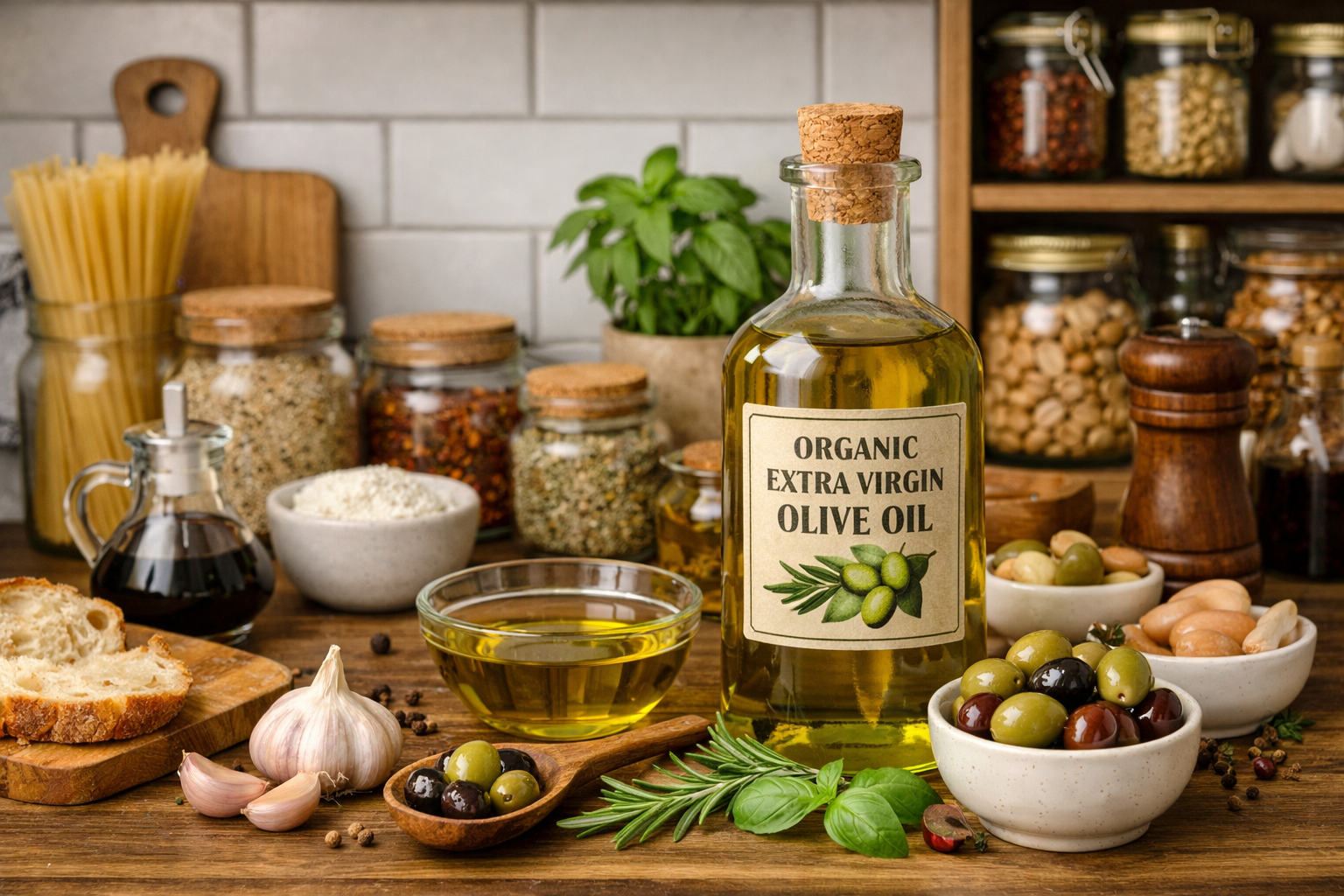
Organic Olive Oil: How to Choose a Bottle and Use It Well
As an Amazon Associate I earn from qualifying purchases. Some links in this post go to Amazon and may earn me a small commission at no extra cost to you.
Last Updated on September 5, 2026 by Smarteryouu
⭐ Organic Olive Oil: How to Choose a Bottle and Use It Well
Organic olive oil is one of the few things in a kitchen that ends up in almost every meal, which makes the bottle you buy more consequential than most single ingredients on the shelf. It is also one of the most confusingly labeled products in the store. The front of a bottle can carry four or five impressive sounding words, none of which are the one that actually tells you something. This guide covers the practical side: which words on the label are defined and which are decoration, why the harvest date matters more than the expiry date, how to store a bottle so it is still good in six months, and where the familiar advice about heat and smoke points has been repeated so often that it has drifted away from what is true. None of it is complicated. Most of it is just not printed anywhere obvious.

⭐ What the Words on the Front of the Bottle Mean
Extra virgin is the only phrase on the front that has a defined meaning. It refers to a grade, and a grade is a technical standard covering how the oil was extracted, how much free acidity it contains and whether it passes a sensory panel without detectable faults. Below it sit virgin, then plain olive oil, then refined, each one a step further from the fruit.
Plain olive oil, sometimes labeled pure or light, is usually a blend of refined oil with a small amount of virgin oil added back for flavor. Light refers to the taste and the color, not to the calories, which is a piece of label language that has confused shoppers for thirty years.
Cold pressed and first pressed are the two phrases worth ignoring. Almost all oil is now produced with centrifuges rather than presses, so first press describes a process most producers no longer use. The words are not false exactly, they are just not doing any work.
Certification sits alongside all of this rather than inside it. It tells you how the olives were grown, and the grade tells you what was done with them afterwards. You want both, and they are separate claims. The post on where the switch is worth it and where it is not covers what certification does and does not cover generally.
⭐ The Date That Matters Most Is Not the One on the Front
Olive oil is a fruit juice. It does not improve with age, it declines from the moment it is made, and the useful window is roughly eighteen months from harvest.
Most bottles print a best before date, which is calculated from bottling rather than harvest and can be a long way from telling you how old the oil actually is. Some producers also print a harvest date, and those are the producers worth rewarding, because it is the number that lets you compare two bottles honestly.
Where no harvest date is given, the practical move is to take the freshest best before date on the shelf and buy the size you will finish in a few months rather than the large tin that looks like better value. A big container at half price is not a saving if the second half is flat by the time you reach it.
⭐ Why the Bottle Itself Changes How Long It Lasts
Three things degrade oil: light, heat and air. That is the entire storage problem, and every piece of advice here follows from it.
Light is why good oil comes in dark glass or a tin. A clear bottle on a bright shelf is losing quality every day it sits there, which is worth remembering when a clear bottle is the prettier one. If you already own oil in clear glass, keeping it inside a cabinet solves most of it.
Heat is why the worst place in most kitchens is the shelf directly above the stove, which is also the most convenient one, which is why nearly everyone does it. Moving the bottle two feet sideways is the single easiest improvement in this whole post.
Air is why the cap goes back on properly and why a decorative open pourer looks lovely and quietly ruins the contents. This is the same principle behind most of the storage advice in the guide to building an organic food pantry, where flour, nuts and spices all have versions of the same problem.
⭐ Heat, Smoke Points and Advice That Got Repeated Too Often
The claim that you must never cook with extra virgin olive oil has been repeated so widely that it is now treated as a rule. It is more of a half truth, and it is worth unpicking because it changes how people cook.
Extra virgin has a lower smoke point than some refined oils, which is where the advice comes from. But the temperatures reached in normal home cooking, roasting vegetables, frying an egg, softening onions, sit comfortably below the point where a decent bottle starts to smoke. Deep frying is a different matter, and so is getting a pan screaming hot for a steak.
The more sensible version of the rule is about value rather than safety. Heat drives off the aromatic compounds you paid extra for, so using an expensive bottle in a hot pan wastes the thing that made it expensive. That is why many kitchens end up with two bottles: an everyday one for cooking, and a better one that never sees a pan.
Whatever oil you use, watch the pan rather than the label. Any oil that is smoking has gone past where it should be, and an empty pan reaches that point far faster than anyone expects. There is more on pans and heat in organic kitchen essentials.
⭐ Tasting It, and What Bitter and Peppery Tell You
Pour a little into a spoon and try it on its own. Most people have never done this, and it takes about a minute to learn more than any label will tell you.
Fresh oil smells green. Grass, tomato leaf, sometimes artichoke or almond. It often tastes faintly bitter and finishes with a peppery catch at the back of the throat that can make you cough. Both of those are signs of a young, well made oil rather than faults, which surprises people who have been taught to think bitter means bad.
Old or poorly stored oil tastes flat and slightly waxy, a bit like crayons. Once you have tasted a fresh oil and a tired one within a few minutes of each other, you will never need a label to tell the difference again.
⭐ When to Reach for Something Else Entirely
No single oil does everything well, and pretending otherwise is how people end up disappointed with a good bottle.
For deep frying, a neutral oil with a high smoke point is the right tool and the cheaper one. For baking, where a fruity flavor would fight the recipe, a neutral oil or butter usually works better, with the exception of the cakes that are meant to taste of it. For very high heat searing, something refined will handle it more comfortably.
Everywhere else, which is most of what happens in a home kitchen, olive oil is the default and there is no particular reason to complicate it.
⭐ Using the Good Bottle Instead of Saving It
The most common mistake with a nice bottle is treating it as too special to open. It sits at the back of the cabinet for a year, being saved for an occasion, and by the time the occasion arrives it has quietly gone flat.
Use it on the ordinary things instead. Over a bowl of soup, on toast with salt, across roasted vegetables after they come out of the oven rather than before they go in, on plain white beans, over a tomato. It is at its best raw and at room temperature, where nothing has cooked away.
This is also, incidentally, the cheapest way to make simple food taste like it was cooked deliberately, which is a fair description of most of what is worth learning in a kitchen. There is more in the same spirit over in the wellness and organic living section.
⭐ Best Sellers
Top Products and Picks
- A certified extra virgin oil in dark glass with a harvest date printed on it, which is the whole of this post compressed into one purchase.
- A tin of everyday cooking oil kept separate from the good bottle, so the expensive one is never the one going into a hot pan.
- A small dark glass cruet with a proper cap, for decanting a week’s worth, which keeps the main bottle sealed and out of the light.
- A set of small tasting bowls, worth having if you ever want to compare two bottles side by side, which is more interesting than it sounds.
⭐ Final Thoughts
A bottle of oil is a small thing to think carefully about, and it is one of the few small things in a kitchen that touches almost everything else. That is the whole argument for paying attention to it.
None of it needs to be complicated. Buy the freshest bottle you can find, keep it somewhere dark and away from the stove, use it before it gets old, and taste it occasionally so you know what good tastes like. That is genuinely the whole method.
And then use it, freely, on ordinary food on ordinary evenings. A bottle saved for a special occasion is a bottle slowly being wasted, and the pleasure of a good oil was never really about the occasion. It was about a Tuesday, a piece of toast, a little salt, and something that tastes better than it has any right to.
⭐ Additional Resources
The grade names on the label come from a published standard, and the United States Department of Agriculture grades for olive oil set out what each one requires, including the acidity limits and the sensory testing behind them.
For the research side, the UC Davis Olive Center is a university program that studies oil quality and testing, and its published work is a large part of why the gap between what a label claims and what is in the bottle became widely known.