
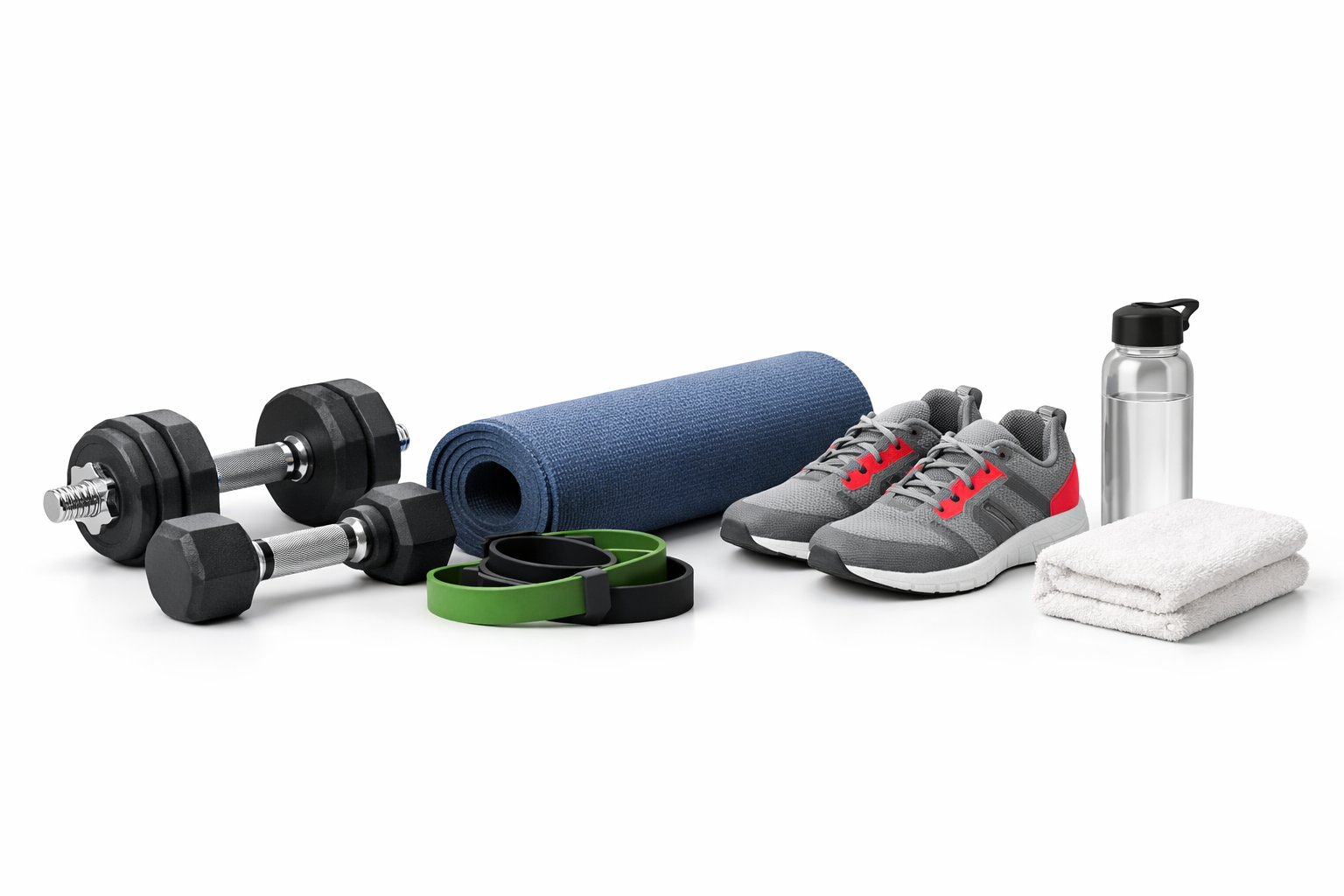
Stay Fit at Home Workout Routine, Twenty Minutes a Day
As an Amazon Associate I earn from qualifying purchases. Some links in this post go to Amazon and may earn me a small commission at no extra cost to you.
Last Updated on October 3, 2026 by Smarteryouu
⭐ Stay Fit at Home Workout Routine, Twenty Minutes a Day
The best stay fit at home workout routine is the one short enough that you would still do it on a bad day. That is the whole trick, and it is why most home routines fall apart in the third week rather than the first. Training at home removes the travel, the queue for equipment and the membership, and what is left is the simple question of whether you did it today. I have been exercising for over a decade, and the two large pieces of equipment I own are a power tower and a Total Gym 1000. Both earn their space because I use them, not because they looked good when I bought them. What follows is a routine built around twenty minutes, an honest answer about training every day, and what each kind of equipment is actually for.

⭐ What Should a Daily Routine Actually Include?
A short warm up, one pushing movement, one pulling movement, one lower body movement, and a few minutes of stretching at the end. That covers everything a beginner needs. Cardio can be part of it or can happen separately as walking, and neither choice is wrong.
The pulling movement is the one people leave out, because it is the hardest to do without equipment. That is also why it matters most. A routine of squats, push ups and planks trains the front of your body and quietly neglects the back.
Keep the same four slots week after week and change what fills them. A daily home workout routine works because the structure stays familiar, which is what lets you notice progress. You are comparing like with like rather than starting a new plan every fortnight.
You do not need equipment to begin. Our morning routine for beginners fills all four slots with nothing but a floor and a chair, and it is a fine place to start before buying anything.
⭐ How Long Should a Home Workout Be?
Twenty minutes is enough, and thirty is plenty. Five minutes to warm up, fifteen for the main work, and a few minutes to stretch at the end. Longer sessions are not better at home, because the thing that produces results is repeating the session rather than extending it.
An hour long plan is where most people go wrong. It looks serious and it survives about ten days, because an hour has to be found and twenty minutes only has to be taken.
Work to time rather than counting repetitions if counting puts you off. Set a timer for the middle fifteen minutes, move through your four movements steadily, and stop when it goes.
On the days when twenty minutes is not there, do five and call it done. If finding even that is the harder problem, our post on easy routines for busy people looks at where the gaps in an ordinary day actually are.
⭐ The Warm Up, and Why Five Minutes Is Enough
A warm up is not stretching. It is moving gently until your breathing changes and your joints have been through their range, which takes about five minutes and no equipment at all.
March on the spot for a minute. Roll your shoulders backward, swing your arms, and do a few slow squats to about half depth. That is the whole thing, and it makes the next fifteen minutes considerably more comfortable.
Save the long held stretches for the end. Stretching hard before strength work does not prevent injury and tends to make you feel slightly weaker for the session that follows.
If you train first thing, take a little longer over it. A body that has been lying still for eight hours needs more warming than one that has been up since seven.

⭐ Strength Without a Rack, What Works at Home
Bodyweight covers the pushing and the legs perfectly well. Push ups against a wall, a counter or the floor give you a whole progression, and squats to a chair do the same for your legs.
Pulling is the gap. Nothing you do on the floor trains your back, which is why a set of resistance bands with a door anchor is the single most useful purchase for a home routine. It costs very little and it fills the slot nothing else can.
Dumbbells are worth adding once bodyweight stops feeling like effort, and adjustable ones make far more sense at home than a rack of fixed pairs. Two to ten kilograms per hand covers most people for a long time.
The bigger frames come later, if at all. A power tower is what I use for back and shoulders, and our guide to equipment for a small space sets out the order to buy things in so you do not end up with a corner full of equipment and no habit.
⭐ How Does a Total Gym 1000 Actually Work?
A Total Gym 1000 is an inclined board on rails that you lie or kneel on, and your own body weight is the resistance. You make it harder by raising the incline and easier by lowering it. There are no weight plates and no bands, which surprises most people who have only seen one in passing.
That design has one genuine advantage over dumbbells at home. Changing the difficulty takes seconds and needs nothing extra, so a beginner and a much stronger person can use the same machine without anyone buying more equipment.
The movements I get most from are the rows and the pullovers, since both train the back while lying down, which is far kinder on the lower back than a bent over row. Chest presses and leg pulls fill the other slots.
Two practical notes before anyone buys one. It folds flat and slides away, which is the main reason it suits a small home, and most models list a user weight limit somewhere around 250 to 275 pounds, so check that against the specification for the exact model rather than assuming.
Most listings bundle it with a pair of light dumbbells and an ab wheel. Those are genuinely useful, but treat them as extras rather than as the reason to buy, since the glideboard is what you are actually paying for.
⭐ Cardio at Home, and Choosing by Where You Live
The right cardio at home depends less on fitness and more on your building. A skipping rope is the cheapest and most effective option available, and it is also the loudest thing you can do in a flat with someone below you.
Check the ceiling before buying a rope, since you need roughly half a metre of clearance above your head. Then think about the floor, because skipping on a suspended wooden floor carries a long way downward.
A walking pad is the quiet answer and it slides under a sofa. It suits anyone whose real problem is a day spent sitting rather than a lack of workouts, and it turns phone calls into steps without any scheduling at all.
A full treadmill is a bigger commitment than most home setups need. Folding models genuinely fold, but a folded treadmill is still a large object leaning somewhere, and folding it away daily is a chore people stop doing by about week three.
⭐ The Cooldown Most People Skip
The last three minutes are the part that gets dropped first and cost the least to keep. Stretch what you just worked, hold each position for two or three slow breaths, and let your breathing settle before you walk away.
After push ups and pressing, open your chest by reaching your hands behind you. After squats, stretch the front of your hips in a low lunge with a cushion under the kneeling knee.
Make the out breath longer than the in breath while you do it. That single habit turns a stretch into something that settles you rather than something you are enduring for three minutes.
If evenings suit you better for this kind of work, our gentle exercises to do before bed are built entirely around it.
⭐ Should You Really Work Out Every Day?
Move every day, but train hard only two or three times a week. Strength is built while you recover rather than while you train, so a hard session every day gives you less progress than three good ones with rest between them. On the other days, walk or stretch.
This is worth saying plainly, because daily routine advice often implies daily effort. The habit should be daily. The intensity should not.
A workable week is three strength sessions of twenty minutes, a walk on most other days, and a few minutes of stretching whenever it fits. That is far less than most plans ask for and far more than most people actually complete.
Judge it by whether it is still happening in six weeks rather than by how hard any single session felt. There is more across our home exercising pages.
⭐ Best Sellers
None of this is needed to start, and the routine above works on a floor with nothing at all. These four are the ones that genuinely change what you can do, in the order most people end up wanting them.
Top Products and Picks
- A set of resistance bands with a door anchor. The first thing to buy, because pulling is the one slot bodyweight cannot fill at home. Get graded strengths rather than a single band, since progress means moving up rather than adding repetitions.
- A pair of adjustable dumbbells. For once bodyweight stops feeling like effort, usually a couple of months in. One adjustable pair takes the space of a shoebox instead of a wall, which matters more at home than the seconds spent changing weight.
- A Total Gym. Worth considering if you want a full machine that folds away, and particularly good for rows and pullovers, which train the back lying down. Check the user weight limit for the model before ordering.
- An under desk walking pad. For anyone whose day is mostly sitting, and the quietest cardio option if someone lives below you. It also fits under a sofa, which no treadmill does.
⭐ Final Thoughts
The routine that lasts is the small one you can repeat, not the ambitious one you can describe. Twenty minutes, four movements, three times a week, with walking and stretching on the days between.
Buy equipment slowly and only when something in the routine is missing. Bands because pulling is missing, dumbbells because bodyweight stopped being hard, a machine because you already know you will use it.
The two large things in my house have both earned their space by being used most weeks, which is the only test worth applying to anything that takes up a corner of a room.
Start tomorrow with the shortest version. Five minutes of warming up and four movements, done once, is a complete session and a real beginning. There is more to explore across Smart Living Essentials.
⭐ Additional Resources
For how much activity is generally recommended by age group, the World Health Organization publishes a fact sheet on physical activity that gives the numbers without prescribing a program.
The Canadian Society for Exercise Physiology takes a wider view across the whole day in its 24 hour movement guidelines, which cover activity alongside sitting time and sleep for each age group.