
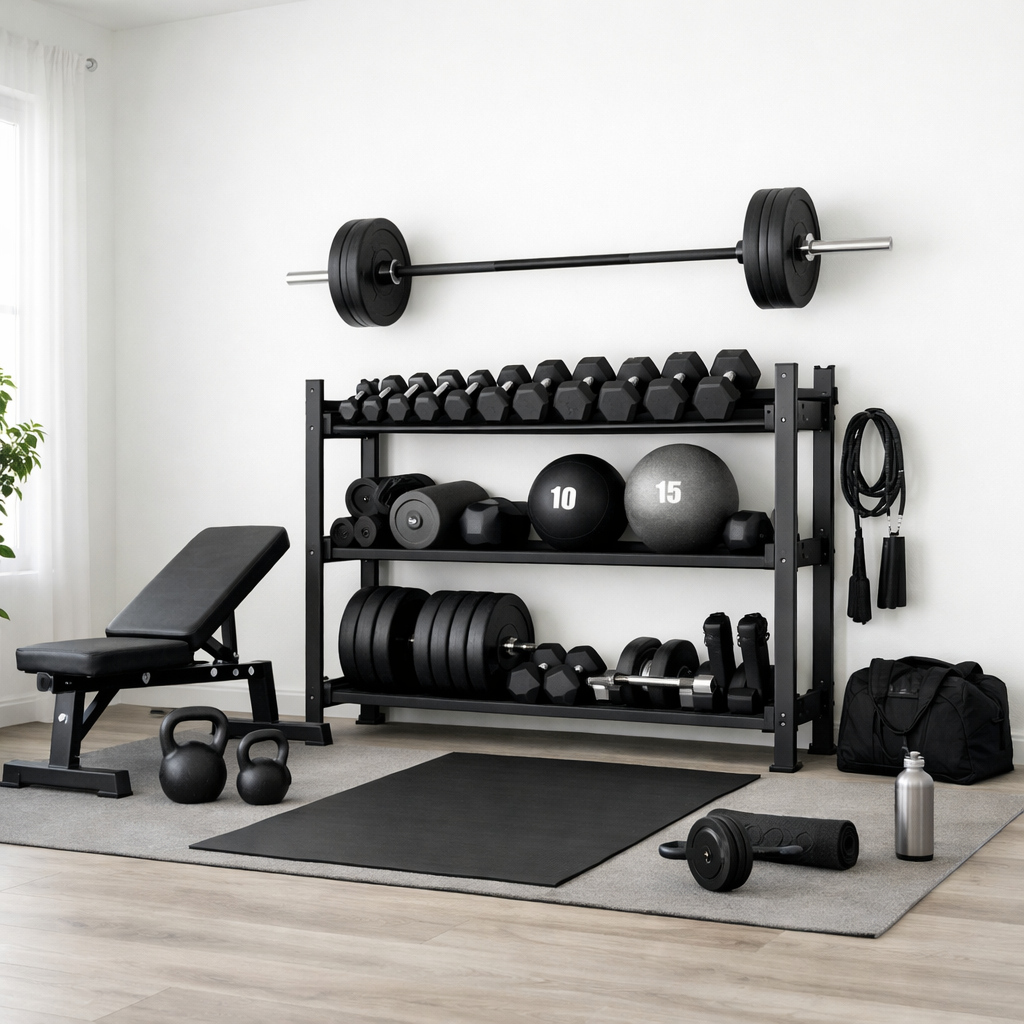
Home Gym Equipment Guide: How to Use Every Item in Your Setup
As an Amazon Associate I earn from qualifying purchases. Some links in this post go to Amazon and may earn me a small commission at no extra cost to you.
Last Updated on August 31, 2026 by Smarteryouu
⭐ Home Gym Equipment Guide, How to Use Each Piece Properly
Most people buy home gym equipment before anyone tells them how to use it, and the result is a corner full of things that get used badly or not at all. This home gym equipment guide is about the second half of that problem. Not what to buy, which we have covered elsewhere, but what each piece is genuinely for, what it should feel like, and the one mistake almost everyone makes on it. I have been exercising at home for over a decade and every mistake below is one I have either made or watched somebody make. Getting these right costs nothing and it is the difference between equipment that works and equipment that quietly hurts.

⭐ What Does Each Piece of Equipment Actually Do?
Dumbbells add load to movements you can already do. Bands add resistance in directions gravity cannot, mainly pulling. A bench changes the angle of a movement. A kettlebell trains swinging and carrying. A rope trains cardio and coordination. A foam roller is recovery rather than training.
That list is worth reading twice, because most people own several items that do the same job and none that do a job they are missing. Two of those categories overlap heavily and the rest do not overlap at all.
The commonly missing one is pulling. A home setup with dumbbells, a mat and a rope trains the front of the body and the legs, and gives the back almost nothing.
If you are still deciding what to own rather than how to use it, our guide to equipment for a small space covers the buying order.
⭐ Dumbbells, and the Mistake That Causes Wrist Ache
Hold them so your wrist stays in a straight line with your forearm. That is the whole thing, and it is the detail nobody mentions.
Under load a wrist naturally bends backward, particularly on presses, and that is where most beginner aches come from. It is almost never a sign that anything is wrong with you. It is a sign that the weight is sitting behind your knuckles rather than over them.
Grip the handle in the base of your palm rather than the fingers, and check the position before each set until it becomes automatic. If it still aches, the weight is too heavy for that movement.
Speed is the second issue. Two seconds up and two or three down is the useful pace, and a set that takes forty seconds does considerably more than the same set rushed. Our post on beginner dumbbell workouts goes movement by movement.
⭐ How Do You Use Resistance Bands Properly?
Anchor them to something solid at the height the movement needs, keep tension on the band at both ends of the repetition, and control the return rather than letting it snap back. A band with slack in it is doing nothing, and the return is half the work.
A door anchor is the piece almost nobody buys and it transforms what bands can do. Without one you are limited to standing on the band, which only gives you upward movements. With one you get rows, which is the whole reason to own bands.
The most common mistake is letting the band pull you back to the start. That wastes the half of the movement where most of the benefit is, and it is what makes bands feel ineffective to people who own them.
Check them for small tears every few weeks, particularly around the anchor point. Bands perish over time and a band that fails mid movement is unpleasant.
⭐ Kettlebells, Where the Swing Goes Wrong
A kettlebell swing is a hip movement, not an arm movement. The bell is thrown forward by your hips snapping straight, and your arms are ropes attached to it. Almost everyone gets this backward the first time.
The symptom is lifting the bell with your shoulders and feeling it in your lower back and arms. The fix is to hinge, pushing your hips backward with soft knees, and let the bell travel between your legs before the hips drive it forward.
Chest height is high enough. Swinging overhead is a different movement with different demands, and it is not the version to learn first.
One moderate bell is genuinely enough at home. Goblet squats, swings and carries cover a great deal, and a set of six bells along a skirting board is how a small room stops being usable.
⭐ The Bench, More Than a Place to Lie Down
A bench earns its space by changing angles rather than by being flat. Incline presses hit the upper chest, a supported row takes your lower back out of the movement, and a raised surface makes step ups and split squats available.
Stability matters more than padding. This is something you get under and put your body weight on, so a bench that shifts is worth replacing rather than tolerating.
The common mistake is setting the incline too steep. Anything past about forty five degrees turns a chest press into a shoulder press without you noticing, and the chest gets left out.
Without a bench, the floor works for pressing and a sturdy chair works for rows and step ups. Neither is a downgrade for a beginner, so this is a later purchase rather than an early one.
⭐ How Should You Use a Foam Roller?
Roll slowly over a large muscle, pause on the spots that feel tight and breathe there for twenty or thirty seconds, then move on. Two or three minutes is plenty. It should feel like firm pressure rather than pain, and it goes after training rather than before.
The mistake is rolling fast and hard, as though speed helps. It does not, and grinding through something genuinely painful is not a sign of it working.
Stay on muscle and off joints and bone. Calves, thighs and the upper back are the useful areas. Rolling directly over your lower back or the side of your knee is not.
Keep it short in the evening, since anything longer starts to wake you up. Our gentle exercises to do before bed cover what suits that hour.
⭐ Skipping Rope, Sizing and Surface
Stand on the middle of the rope and the handles should reach roughly to your armpits. Too long is the usual problem and it makes the rope catch on your feet, which people read as poor coordination rather than poor sizing.
Turn it with your wrists rather than your arms. Elbows stay close to your sides, and the jumps stay small. You need about two centimetres of clearance, not a proper leap.
Surface matters. Concrete is hard on the joints and hard on the rope, and a thin mat under your feet solves both. Check the ceiling too, since you need roughly half a metre above your head.
Thirty seconds at a time is a reasonable start. It is far more demanding than it looks, and it works best in short bursts between other exercises rather than as a long block.
⭐ Which Piece Should You Learn First?
Learn bands first. They are the cheapest, the safest to get wrong, and they fill the pulling gap that nothing else at home covers. Dumbbells second, a bench third, and everything else after that, once you know what your routine is missing.
Learning one piece properly beats owning four you use vaguely. A month with bands and a door anchor teaches more than a room full of equipment used without much thought.
Give each new item two weeks before adding another. That is long enough to find out whether you actually reach for it, which is information you cannot get any other way.
Our post on home exercises that actually work puts several of these together into one circuit, if you would rather see them used than described.
⭐ Best Sellers
Top Products and Picks
These four are the pieces this guide covers most, in the order worth learning them.
- A set of resistance bands with a door anchor. Learn this first. The anchor is the part people skip and it is what makes rows possible, which is the movement most home setups are missing entirely.
- A pair of adjustable dumbbells. Second, once bands stop being challenging. Adjustable matters because your legs and shoulders need very different weights and one pair covers both.
- A folding bench. Third, and only once presses and rows are part of your routine. Choose stability over padding, since this is something you put your body weight on.
- A foam roller. Last, and only if your legs feel genuinely tight rather than merely tired. A medium density one is easier to start with than a hard textured one.
⭐ Final Thoughts
Every mistake on this page is small, free to fix, and the reason somebody somewhere has decided a piece of equipment does not work for them.
Straight wrists, tension on the band, hips driving the kettlebell, slow on the roller, and a rope cut to your height. That is most of it, and none of it costs anything.
Learn one piece properly before adding the next. Two weeks each is enough to find out whether you reach for it, and that is worth more than owning everything.
Pick the item you already own and use least, and spend one session this week doing it slowly and correctly. That is usually where the biggest improvement is hiding. There is more across home exercising and the rest of Smart Living Essentials.
⭐ Additional Resources
For how much activity is generally recommended by age group, the World Health Organization publishes a fact sheet on physical activity that gives the numbers without prescribing a program.
The Canadian Society for Exercise Physiology takes a wider view across the whole day in its 24 hour movement guidelines, which cover activity alongside sitting time and sleep for each age group.