
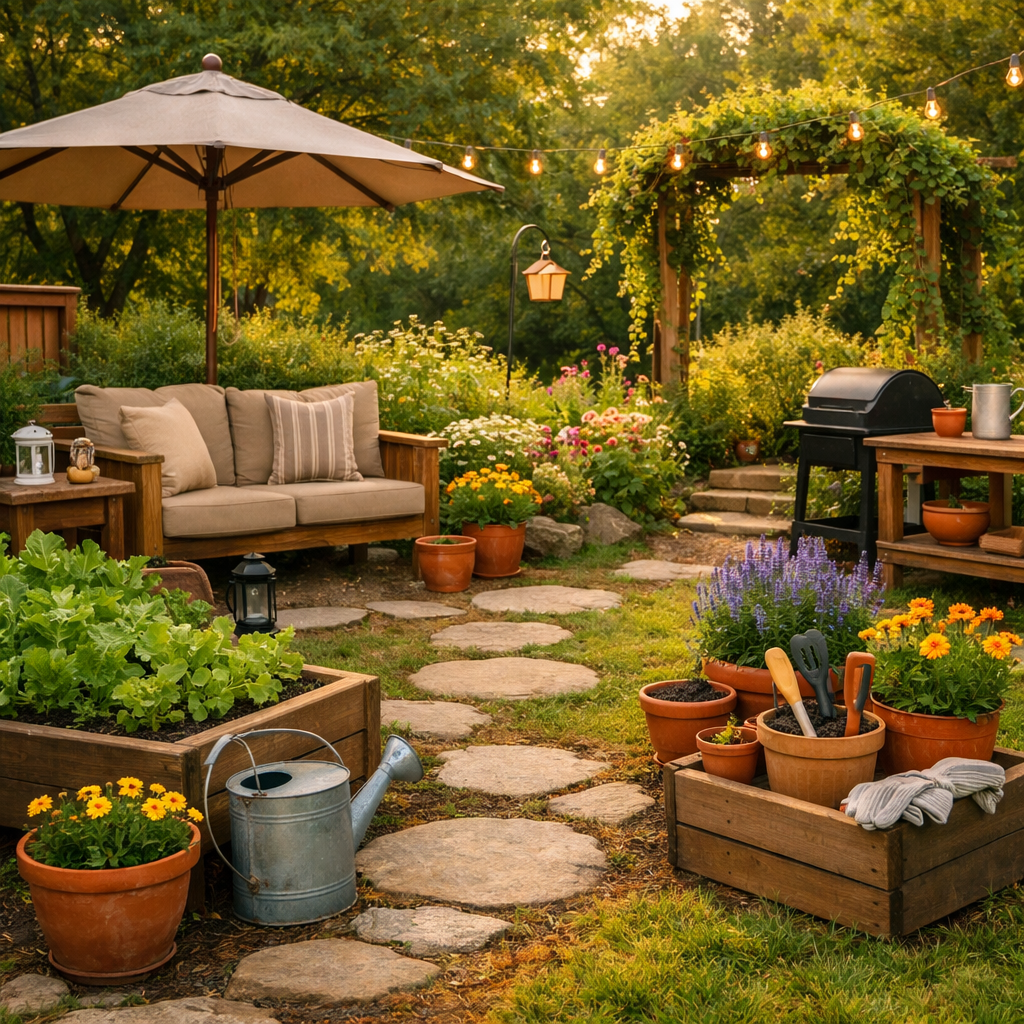
Small Backyard Garden Ideas for a Cozy Outdoor Space
As an Amazon Associate I earn from qualifying purchases. Some links in this post go to Amazon and may earn me a small commission at no extra cost to you.
Last Updated on September 5, 2026 by Smarteryouu
⭐ Small Backyard Garden Ideas for a Cozy Outdoor Space
Most small backyard garden ideas you find online were written for a yard about four times the size, which is why they never quite work when you try them. A narrow strip down the side of a house, a courtyard, a patch of grass barely wider than a car, or a balcony with room for three pots. These are the spaces most people actually have, and they need a different approach rather than a shrunken version of a big garden. The good news is that a small space is genuinely easier in several ways. Less watering, less weeding, less to keep on top of on a busy week. What it demands instead is that you decide clearly what the space is for, because there is no room for a plant that is not earning its place. Everything below assumes you are working with very little room and would like it to feel like more.

⭐ Work Out What You Are Actually Working With
Before buying a single pot, spend one sunny day paying attention to where the light falls. Look at nine in the morning, at one, and again at five, and note which parts of the space are lit each time. It takes almost no effort and it is the single most useful hour you will spend on the whole project.
Small spaces are usually shadier than they look, because a fence or a neighboring wall that would be a minor feature in a large garden is casting shade across most of a small one. Six hours of direct sun is the usual threshold for tomatoes, peppers and most fruiting vegetables. Three or four hours is enough for lettuce, spinach, chard and most herbs. Under that, you are looking at foliage plants and shade lovers, and it is far better to know that now than in July.
Check the practicalities in the same hour. Where the nearest tap is and whether a hose will reach. Whether the space is a wind tunnel, because narrow gaps between buildings often are, and wind dries pots out faster than sun does. Whether there is anywhere to put a bag of compost down. If you are starting a garden from scratch rather than working with one, the beginner guide to starting your first garden covers site and soil in more detail.
⭐ Growing Upward When There Is No Room Sideways
The floor of a small space fills up immediately. The walls and fences almost never do, and that is where the extra growing room is hiding.
The simplest version is a trellis against a sunny wall with something climbing it. Beans, peas, cucumbers and small squash all climb willingly and take up almost no ground. A single pot at the base of a trellis produces far more than the same pot sitting on its own.
Wall mounted planters and hanging baskets work, with one honest caveat. Anything up high dries out faster than anything on the ground, because it catches more wind and more sun and holds less soil. If you are away for a weekend in August, the hanging basket is the thing that will not survive it. Keep the high spots for plants you can afford to lose and the ground level pots for anything you care about.
Shelving is the underrated option. A simple set of outdoor shelves against a wall turns one patch of floor into three levels of growing space, and it puts smaller pots at a height where you can actually see them, which matters more than it sounds when the alternative is a row of pots on the ground that you stop noticing by June.
⭐ Containers, and Why Size Decides Everything
If there is one thing that separates a small garden that works from one that quietly dies in August, it is pot size. Almost every beginner buys pots that are too small, and almost every plant that fails in a container failed because it ran out of water and root room rather than because it was neglected.
As a rough guide, herbs and lettuce are happy in something the size of a large mixing bowl. Peppers, bush beans and compact flowers want a bucket. Tomatoes, zucchini and anything that gets tall want something closer to a household bin. Bigger is nearly always better, because a larger volume of soil holds water longer and buffers the roots against heat.
Drainage holes are not optional and there should be several of them. A pot with one small hole in a wet spring becomes a bucket of stagnant water, and roots sitting in that will rot faster than they would ever dry out.
On material, terracotta looks lovely and dries out quickest, which is a real problem in a hot narrow space. Glazed ceramic and plastic hold moisture far longer. Fabric grow bags are the practical compromise, they are cheap, they fold away over winter and they are hard to overwater. And use potting mix rather than soil dug from the ground, which compacts into a solid block in a container.
⭐ Choosing Plants That Suit the Space
The temptation in a small garden is to grow one of everything. It is also the fastest route to a crowded, disappointing summer, because most of it will be competing for light and none of it will do well.
Pick things you will actually use, and look for varieties bred for pots. Seed packets and labels often say bush, dwarf, patio or compact, and those words are doing real work. A bush tomato stays about knee high and needs no staking. A standard variety will reach well over head height and take over the whole space.
Cut and come again crops give the best return per pot, because you harvest a handful and the plant keeps producing. Salad leaves, chard and spring onions all work this way. Herbs are the other obvious win in a small space, and they are covered properly in the guide to the easiest herbs to grow for beginners.
Leave room for one thing that is purely for looking at. A small garden that is entirely productive starts to feel like a task list, and the point of the space is that you want to be in it.
⭐ Watering, Which Is the Part Containers Get Wrong
Pots dry out several times faster than open ground, and in a hot week a small container can go from wet to bone dry in a single afternoon. This is the difference nobody warns beginners about, and it is why container gardens fail in July rather than in May.
Check by pushing a finger into the soil rather than by looking at the surface. The top can look dry while the root zone is fine, and it can look damp while everything below is parched. When you do water, water until it runs out of the bottom, then stop. A light splash every day wets the top inch and encourages roots to stay near the surface where they are most vulnerable.
Early morning is the best time, evening is second best, and the middle of a hot day is mostly evaporation. Grouping pots together helps more than you would expect, since they shade each other and raise the humidity between them. A layer of mulch on top of the soil in each pot cuts water loss noticeably and takes about a minute to add.
⭐ Making the Space Feel Bigger Than It Is
A few visual tricks genuinely work, and they cost very little.
Fewer, larger pots read as calmer and more deliberate than many small ones, which look cluttered no matter how nice each one is. Three good containers beat eleven odds and ends every time.
Repeating one plant or one pot color in three places pulls the whole space together and makes it feel designed rather than accumulated. So does painting a fence a single dark color, which sounds counterintuitive but pushes the boundary visually backward and makes green foliage stand out against it.
Leaving one clear corner does more for the sense of space than filling it would. And keeping a path, even a token one, gives the eye somewhere to travel. If you want the space to be usable after dark as well, that is a separate subject and there is a guide to outdoor lighting that makes evenings feel warmer.
⭐ What to Leave Out
Being clear about what does not go in a small space is as useful as any of the above, and it is the part most articles skip because it is less fun to write.
Anything that spreads aggressively belongs in a pot or nowhere. Mint is the classic example and it will take a bed in one season. Full sized fruit trees, large shrubs and most ornamental grasses will outgrow the room within two years and then need removing, which is more work than never planting them.
A compost bin is usually a stretch in a very small space, and a small one attracts more problems than it solves. A large storage shed is the same. If storage is the pressure point rather than growing room, the outdoor and garden essentials guide covers that side of it, and the outdoor and garden section has the rest.
Finally, leave out the plan to do it all this year. A small garden is genuinely finished in two or three seasons, which is fast, and rushing it mostly produces a set of pots you did not think about.
⭐ Best Sellers
Top Products and Picks
- A set of fabric grow bags in the larger sizes, which fold away over winter and are almost impossible to overwater.
- A wall mounted trellis panel, the cheapest way to turn a bare fence into growing space.
- A long reach watering can with a narrow spout, which is what makes watering pots on shelves a two minute job rather than a chore.
- A tiered plant stand, for turning one square of floor into three levels of pots without drilling anything.
⭐ Final Thoughts
There is a quiet advantage to a small garden that nobody mentions. You can see all of it at once, you can water the whole thing in five minutes, and nothing gets forgotten in a far corner. Big gardens have parts their owners have not looked at properly in months.
So the aim is not to make a small space pretend to be a large one. It is to let it be what it is, which is a place you can step into with a cup of tea and find something has changed since yesterday. That does not require much room at all.
Start with three pots and one thing climbing a wall. See what survives the summer and what you actually ate or looked at. Next spring you will know more about your own space than any article can tell you, and the year after that it will look like it was always meant to be there.
⭐ Additional Resources
For pot sizes, potting mixes and which plants suit containers, the Oregon State University Extension guide to container gardening is a good plain reference, written by a university extension service rather than by anyone selling pots.