
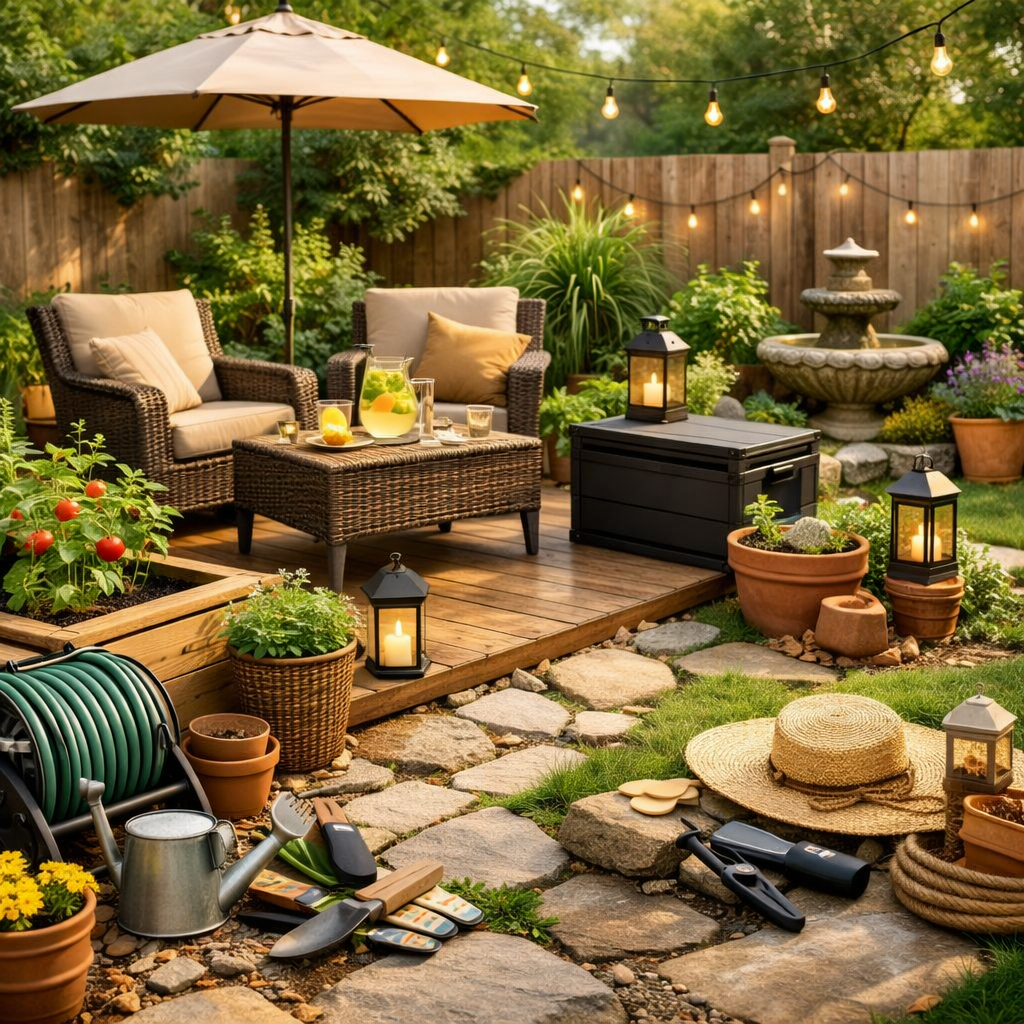
Outdoor and Garden Essentials: Storage, Shade and Keeping a Backyard Tidy
As an Amazon Associate I earn from qualifying purchases. Some links in this post go to Amazon and may earn me a small commission at no extra cost to you.
Last Updated on September 5, 2026 by Smarteryouu
⭐ Outdoor and Garden Essentials: Storage, Shade and Keeping a Backyard Tidy
The outdoor and garden essentials that actually decide whether a yard stays pleasant are not the ones anybody photographs. They are the box the cushions live in, the place the hose ends up, the bit of shade over the spot you sit in at four in the afternoon, and the edge between the lawn and the bed. Get those right and the space looks after itself. Get them wrong and a yard that looked lovely in May is a collection of things propped against a fence by August, which is what happens to most of them. This guide is about the working side of a backyard rather than the decorative one. Where things live, how to water without standing there holding a hose, how to get shade you can move, and the two small jobs each season that stop everything sliding backward.

⭐ Somewhere for Things to Live
Almost every untidy yard is untidy for one reason. Things that get used outdoors have nowhere to go, so they stay where they were last put down.
The fix is not a bigger shed. It is a place for each category of thing near where that thing is used. Cushions near the seating. Hose near the tap. Tools near the beds. A single shed at the bottom of the garden means everything gets left out, because nobody walks forty feet to put a trowel away.
Start by watching where things actually accumulate over a week rather than deciding where they ought to go. That pile by the back door is telling you a storage box belongs by the back door. It is the same principle as the jar on the kitchen counter, and it works for the same reason.
Hand tools have their own version of this problem, and it is covered along with cleaning and sharpening in the guide to choosing garden tools that last.
⭐ Choosing Storage That Survives a Winter
Outdoor storage is one of the categories where the cheap version genuinely fails, and it fails in a predictable way.
Thin plastic goes brittle in sunlight over two or three summers and then cracks the first cold morning something heavy is dropped in it. Look for a lid that overlaps the box rather than sitting flush inside it, since that is what keeps rain out, and hinges that are part of the molding rather than screwed on.
Whatever you buy, raise it off the ground on a couple of paving slabs or a pallet. A box sitting directly on soil or grass wicks moisture upward, and the contents get damp even though the lid is doing its job. This is the single most common reason cushions come out of storage smelling wrong.
Ventilation matters as much as waterproofing. A completely sealed box traps condensation, so anything stored damp stays damp. Open it on the first dry day in spring rather than in June.
⭐ Hoses, and the Part That Always Fails
A hose is a hose, mostly. What separates one that lasts from one that does not is the fittings and how it is stored.
Buy standard sized connectors so you can replace one part rather than the whole thing, and keep a spare washer or two, because a dripping connection is nearly always a worn washer costing almost nothing rather than a failed hose.
Kinking is the thing that makes people hate a hose, and it is mostly a storage problem. A hose left in a loose heap develops permanent bends. A reel or a simple wall hanger keeps it in wide loops and it stays flexible for years. Drain it before winter, since water left inside freezes and splits the wall from the inside.
Length is worth thinking about once rather than repeatedly. Measure to the furthest point you water and add a little, then stop. An unnecessarily long hose is heavier to drag, slower to reel in and more likely to end up left across the lawn.
⭐ Watering Without Standing There Holding It
Hand watering is pleasant for about a week and then it is a chore, which is when plants start getting a quick splash instead of a proper soak.
A soaker hose laid along a bed and covered with mulch is the cheapest upgrade available. It puts water at the roots rather than on the leaves, it loses far less to evaporation than a sprinkler, and it turns watering into opening a tap for twenty minutes.
A simple mechanical timer on the tap costs very little and removes the main failure mode, which is forgetting it is running. It also means a few days away in July stops being a problem.
Water early rather than in the evening where you can. Morning gives plants the day to use it and lets foliage dry, while evening watering leaves things damp overnight, which is what fungal problems like. Containers are the exception because they dry out so fast, and they are dealt with properly in the guide to small backyard garden ideas.
⭐ Shade You Can Actually Move
Shade is the thing that decides whether a yard gets used in July, and the sun moves, which is why fixed shade so often ends up in the wrong place.
Go out at the time you would actually want to sit there, which for most people is late afternoon rather than noon, and see where the sun is. Shade built for midday frequently misses by an hour or two, and an umbrella that works at one is useless at five.
A cantilever umbrella, where the pole sits to one side, is the most adaptable option because it swings through the afternoon and does not put a post in the middle of the space. It needs a genuinely heavy base, and the weight recommended on the box is a minimum rather than a target. A shade sail is cheaper and permanent, which makes it excellent if you know exactly where the sun is and a poor choice if you are guessing.
Whatever you use, take it down in high wind. More umbrellas are destroyed by one gusty afternoon than by five years of ordinary use.
⭐ Screening, Edges and Where the Yard Ends
Two cheap things change how a yard reads more than almost anything else, and neither involves buying furniture.
The first is a defined edge between lawn and bed. A cut edge, made with a spade once and then tidied twice a year, makes an ordinary garden look deliberate. Physical edging strip does the same job with less repetition and stops grass creeping into beds, which is where a surprising amount of weeding time goes.
The second is screening one thing you would rather not look at. A bin store, a neighbor’s window, a gap in a fence. A single panel of trellis or a tall planter in the right place does more for the feeling of a space than a whole new set of furniture would.
If seating and the look of the space is what you are after rather than the working side of it, that belongs to the outdoor patio section, and lighting is covered separately in the guide to outdoor garden lighting.
⭐ The Two Jobs That Keep It From Sliding Back
A yard does not decline gradually. It holds together and then, somewhere in late July, it stops. Two habits prevent almost all of it.
The first is a ten minute pass at the end of anything you do outside. Everything goes back in its box, the hose gets reeled, the tools come inside. Not a tidy up, just not leaving things out. Done every time, it removes the big weekend clear up entirely.
The second is topping up mulch once a year. Two or three inches on beds suppresses weeds, holds moisture, and saves more time over a summer than any tool on this list. It is the least interesting job in gardening and the highest returning one.
That is genuinely all the maintenance a normal yard needs, and it is a fraction of what people assume. The rest of the category is in the outdoor and garden section.
⭐ Best Sellers
Top Products and Picks
- A weatherproof storage box with an overlapping lid, raised off the ground, which is what keeps cushions dry rather than merely covered.
- A wall mounted hose reel, which is the difference between a hose that lasts a decade and one that kinks permanently in its second year.
- A soaker hose with a mechanical tap timer, the cheapest way to stop watering being a job you have to remember.
- A cantilever umbrella with a heavy base, chosen so the shade can follow the afternoon rather than sitting where the sun was at noon.
⭐ Final Thoughts
None of this is the part of a garden anyone talks about. Nobody shows off a hose reel. But the yards that stay pleasant year after year are the ones where the boring things were sorted out early and then stopped needing attention.
It is worth doing in that order too. A box by the door and a reel on the wall will change how the space feels more reliably than a new set of chairs, and cost a fraction as much.
Then the good part, which is that a yard where everything has a place is a yard you go into without first having to deal with something. That is most of what makes an outdoor space get used rather than looked at through a window.
⭐ Additional Resources
Outdoor watering is where most household water goes in summer, and a good deal of it never reaches a root. The Environmental Protection Agency WaterSense watering guidance covers timing, how long to run a system, and the maintenance checks that stop water being wasted before it gets to the plants.