
What Size Rug for a Living Room? A Simple Guide That Avoids the Tiny Rug Mistake
As an Amazon Associate I earn from qualifying purchases. Some links in this post go to Amazon and may earn me a small commission at no extra cost to you.
Last Updated on October 2, 2026 by Smarteryouu
⭐ What Size Rug for a Living Room? A Simple Guide That Avoids the Tiny Rug Mistake
A rug can pull a room together more than almost anything else. It adds warmth, softens sound and gives the furniture a clear place to belong. It can also make a room look slightly unfinished if the size is wrong.
If you have ever wondered what size rug for a living room actually works, you are not alone. The most common decorating mistake in any home is a rug that is simply too small. It floats in the middle of the floor like an island, and the furniture around it looks disconnected.
The good news is that choosing the right size is mostly about measuring rather than taste. A few simple guidelines about furniture legs and bare floor borders, plus a roll of painter’s tape, will tell you almost everything before you spend anything. This guide walks through the living room first, then the bedroom and dining area, in plain language.
Some links on this page are affiliate links. If you buy through one, this site may earn a small commission at no extra cost to you.

⭐ Why Does Rug Size Matter So Much?
A rug defines a zone. It tells the eye which pieces of furniture belong together and where one area ends and another begins. When the rug is large enough to connect the sofa, chairs and coffee table, the room feels calm and complete.
When it is too small, the opposite happens. The furniture sits around the rug rather than on it, and the room can feel scattered even when every piece is lovely on its own.
Size also affects how large the room itself feels. It seems backwards, but a generously sized rug often makes a room look bigger, because it creates one continuous surface instead of breaking the floor into small patches.
Our guide to small living room decor ideas explores more ways to make a compact space feel open, and the rug is often the first change worth making.
⭐ What Size Rug Do You Need for a Living Room?
For most living rooms, an 8 by 10 foot rug is the most versatile choice, with 5 by 8 suiting smaller spaces and 9 by 12 suiting larger ones. A common guideline is that the rug should be large enough for at least the front legs of every main seat to rest on it.
These three sizes cover the vast majority of living rooms. The right one depends less on the room’s total size and more on the size of your seating area.
A good way to decide is to measure the space your furniture actually occupies. Measure from the outside edge of the sofa to the outside edge of the chair opposite, and across from side to side. The rug should roughly match that area, or be a little larger.
If you are between two sizes, the larger one is usually the better choice. It is far more common to regret a rug that is too small than one that is slightly too big.
Round rugs follow slightly different thinking. They suit a reading corner, a round coffee table or a small entry, but they rarely anchor a full sofa arrangement well. In most living rooms, a rectangle does the main job and a round rug works best as a smaller accent somewhere else.
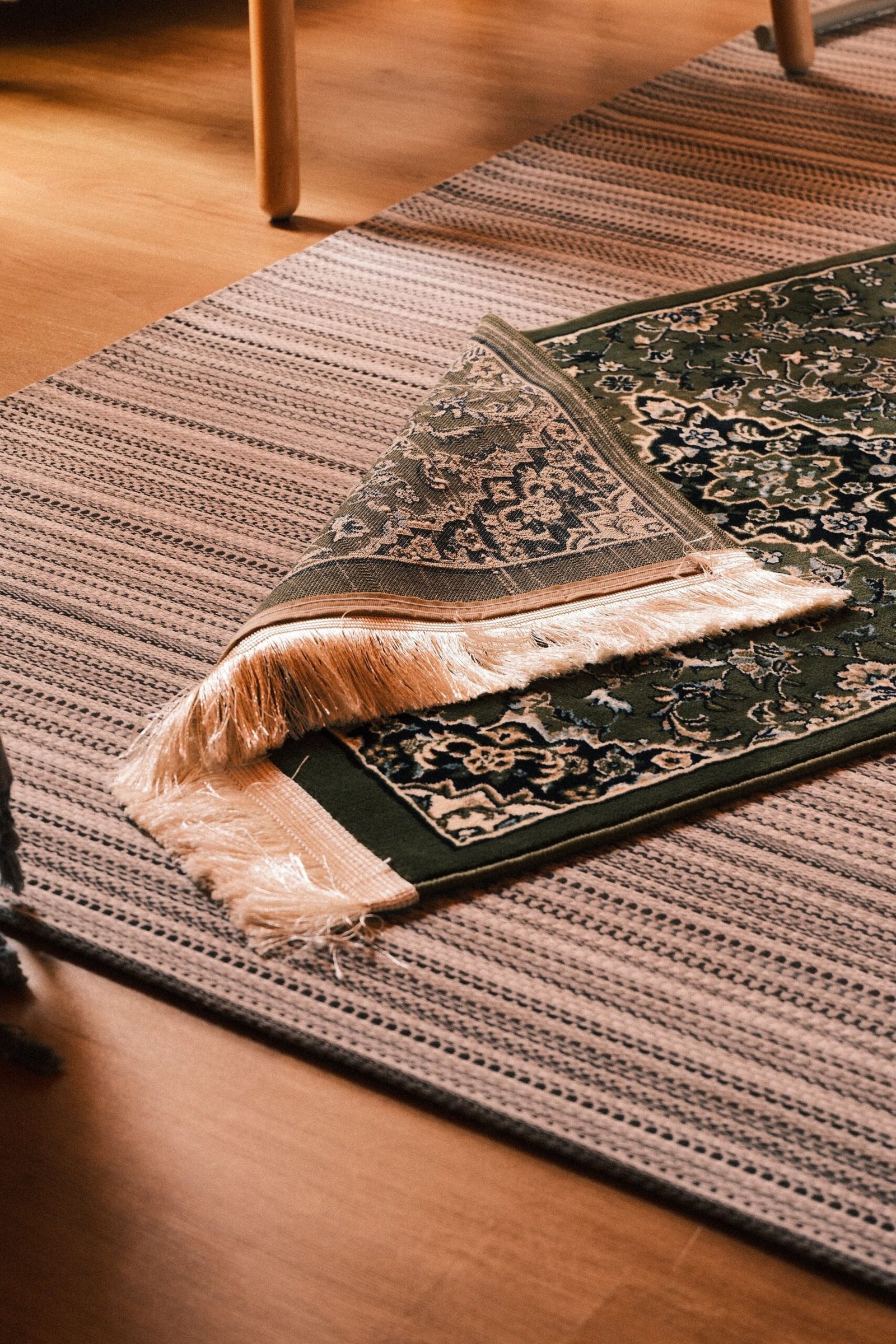
If you already own a rug that turned out too small, layering can rescue it. Place a larger, plain rug such as a flat woven jute underneath, and set the smaller patterned rug on top. The larger base connects the furniture, and the rug you love still gets pride of place.
⭐ Front Legs On, All Legs On, or Floating?
There are three common ways to arrange furniture on a living room rug, and each has its place.
All legs on is the most generous option. Every piece of furniture sits fully on the rug, which works beautifully in larger rooms and open plan spaces where the rug needs to create a clear seating zone.
Front legs on is the most popular and forgiving arrangement. The front legs of the sofa and chairs rest on the rug while the back legs sit on the floor. It connects the pieces together and works in most rooms and most budgets.
Floating means no furniture touches the rug at all, only the coffee table sits on it. This tends to work only in very small spaces, and even then it can make the room feel slightly disconnected. If you choose it, keep the rug close to the sofa so there is no awkward gap.
Whichever you choose, keep it consistent. Mixing styles, with one chair fully on and another fully off, is usually what makes a room look slightly wrong.
⭐ How Much Bare Floor Should Show Around a Rug?
A common guideline is to leave roughly 12 to 18 inches of bare floor between the edge of the rug and the walls in most rooms. In a smaller room, around 8 to 10 inches can work. That border frames the rug and makes the room feel intentional rather than wall to wall.
This border is part of what makes a rug look like a deliberate choice. Too little floor showing can feel cramped, while too much makes the rug look small again.
Consider doorways and heating vents too. A rug that catches the bottom of a door every time it opens quickly becomes an annoyance. Check the swing of each door before you commit to a size.
In rooms with an unusual shape, focus on the seating area rather than the walls. The rug belongs to the furniture, not necessarily to the whole room.
⭐ Tape It Out on the Floor First
This is the single most useful step, and it costs almost nothing. Before you buy anything, use painter’s tape to mark the outline of the rug size you are considering directly on the floor.
Live with it for a day or two. Walk around it, sit on the sofa, and notice where the front legs land. It is remarkable how often a size that looked right online feels too small once it is outlined in the actual room.
Try a second outline in the next size up if you are unsure. Seeing the two side by side usually makes the decision obvious.
Painter’s tape peels away cleanly from most finished floors, so there is nothing to lose by testing. It is the same trick that makes painting and caulking easier, and it works just as well here.
⭐ Bedrooms and Dining Areas Follow Different Rules
In a bedroom, the goal is to have something soft underfoot when you step out of bed. A common approach is a rug that extends about 18 to 24 inches beyond each side of the bed and the foot. For a queen bed, that often means an 8 by 10 rug placed so the bottom two thirds of the bed sit on it, with the nightstands left on the floor.
Two runners, one on each side of the bed, are a good alternative in narrow rooms. Our guide to bedroom decor ideas has more on making a bedroom feel calm and finished.
Dining rooms have one important rule. The rug needs to be large enough that chairs stay fully on it when they are pulled out. A common guideline is to add around 24 inches on every side of the table. Otherwise chair legs catch the edge every time someone sits down.
In hallways, a runner should leave a few inches of floor showing at each end and down both sides, so it looks placed rather than squeezed in.
⭐ What Goes Under the Rug Matters Too
A good rug pad is easy to overlook, but it makes a real difference. On hard floors, a pad stops the rug from sliding, keeps corners from curling up, and adds a little cushioning underfoot.
Choose a pad slightly smaller than the rug so it stays hidden. Most can be trimmed with ordinary scissors.
Felt pads on furniture legs are another small but useful step. They let chairs slide without snagging the rug, and they protect the floor at the edges where legs rest half on and half off. Adding felt pads is one of our favourite beginner home projects you can finish in under an hour.
If you are furnishing on a budget, a well sized simple rug will almost always look better than a small expensive one. Our guide to affordable decor ideas for renters has more on where to spend and where to save, and more inspiration is gathered in our Home Decor Inspiration section.
⭐ Best Sellers
Top Products and Picks
A few simple tools that help any rug look and sit better, whatever size you choose.
Before you shop
STANLEY FATMAX 25 Foot Tape Measure
For measuring the room, the furniture and the space between them before a rug is even on your list. A wide blade that stays straight across a room makes this a one person job.
Check price on AmazonUnder every rug on a hard floor
GORILLA GRIP Rug Pad Gripper
For stopping a rug from sliding, bunching or curling at the corners on wood, tile or laminate. Choose your rug size on the listing, since the link opens on the smallest one. Trim it slightly smaller than the rug.
Check price on AmazonFor furniture that sits on the rug
X PROTECTOR Felt Furniture Pads, 48 Pieces
For chair and table legs, so they slide instead of snagging and protect the floor at the rug’s edge. Peel, stick and done. The pack is large enough for most living rooms.
Check price on Amazon⭐ Final Thoughts
Choosing a rug feels like a style decision, but it is mostly a measuring one. Once the size is right, almost any colour or pattern you love will look at home.
Remember the simple guidelines. Aim for at least the front legs of your seating on the rug, leave a comfortable border of floor around the edges, and choose the larger size when you are unsure.
Most of all, take the time to tape the outline on the floor before you buy. A day or two of walking around a few strips of tape can save you from a rug that never quite fits, and it turns a guess into a confident choice you will enjoy for years to come in a room that finally feels finished.