
Resistance Band Exercises for Beginners: A Simple Full Body Routine at Home
As an Amazon Associate I earn from qualifying purchases. Some links in this post go to Amazon and may earn me a small commission at no extra cost to you.
Last Updated on October 2, 2026 by Smarteryouu
⭐ Resistance Band Exercises for Beginners: A Simple Full Body Routine at Home
Resistance bands might be the most underrated piece of exercise equipment there is. They cost less than a single dumbbell, fold into a drawer, and still give your muscles something real to work against.
That makes resistance band exercises for beginners a gentle, practical way to start strength training at home. There is no heavy equipment to buy, nothing to set up, and very little that can go wrong when you begin with light bands and simple movements.
This guide explains the two main types of bands, how to choose a starting strength, and seven straightforward exercises that together work the whole body. It also covers the safety habits that matter most, especially when using a door anchor. Everything here fits into a small space and about twenty minutes, twice a week.
Some links on this page are affiliate links. If you buy through one, this site may earn a small commission at no extra cost to you.

⭐ Why Are Resistance Bands Good for Beginners?
Bands let you start with very little resistance and increase it gradually. The tension grows as the band stretches, so each movement starts easy and becomes harder at the end of the range. That makes them forgiving to learn with, easy to store and inexpensive to replace.
They also travel well. A set of bands weighs almost nothing, so a routine can come with you on a trip or move from the living room to the bedroom in seconds.
Bands work well alongside other equipment too. Many people use them to learn a movement before picking up dumbbells, or to add a little extra challenge to bodyweight exercises. Our guide to beginner dumbbell workouts at home is a natural next step once bands start to feel easy.
The Government of Canada’s physical activity tips suggest adding activities that strengthen muscles and bones at least two days per week. Bands are one of the simplest ways to make that happen without leaving home.
⭐ Loop Bands or Tube Bands, What Is the Difference?
There are two common types, and each suits different exercises.
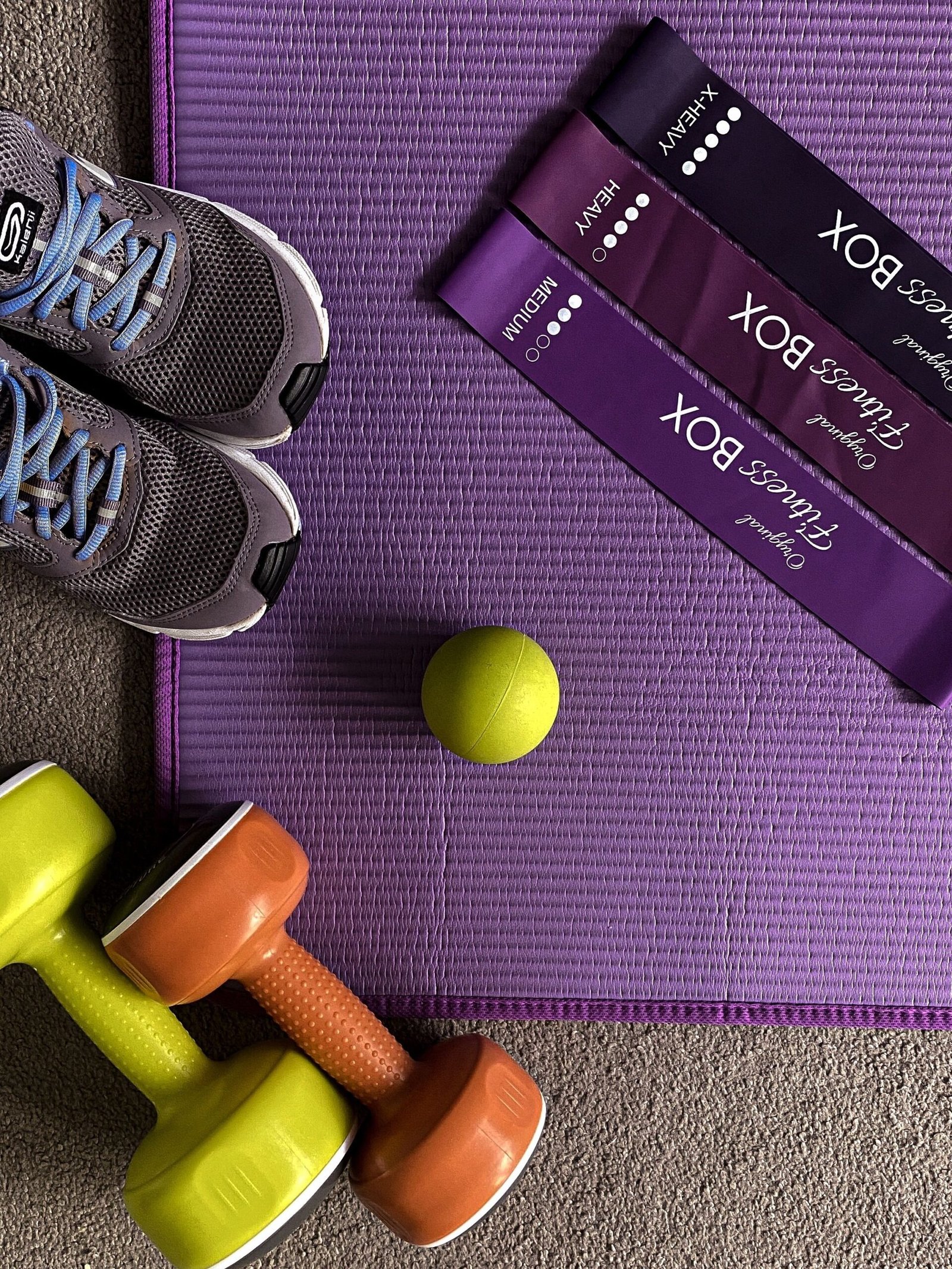
Loop bands are flat, continuous circles of stretchy material. Small loops go around the legs just above the knees or around the ankles, and they are ideal for lower body moves like squats, bridges and side steps. They usually come in sets of several strengths, each a different colour.
Tube bands have handles on each end and often come with a door anchor. They are best for upper body movements such as rows, presses and curls, because the handles feel natural in your hands and the anchor lets you pull from different angles.
Many people start with a set of loops for the lower body and add a set of tube bands once they want more variety. Between them, they cover almost every basic strength movement.
⭐ Start With the Right Bands
It is tempting to choose a strong band straight away, but starting lighter is almost always better. You want to finish each set feeling that the last few repetitions were challenging while your form stayed good.
A simple test is to try ten repetitions of a movement. If you could easily do twenty more, the band is too light. If you cannot complete ten with good form, it is too heavy.
Colours usually indicate strength, but they are not the same between brands. A green band from one company may be much lighter than a green band from another, so always go by the strength printed on the package or by how the band feels.
Keep a few strengths handy. Your legs will almost always need a stronger band than your arms, and some exercises feel very different from others even with the same band.
⭐ Seven Simple Moves for a Full Body Routine
These seven exercises work the major muscle groups and suit almost everyone who is starting out. Aim for 10 to 12 slow, controlled repetitions of each.
Band squat. Place a loop band just above your knees, feet hip width apart. Sit back as if into a chair, keeping your knees pressing gently outward against the band, then stand up tall.
Glute bridge. Lie on your back on a mat with a loop band above your knees and your feet flat on the floor. Press through your heels to lift your hips, pause at the top, then lower slowly.
Side steps. With a loop band around your ankles or just above the knees, bend your knees slightly and take small steps sideways, keeping tension in the band the whole time. Step back the other way.
Seated row. Sit on the floor with legs straight and loop a tube band around the soles of your feet. Hold the handles and pull them toward your ribs, squeezing your shoulder blades together, then return slowly.
Chest press. Anchor a tube band behind you at chest height, facing away from the door. Hold the handles at your chest and press forward until your arms are straight, then return with control.
Overhead press. Stand on the middle of a tube band with feet hip width apart. Hold the handles at shoulder height and press straight up, then lower slowly.
Bicep curl. Stand on the middle of a tube band, palms facing forward, and curl the handles toward your shoulders, keeping your elbows close to your sides.
⭐ How Often Should Beginners Use Resistance Bands?
Two or three sessions a week, with at least one rest day between them, is a sensible starting point. Complete the seven moves once as a circuit, rest for a minute or two, then repeat once or twice more. The whole session takes around twenty to thirty minutes.
Consistency matters far more than intensity. Two steady sessions every week for three months will do much more than an ambitious week followed by a month off.
Progress gently. When ten to twelve repetitions start to feel easy, move to the next band strength for that exercise, or add a couple of repetitions before stepping up.
If you want ideas for fitting movement into a busy day, our ten easy home exercise routines for busy people shows how to slot short sessions into moments you already have.
⭐ Anchoring and Safety Habits That Matter
Bands are safe when used sensibly, and a few habits make them safer still.
Check every band before each session. Look for small nicks, tears or sticky patches, especially near the handles. A damaged band can snap, so replace it rather than hoping it lasts one more workout.
When using a door anchor, place it on the hinge side of the door and close the door so it opens away from you. That way, if the anchor slips, the door cannot swing open toward you. Lock it if you can, and let others in the home know not to open it mid workout.
Never let go of a band while it is stretched. Return it slowly to its resting length every time. Keep bands out of direct sunlight and away from sharp edges when stored, since both shorten their life.
If any movement causes pain rather than ordinary muscle effort, stop. It is always worth speaking with a health professional before starting a new exercise routine if you have an injury or a health condition.
⭐ Where Bands Fit in a Small Home Gym
One of the best things about bands is how little room they need. A whole set fits in a small basket or drawer, and the routine above needs only enough floor space to lie down and take a few steps sideways.
That makes bands ideal for apartments and small homes. Our guide to exercising at home in a small space covers how to make the most of limited room, and our look at the best home exercise equipment for a small space explains what to add next and what to skip.
A thick mat is the one other item that makes band work more comfortable, particularly for bridges and seated rows on a hard floor. Beyond that, bands on their own can carry a beginner a long way. More routines and equipment guides are gathered in our Home Exercising section.
⭐ Best Sellers
Top Products and Picks
Everything the routine above needs, in the order most people buy it.
Start here
Gritin Resistance Loop Bands, Set of 5
For squats, bridges and side steps, the lower body half of this routine. Five colour coded strengths from very light to heavy, so you can step up gradually. Small enough to keep in a drawer.
Check price on AmazonFor the upper body moves
TheFitLife Resistance Tube Bands with Handles
For rows, presses and curls. The set includes handles, a door anchor and ankle straps, and the tubes can be combined for more resistance. The best next step once loop bands feel familiar.
Check price on AmazonFor floor exercises
Retrospec Solana Yoga Mat, Half Inch Thick
For bridges and any move where you kneel or lie down. The thick padding is kind to knees on hard floors, and the strap makes it easy to roll up and store. Linked here is the Wild Spruce colour.
Check price on Amazon⭐ Final Thoughts
Starting strength training does not require a gym membership or a room full of equipment. A few inexpensive bands, a mat and twenty minutes a couple of times a week are genuinely enough to begin.
Keep it simple at first. Choose lighter bands than you think you need, learn the seven moves slowly, and focus on steady form rather than speed. Check your bands regularly and anchor them safely. Progress will come quietly, one band strength at a time.
Most importantly, keep showing up. The routine that works is the one you actually do, week after week. Bands make that easier than almost anything else, because they are always ready, always quiet and never more than a drawer away when you have a spare half hour.
⭐ Additional Resources
Government of Canada: Physical activity tips for adults outlines how much activity adults are encouraged to aim for each week, including muscle strengthening activities.