
Automobile Essentials You Actually Need
As an Amazon Associate I earn from qualifying purchases. Some links in this post go to Amazon and may earn me a small commission at no extra cost to you.
Last Updated on September 27, 2026 by Smarteryouu
⭐ Automobile Essentials You Actually Need, and What I Skipped
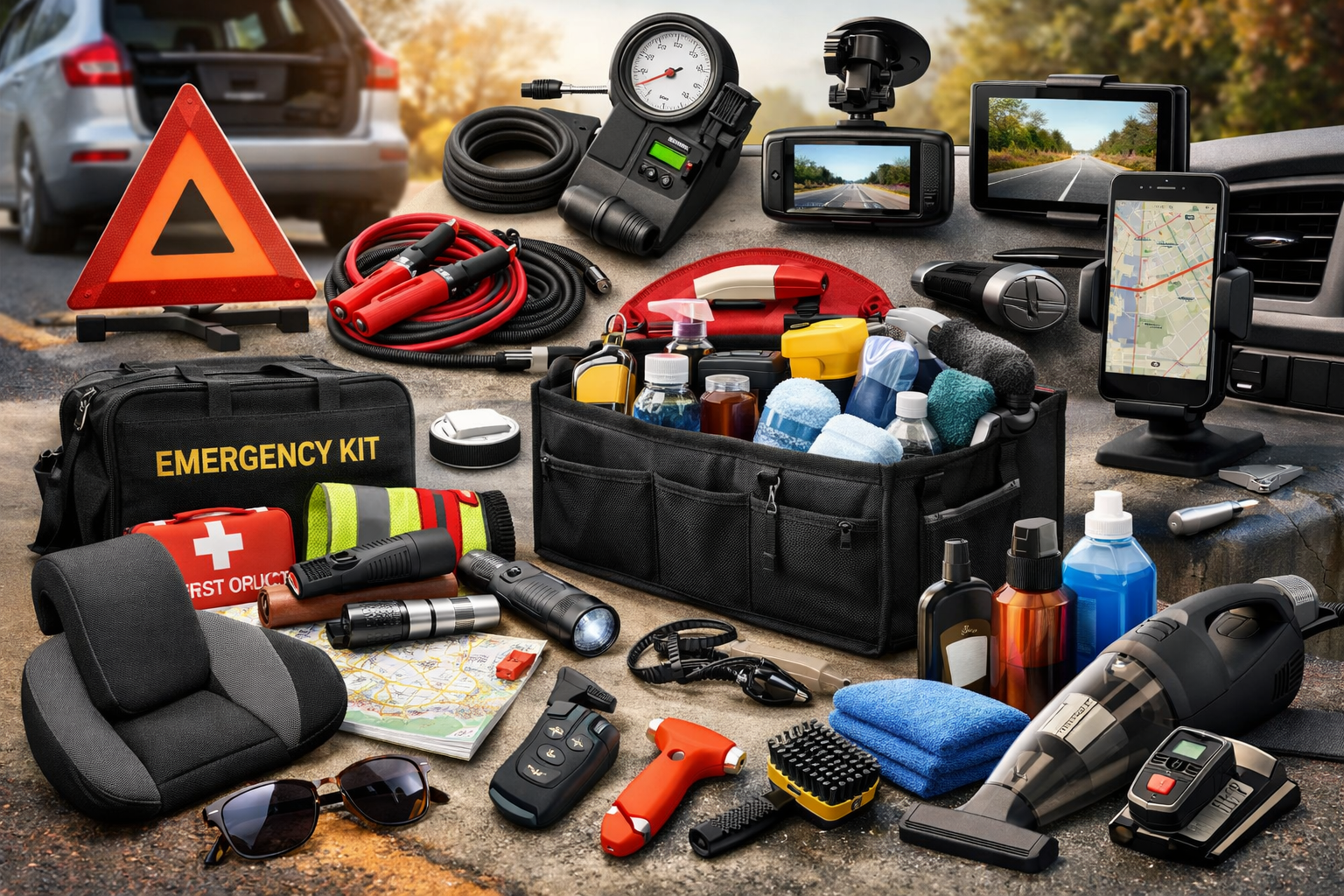
After several cars and a lot of ordinary driving, I have a fairly clear sense of which automobile essentials earn a permanent spot in a vehicle and which get bought with good intentions and then rattle around in a door pocket for three years. This is the real list. It is organised by what each thing actually solves rather than by category for its own sake, and it includes the winter box, which in this part of the world is not optional. It also includes a short section at the end on what did not work out, because a list of only successes is not much use to anyone deciding what to spend money on.

⭐ Comfort on an Ordinary Tuesday
Most driving is not a road trip. It is the same twenty five minutes twice a day, and that is where comfort actually matters, because it is where the hours accumulate.
A seat cushion makes a real difference on a longer commute, in the way that is hard to notice until you take it out again. A small lumbar pillow does something similar for posture, and it helps most in traffic rather than on a moving road, because sitting still is harder on a back than driving is.
A water bottle that lives in the car rather than one you remember to bring is the whole trick there. Same with a handful of snacks that do not melt. Nuts, a couple of bars, nothing that needs a cold pack.
None of this is exciting and all of it adds up across a normal week.
⭐ Getting Organised, Which Solved a Daily Annoyance
A disorganised car is a small constant irritation that is easy to underrate until it stops.
A boot organiser fixed something I had been quietly annoyed by for years, which was groceries and tools sliding across the back every time I braked. Once things had an assigned place the problem simply ended, and it cost under twenty dollars.
A small pouch for cables, sunglasses and the rest keeps the console from becoming the place everything without a home ends up. Seat back pockets do the same for the rear, and matter more with passengers in the back regularly.
A phone mount belongs in this section rather than in a technology one, because it is an organisation item that happens to be a safety item. A phone at eye level is a different thing from a phone in your lap, and the difference is where your eyes are when something changes ahead of you.
⭐ Where the Documents Live
This one sounds trivial and is not.
Insurance, registration and roadside assistance details go in one pouch in the glovebox, and the pouch does not move. The reason is not tidiness. It is that the moment you need those documents is never a calm one, and hunting through a glovebox at the side of a road with someone waiting is a bad time to discover the registration expired in March.
Photograph them as well and keep the photos somewhere you can reach offline. Two minutes, once.
⭐ The Winter Box
Weather here turns an ordinary drive into a complicated one with very little warning, so a few things go in around November and come out in April.
A proper scraper and a snow brush are not negotiable. The cheap ones snap in the cold, usually on the morning you most need them, and the difference in price is about eight dollars.
Gloves in the console rather than in the house, because the ones in the house are never with you when you are clearing a windscreen. A blanket in the boot, which you will almost certainly never use and will be extremely glad of once. A small folding shovel if you park anywhere that drifts.
An umbrella and a packable rain shell cover the other three seasons, mostly for the walk between the car and wherever you are going.
The winter set of tyres matters more than everything in this section put together, which our guide to running two full sets on alloy rims goes through properly.
⭐ Keeping the Inside Liveable
Most of what makes a car feel neglected is accumulated small rubbish rather than anything deeper.
A small bin hanging off a seat back or the console prevents the slow build up of wrappers and receipts that otherwise happens in every car I have owned without exception. It is a five dollar fix for a problem that takes an hour to undo once it has run for six months.
A microfibre cloth in the door pocket handles the dashboard and the screen in a minute at a petrol stop. A portable vacuum changed how often the inside actually gets cleaned, mainly because it turned a special trip into five minutes on a Saturday.
Beyond that it becomes a proper job rather than upkeep, and the kit that actually stays in my cleaning box covers what is worth owning for that.
⭐The Things That Go Wrong, Briefly
Everyday preparedness and genuine emergency preparedness are two different lists, and trying to carry one list for both is how people end up with neither.
The everyday version is short. A pressure gauge, because the habit is worth more than the tool. A jump pack, kept charged, because a flat battery is the single most common way a normal day turns into a stressful one. A basic first aid kit for something minor.
Everything past that, warning triangles, a proper kit, a light, a window tool, belongs in a deliberate box rather than scattered through the car. That is its own subject and our roadside emergency kit covers it properly, including where each piece should physically live.
⭐ Where Each Thing Should Actually Live
This is the part nobody writes about and it is half of whether any of it works.
The rule I ended up with is simple. If you need it while driving, it goes within reach of the driver’s seat without unbuckling. If you need it when the car has stopped and something has gone wrong, it goes in the boot where you can get at it with the boot lid up in the rain.
So the glovebox holds documents, the cloth, a pen and the pressure gauge. The console holds the cable pouch, gloves in winter and the bin. The driver’s door pocket holds the scraper from November, because a scraper in the boot means opening the boot to clear the boot.
The boot holds the jump pack, the first aid kit, the blanket and the organiser with everything else in it. All of that in one place rather than spread across three compartments, because the thing you are looking for at the roadside is the thing you cannot find.
The one item that breaks the rule is the window tool, which belongs within reach of the driver and nowhere else, since its entire purpose is a situation where you cannot get out of the seat. A window breaker in the boot is a window breaker you do not own.
⭐ What Never Earned Its Place
Being honest about this is more useful than another list of recommendations.
Seat gap fillers. Bought them, fitted them, and they worked, and then they made the seat rails awkward to clean under and I took them out. Reasonable product, wrong for me.
A car safe. It sat empty for two years, because anything worth locking away is worth taking with you, and anything not worth taking with you did not need a safe.
Air fresheners of the hanging kind. They mask rather than fix, and the thing they were masking was a boot that needed cleaning out.
And a second phone charger, bought because the first one lived in the other car, which is a category of purchase I now recognise and resist. If you are starting from nothing, the honest order is a boot organiser, a phone mount, a pressure gauge, then the winter box in the autumn. Our beginner guide to maintenance covers what to add once the car itself needs attention.
⭐ Best Sellers
Top Products and Picks
Three that have stayed. Ratings and review counts were read from each listing on the day this was written, and they move.
The one that fixed a daily annoyance
HOTOR Collapsible Boot Organiser
Stops shopping and tools sliding across the boot on every corner, and folds flat when you need the space back. Around eighteen dollars, rated 4.5 from 953 reviews. Check the base is non slip, since the ones without it slide as a unit instead.
Check price on AmazonA safety item disguised as a convenience
Lamicall Magnetic Vent Car Mount
Keeps the phone at eye level rather than in a lap, which is where the actual safety difference sits. Around seventeen dollars, rated 4.5 from 16,086 reviews. Needs a magnetic case or a metal plate on the phone, which catches people out.
Check price on AmazonWorth trying if your commute is long
Memory Foam Wedge Seat Cushion
Helps on a long commute in the way you only notice by removing it. Around twenty three dollars. Rated 4.4, but from only 46 reviews, which is thin evidence and worth saying plainly rather than presenting as settled. Treat the rating as provisional.
Check price on Amazon⭐ Final Thoughts
Nothing that has actually held up in my cars is interesting. A cushion, a boot organiser, a pouch of documents, a scraper that does not snap. That is the list.
What they have in common is that each one removed a small recurring annoyance rather than adding a capability. That seems to be the pattern with anything that stays in a car for years. The things bought for a situation that might happen tend to get moved to the garage eventually. The things that fix something happening every week stay.
You do not need to do this all at once, and buying it all in one order is how half of it ends up unused. Pick whichever thing has irritated you most recently and fix that.
Then do the winter box in October, before you need it, rather than in the queue at a hardware shop on the first cold morning with everyone else.
⭐ Additional Resources
Transport Canada’s overview of road safety in Canada sets out the national picture on vehicle safety and driver behaviour, and is a neutral reference point rather than anyone’s product page.