
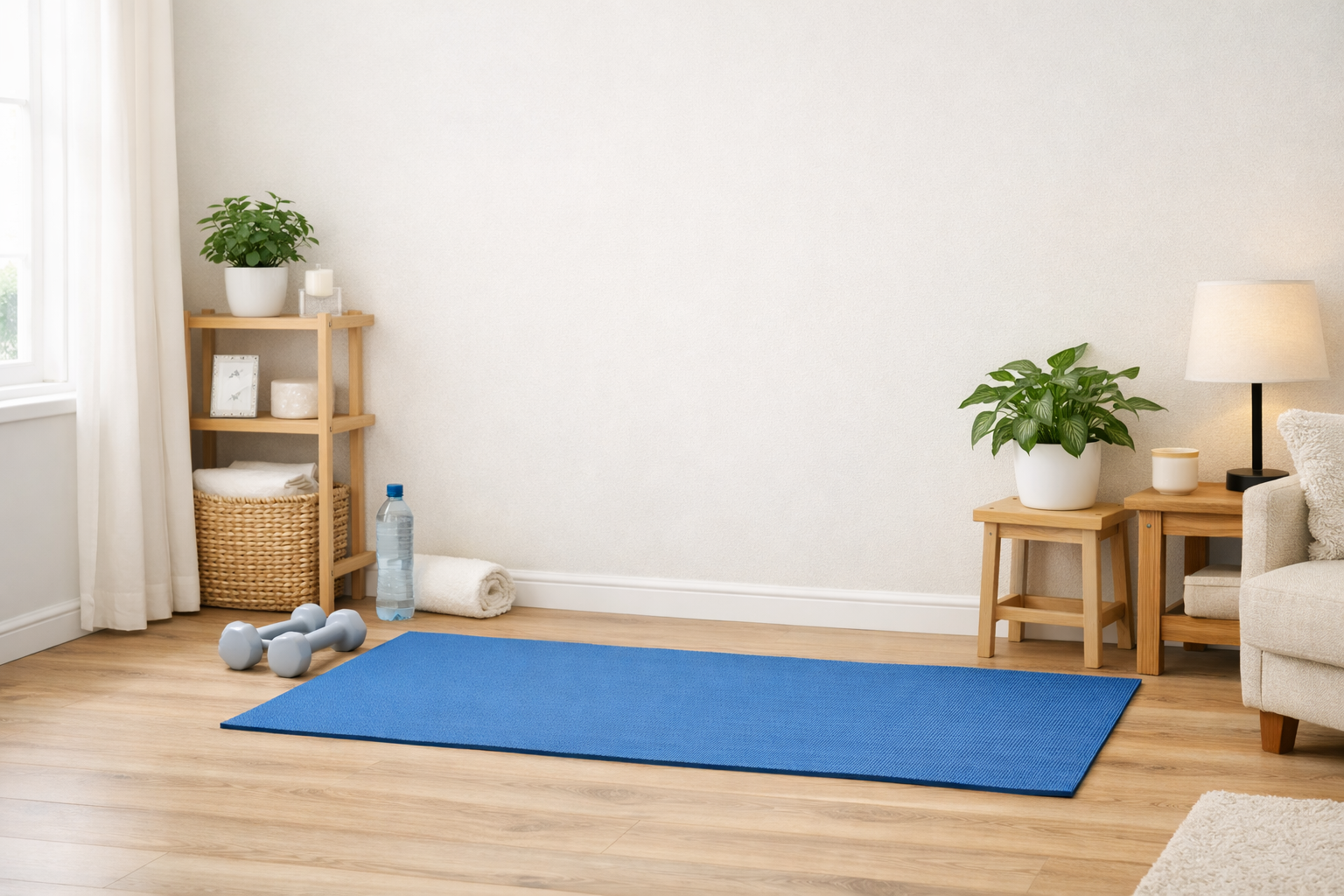
Home exercising in a small space
As an Amazon Associate I earn from qualifying purchases. Some links in this post go to Amazon and may earn me a small commission at no extra cost to you.
Last Updated on September 5, 2026 by Smarteryouu
⭐ Home exercising in a small space
Home exercising in a small space is less limiting than it sounds. Most beginner routines need about the area of a bath towel, and almost none of them need you to lie down.
The real constraints are usually different ones. A floor you cannot jump on. A room where somebody else is working. A rug you would rather not move every time. Those shape what works far more than square footage does.
So this page keeps to movements you can do standing up, in a hallway or beside a bed, without special equipment and without waking anyone below you.
Everything here is a starting point rather than a program. Do the easiest version, do it more often than feels impressive, and let the difficulty arrive on its own.

⭐ How Much Room You Actually Need
Stand up and stretch your arms out to the sides. If nothing is in the way, you have enough room for everything on this page.
For most adults that is a strip roughly two feet by six feet, which is the space beside a bed, the end of a hallway, or the gap between a sofa and a coffee table once the table has been nudged over.
Check the ceiling too, particularly in a basement or under a sloped roof. Raising your arms overhead is part of most warm ups, and finding out mid movement is an unwelcome surprise.
Then pick one spot and keep using it. A fixed place removes a small decision from every session, and small decisions are what quietly end routines. There is more on getting started generally in our home exercising section.
⭐ Movements That Work Standing Up
Standing work is the backbone of a small space routine, because it needs no floor clearance and nothing to get down onto or back up from.
Marching on the spot warms everything up and costs nothing. Lift the knee to hip height if you can, keep the shoulders relaxed, and let it be gentle for the first minute rather than brisk.
Standing knee raises take the same movement slower and add balance. Calf raises need about a foot of floor and quietly do a lot for ankles and lower legs. Side steps move the hips through a range that sitting takes away, and they need only about three feet of clear floor.
Add a hip hinge once those feel easy. Feet apart, hands on the front of your thighs, push the hips back and slide your hands down until you feel a stretch behind the legs, then stand up. That single movement is the basis of most lifting you do in ordinary life.
⭐ Let a Wall and a Chair Do the Work
The two most useful pieces of equipment in a small home are already there, and both make hard movements accessible rather than making easy ones harder.
Wall push ups are a full push up with the angle changed. Hands on the wall at shoulder height, feet a step back, lower the chest toward the wall and press away. Walking your feet further back makes it harder, so one movement covers months of progress. A kitchen counter sits neatly between the wall and the floor when you are ready.
A chair turns squats into something anyone can do. Stand in front of it, sit down slowly under control, stand back up. Touching the seat and rising again teaches depth and gives you a way to stop safely if your legs tire.
A chair back also steadies you for balance work, which matters if standing on one leg is not yet comfortable. Hold it lightly with one hand, not gripped, and let go for a second or two at a time as you improve.
⭐ Keeping It Quiet When Someone Lives Below
This is the constraint nobody writes about, and it is the reason plenty of apartment workouts get abandoned after the first conversation with a neighbor.
The rule is simple. Nothing that lands. Step instead of hop, march instead of run on the spot, and swap jumping jacks for the same movement done as a step out to one side and back.
A thicker mat helps more than a thin one, since it absorbs the footfall rather than just cushioning your knees. Training on a solid floor rather than a suspended one helps too, which usually means a hallway or a spot near a load bearing wall.
Time of day is worth a thought as well. The same session at seven in the morning and nine in the evening are received very differently by the person underneath you.
⭐ A Short Routine You Can Repeat
Start with a minute of marching on the spot, some slow shoulder rolls, and a few easy hip hinges. The point of a warm up is to raise your temperature slightly and remind the joints what is coming, not to tire you out.
Then work through four movements. Ten wall push ups, ten chair squats, ten standing knee raises on each side, and ten side steps in each direction. Move slowly enough that you could stop cleanly at any point.
Rest for a minute and repeat the four if you have the time and the energy. Two rounds is a genuine session. One round on a bad day still counts, and counts for more than skipping it.
Finish with a slow stretch for the front of the thighs, the back of the legs and the shoulders, held long enough to breathe out twice in each position. For a morning version of the same idea, see our post on simple exercises you can do every morning.
⭐ How to Make It Harder Without More Space
Small rooms stop you adding movements, not adding difficulty. There are four ways to progress and none of them needs another square foot.
Slow the movement down. A squat taken over four seconds down and two seconds up is considerably harder than the same squat rushed, and it is easier on the joints rather than harder.
Pause at the difficult point. Two seconds at the bottom of a squat or with your chest close to the wall removes the bounce that was doing part of the work for you.
Take the support away gradually, and use one leg where you used two. A wall push up with feet further back, a chair squat that only hovers over the seat, a single leg calf raise. Each is the same movement asking a little more, and none of them changes the space you need.
⭐ When Something Does Not Feel Right
Muscles that feel worked the next day are normal, particularly in the first couple of weeks, and it usually settles as the movements become familiar.
A sharp or sudden sensation during a movement is different. Stop that movement, use the easier version, and see how it feels next time rather than pushing through to finish the set.
Range of motion is the usual culprit for beginners. Squatting deeper than is comfortable, or pushing a stretch until it stings, tends to cause more trouble than the weight of your own body ever will.
If anything persists or you are working around an existing condition, that is a conversation for a qualified professional rather than a page like this one.
⭐ Making the Corner Easy to Use
Whether you keep going has less to do with motivation than with how many steps sit between deciding and starting.
Leave the mat out if you possibly can. A rolled mat in a closet adds two steps at each end of every session, and those four steps are enough to lose a routine on a tired evening.
Keep the corner clear of everything else. The moment it becomes the place laundry lands, it stops being the place you train, and reclaiming it takes more effort than keeping it did.
If you do decide to add a few pieces later, our guides to equipment for a small space and a minimalist setup cover what is worth the floor space.
⭐ Best Sellers
Top Products and Picks
Four items cover most of what this guide describes, and all are easy to find on Amazon.
- A thicker exercise mat, around half an inch, which is kinder to knees than a thin yoga mat and quieter for anyone living below.
- A set of light resistance bands, which add difficulty to standing movements without adding anything to store.
- A set of interlocking foam floor tiles, for anyone training over a suspended floor who wants a permanent quiet patch rather than a mat to roll out.
- A simple interval timer that sits on a shelf, so a session runs on its own rather than through your phone, which tends to become a different activity entirely.
⭐ Final Thoughts
A small home is not the obstacle it gets treated as. Almost everything a beginner needs happens within arm’s reach of where you are standing, and the rest can wait until it is missed.
What tends to stop people is not the size of the room. It is the sense that a session has to look like something, and that ten quiet minutes beside the bed does not count.
It counts. Repeated through a normal week, in the gaps that already exist, it adds up to far more than the ambitious plan that needed a spare room and never started.
Clear a strip of floor this evening, do one round of four movements, and leave the mat where it is. That is the whole beginning.