
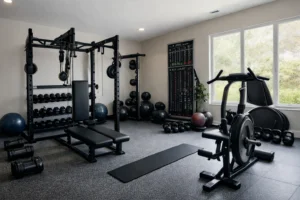
Build a Home Gym, Setting Up the Room Before You Buy Anything
As an Amazon Associate I earn from qualifying purchases. Some links in this post go to Amazon and may earn me a small commission at no extra cost to you.
Last Updated on October 3, 2026 by Smarteryouu
⭐ Build a Home Gym, Setting Up the Room Before You Buy Anything
Almost everyone who sets out to build a home gym starts with a shopping list, and that is the wrong end of the problem. The equipment is the easy part and it is available tomorrow. The room is what decides whether any of it gets used, and the room cannot be returned. I have been exercising at home for over a decade, and the two large pieces of equipment I own sit where they do because of the floor and the ceiling rather than because I planned it that way. This page is about the space itself. What the floor has to take, how much height you need above your head, where the noise goes, and which room in the house quietly makes the whole thing fail. None of it costs anything to check.

⭐ What Should You Check Before Buying Any Equipment?
Check four things. The floor and what it will take, the ceiling height with your arms above your head, whether noise will carry to anyone else in the building, and whether the room is somewhere you naturally pass. All four are free to check and all four are expensive to get wrong.
The order matters. Every one of those can rule out a piece of equipment entirely, and finding out after delivery is how people end up with a treadmill in a hallway or a pull up bar they cannot hang from.
Go and stand in the room now. Reach up, reach out sideways, and lie down on the floor. If all three feel cramped, that is useful information before you spend anything rather than after.
Once the room is settled, the buying gets much simpler. Our guide to equipment for a small space covers what to buy and in what order, once you know what the room will actually hold.
⭐ How Much Space Does a Home Gym Actually Need?
For bodyweight work you need about two metres by one and a half, which is a mat plus room to extend your arms. A bench and dumbbells push that to around two and a half by two. Larger frames need their own footprint plus clear space to move in front of them.
That is far less than most people picture. A corner of a living room covers the first case entirely, and the idea that you need a spare room is the single most common reason people never start.
Measure the clear floor rather than the room. A four metre bedroom with a bed and a wardrobe in it might offer less usable space than a corner of a lounge, and it is the clear rectangle that matters.
Leave room to walk past whatever you install. A frame that blocks a doorway or forces you to squeeze around it every day becomes resented within a month, however much you paid for it.
⭐ The Floor, and What It Has to Take
Hard floors are better than carpet for almost everything. Carpet feels kinder underfoot and it makes tall equipment rock slightly on every repetition, which is unpleasant and genuinely less stable.
Interlocking foam tiles are the usual answer for a whole corner. They cost very little, they go down in an afternoon, and they protect a wooden floor from both dropped weights and the feet of a frame.
A thicker rubber mat is better underneath one heavy item. Foam tiles compress under a concentrated load, so a frame or a treadmill wants something denser than the surrounding floor.
Upstairs rooms deserve a thought about load. A person plus a frame plus dumbbells sits comfortably inside what a normal floor takes, but placing heavy things near a wall rather than in the middle of a span is a sensible habit, and dropping weights on a suspended floor is worth avoiding entirely.
⭐ Ceiling Height, the Thing People Check Last
Stand where the equipment will go, reach both arms overhead, and see what your hands are near. That single check rules out more purchases than floor space ever does, and almost nobody does it before ordering.
Skipping needs roughly half a metre above your head. Pressing dumbbells overhead needs a similar clearance while standing. A pull up frame needs enough room above the bar for your head plus a little more.
Light fittings are the usual casualty. A pendant light in the middle of a room takes the best part of it out of use, and moving to a flush ceiling fitting is a small job that solves the problem permanently.
Most tall frames stand somewhere around two point two metres, so check that against your ceiling before ordering rather than after. There is more on this in our guide to using a power tower, which is the piece of equipment this catches out most often.
⭐ Will a Home Gym Be Too Noisy for the Rest of the House?
It depends almost entirely on whether anyone is below you. Impact noise travels downward through a floor far more than it travels sideways through a wall, so a ground floor room on a solid base can take almost anything, while an upstairs room above a bedroom cannot.
The loud things are skipping, jumping, dropping weights, and stepping off a bar rather than lowering yourself. Everything else is quieter than a washing machine.
A thick mat under the working area absorbs a surprising amount of it. Beyond that, choosing quiet movements matters more than any material. A walking pad, resistance bands and slow strength work make almost no noise at all.
Think about timing too. A six in the morning session in a flat is a different proposition to the same session at seven in the evening, and picking the hour thoughtfully avoids most of the problem without changing anything else.
⭐ Light, Air and Why the Garage Often Fails
The garage looks like the obvious answer and it is where most home gyms go to die. It is cold in winter, it is often damp, the light is usually poor, and it is outside the part of the house you actually live in.
Cold is the main problem. A room you have to warm up before you can use it adds a step, and any step that stands between you and starting will eventually win.
Damp is the second. Metal frames and rubber coated weights do not enjoy an unheated garage over a winter, and neither does a mat left on a cold concrete floor.
If the garage is genuinely the only option, spend the money on light and heat before equipment. A bright light and a small heater cost less than a set of dumbbells and make far more difference to whether the room gets used.
⭐ Where in the House Should It Actually Go?
Put it somewhere you already walk past several times a day. A corner of a living room or bedroom beats a spare room at the end of a hallway, because passing the equipment is what reminds you it exists. Out of sight is the surest way to stop using something.
This is the one piece of advice here that people resist, because a dedicated room feels more serious. In practice a dedicated room a floor away gets used considerably less than a mat you step over on the way to the kitchen.
Think about who else uses the room. A frame in a shared living room needs to look acceptable when nobody is training, which is a real consideration rather than a vain one.
Set it up and leave it set up. Anything that has to be assembled or fetched gets used less, and our storage and organisation ideas cover keeping it tidy without putting it away.
⭐ Power, Storage and the Small Practical Details
Check where the sockets are before you decide the layout. A treadmill or a walking pad needs one within reach, and a trailing extension lead across a training area is genuinely worth avoiding.
Give the small things a home from the start. A basket in the corner for bands, a rope and a timer keeps them visible, and visible equipment is used equipment.
Air matters more than people expect once you are working hard. An openable window, or a small fan in a room without one, changes how a summer session feels considerably.
Finally, do not finish the room before you start using it. Train in the space for a month with almost nothing in it, and you will know exactly what it needs. Our post on home exercises that actually work is a routine that needs a corner and very little else.
⭐ Best Sellers
Top Products and Picks
These four are for the room rather than the workout, which is where most people underspend. All are easy to find on Amazon.
- Interlocking foam floor tiles. The first thing to buy for a hard or cold floor, and cheaper than almost any equipment. They lay in an afternoon and protect the floor from both dropped weights and equipment feet.
- A thick rubber equipment mat. For underneath one heavy item, since foam tiles compress under a concentrated load. Essential on carpet and worth it above a room someone uses.
- A clip on or floor standing fan. For any room without an openable window, and for summer generally. It costs less than a pair of dumbbells and changes how a session feels far more.
- A storage basket or small shelf unit. So bands, ropes and timers live where you train rather than in a cupboard. Anything you have to fetch gets used less.
⭐ Final Thoughts
The room decides more than the equipment does. A corner with good light, a hard floor and enough height above your head will support years of training with almost nothing in it.
Every check on this page is free. Standing in the space and reaching upward takes ten seconds and will save you from at least one purchase you would have regretted.
Choose the room you walk past rather than the room that sounds impressive. That single decision predicts whether a home gym gets used better than anything you put in it.
Go and stand in the space tonight, reach up, and lie down on the floor. Then buy the flooring, and let the equipment wait until you have trained there a few times. There is more across home exercising and the rest of Smart Living Essentials.
⭐ Additional Resources
For how much activity is generally recommended by age group, the World Health Organization publishes a fact sheet on physical activity that gives the numbers without prescribing a program.
The Canadian Society for Exercise Physiology takes a wider view across the whole day in its 24 hour movement guidelines, which cover activity alongside sitting time and sleep for each age group.