
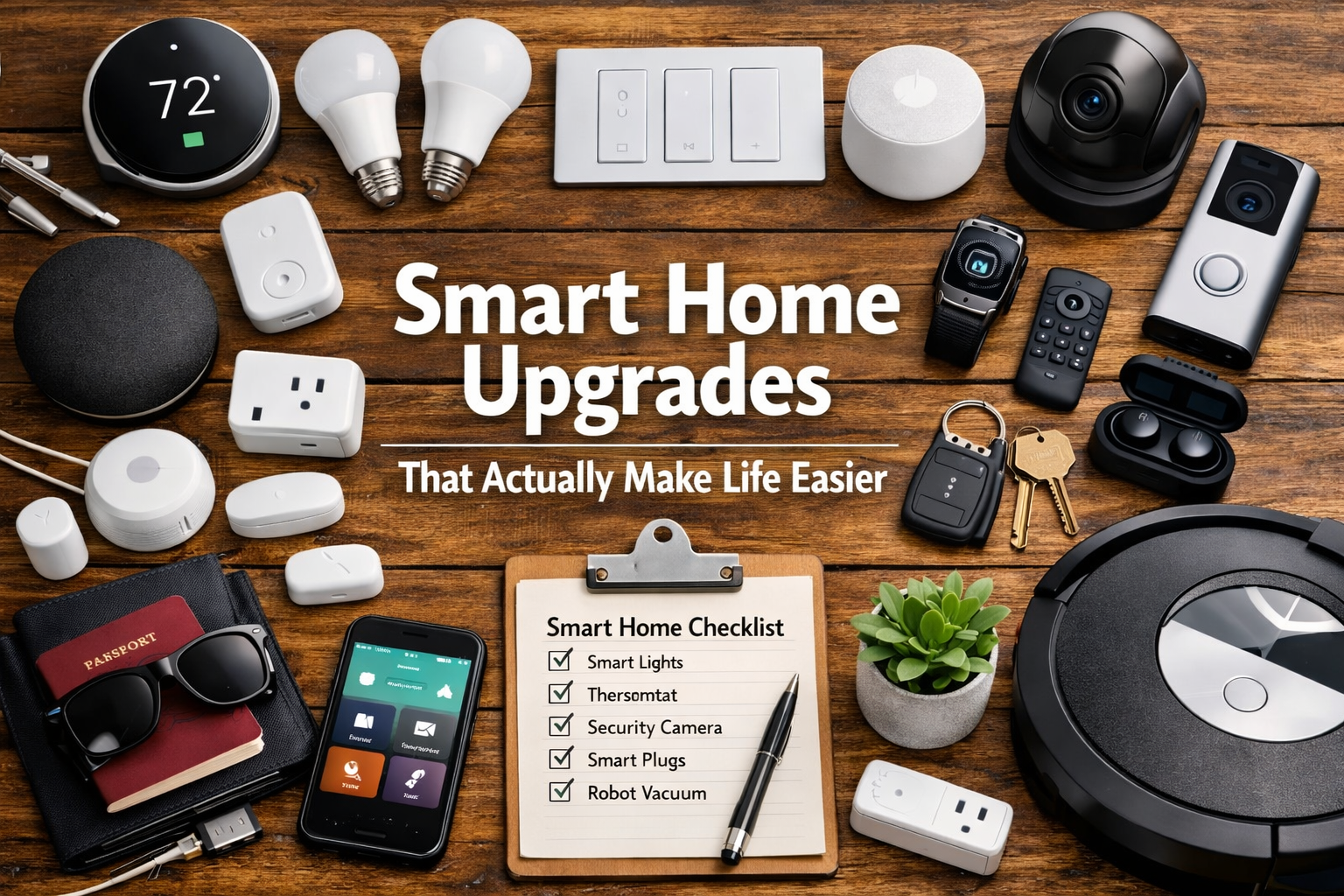
Smart Home Upgrades: What Actually Earned Its Place and What Got Unplugged
As an Amazon Associate I earn from qualifying purchases. Some links in this post go to Amazon and may earn me a small commission at no extra cost to you.
Last Updated on September 11, 2026 by Smarteryouu
⭐ Smart Home Upgrades: What Actually Earned Its Place and What Got Unplugged
The interesting question about smart home upgrades is not which ones are good. Almost all of them work as advertised. The interesting question is which ones you are still using in year three, because that number is much smaller than anybody expects and it is not the list you would have predicted on the day you bought them. This house has had a fair few things pass through it. Some are still running and have become invisible, which is the highest compliment a device in this category can earn. Others were used enthusiastically for about six weeks and then quietly stopped being used, and one or two came off the wall entirely. What follows is that audit, plus the single test that turns out to predict the outcome before you spend anything.

⭐ What Makes a Device Stick?
It works without anybody deciding anything. That is the whole test. A device that runs on a schedule or a trigger becomes part of the house within a month, and a device that needs a person to open an app, say a phrase or press something gets used for a fortnight and then forgotten.
This is worth applying in the shop, because it sorts the category more reliably than any specification. Ask what has to happen for this thing to be useful. If the answer includes the word remember, it will not last.
It also explains why the cheap items outlive the expensive ones here. A plug on a timer asks nothing of you. A device with an impressive feature set usually asks quite a lot, and household attention is the resource that runs out first.
⭐ The Four Still Running Years Later
Lights on a schedule are the first, and they are the least impressive thing in the house. Lamps come on before dusk and go off at bedtime, and the result is that nobody has walked into a dark house in years. Nobody has ever commented on it, which is the point.
The robot vacuum is the second, and it is the one I would replace fastest. It removed a recurring job rather than making one easier, and it runs whether or not anybody is home. The robot vacuum guide covers what actually matters when choosing one.
Cameras are the third and they earn their place in an unusual way, which is that you barely interact with them and are glad they exist. Mine record continuously and I look at the footage perhaps twice a year, which is exactly the right amount.
Water leak sensors are the fourth and they are the cheapest thing on this list by a distance. They sit under the sinks and behind the washing machine doing nothing at all, which is what you want, and they are the only device in this category with a genuinely large downside if you skip them.
⭐ What Got Quietly Unplugged
Nothing dramatic failed. Things simply stopped being part of the routine, which is how this always goes.
Color changing lighting was the first casualty. It is genuinely fun and after a few weeks every household I know settles on one warm setting and never touches the colors again. That is not a criticism of the product, it is a reason to buy the cheaper version.
Elaborate scenes were the second. A routine that dims three lights, sets a temperature and starts music sounds wonderful and requires somebody to remember its name. Nobody does. The routines that survived here are the ones triggered by time or by the last phone leaving the house.
The other thing that ends a device is the manufacturer rather than the hardware. A small brand stops updating its app, the app eventually stops working on a newer phone, and a device that is physically perfect becomes a paperweight. That has happened here twice and it is the strongest argument for buying from companies likely to still exist in five years, even at a small premium.
And anything requiring its own app went last. Devices from four brands work in a rough sense and mean four apps, and four apps is how a household gives up on the whole idea. The guide to automations that actually save time covers which ones survive contact with real life.
⭐ Why Voice Control Fades
Voice is the feature that sells the category and it is not the feature that keeps it. Almost everybody uses it constantly for a month and then settles into a much narrower set of uses, usually timers, music and turning off the lights from bed.
The reason is that speaking a command is slower than a switch for anything you are standing next to, and it fails in front of other people, which nobody enjoys. It is genuinely excellent when your hands are full or you are in another room, and that is a smaller share of the day than the advertising implies.
That is not a reason to skip a speaker. It is a reason to buy the cheap one first, find out how your household actually behaves, and only then decide whether a better one is worth it. The buying order guide puts it at stage three for exactly that reason.
⭐ Is a Video Doorbell Worth It?
Yes, and for reasons that have almost nothing to do with security. It earns its place through deliveries, visitors and being able to answer the door from wherever you are, which happens several times a week in most households.
That is worth knowing because it changes what you should buy. If the goal is knowing what happens at your front door, one doorbell does nearly all of it and the rest of the catalogue is optional. Households that buy a four camera kit on day one usually end up with two cameras pointed at nothing.
The caveat is the ongoing cost and the battery routine, both of which are easy to miss at the point of purchase. My honest account of living with a wireless system covers both.
⭐ The Ones That Depend Entirely on Your House
Some devices are neither winners nor disappointments. They are simply right for some households and pointless in others, and the marketing never says which is which.
A smart thermostat is the clearest case. If your household leaves the house on a predictable pattern, it pays for itself. If somebody is home all day, most of the saving disappears and you have bought a nicer looking dial.
Smart locks are the same. Genuinely useful if people need letting in when you are not there, and solving nothing if that never happens. And a robot vacuum depends entirely on whether your floors are clear enough for one to work, which is a fact about your house rather than about the machine.
⭐ How Do You Decide Before Buying?
Describe the moment it will be useful, out loud, in one sentence. If you can say exactly when it helps and how often that moment happens, buy it. If the sentence comes out vague, you are buying a category rather than a solution and it will end up unused.
The second question is what happens when it fails, because everything fails eventually. A device whose failure leaves you with a normal light or a normal door is a safe purchase. A device whose failure locks you out of something is a decision rather than a gadget.
And buy one thing at a time. Almost every regret in this house came from an enthusiastic afternoon rather than from a bad product, and the sequence that avoids that is in the smart home section.
⭐ Best Sellers
Top Products and Picks
- A pack of water leak sensors, the item on this page with the best ratio of cost to consequence. Buy these before any camera, since they are the only devices here that prevent an expensive problem rather than record one.
- A smart plug multipack, which is what the surviving lighting schedules actually run on. Cheap, invisible once set up, and the thing most likely to still be in use in five years.
- A plain warm white smart bulb set rather than color changing, for anyone furnishing a room now. Color is fun for a month and almost every household settles on one warm setting.
- An entry level smart speaker, worth buying cheap first. It tells you how much your household really uses voice before you spend anything on sound quality.
⭐ Final Thoughts
What this audit really shows is that the good version of a connected house is unremarkable. Lights that follow the day, floors that get cleaned, cameras nobody looks at, and a couple of sensors doing nothing under a sink.
None of that is what gets photographed, and none of it is what the boxes advertise. The impressive version, with scenes and voice commands and a panel on the wall, is the version that quietly stops being used, because it asked for attention every day and eventually did not get it.
So the question worth asking before every purchase is not whether the device is good. It is whether you will still be thinking about it in six months, and the honest answer is usually that you would rather not have to.