
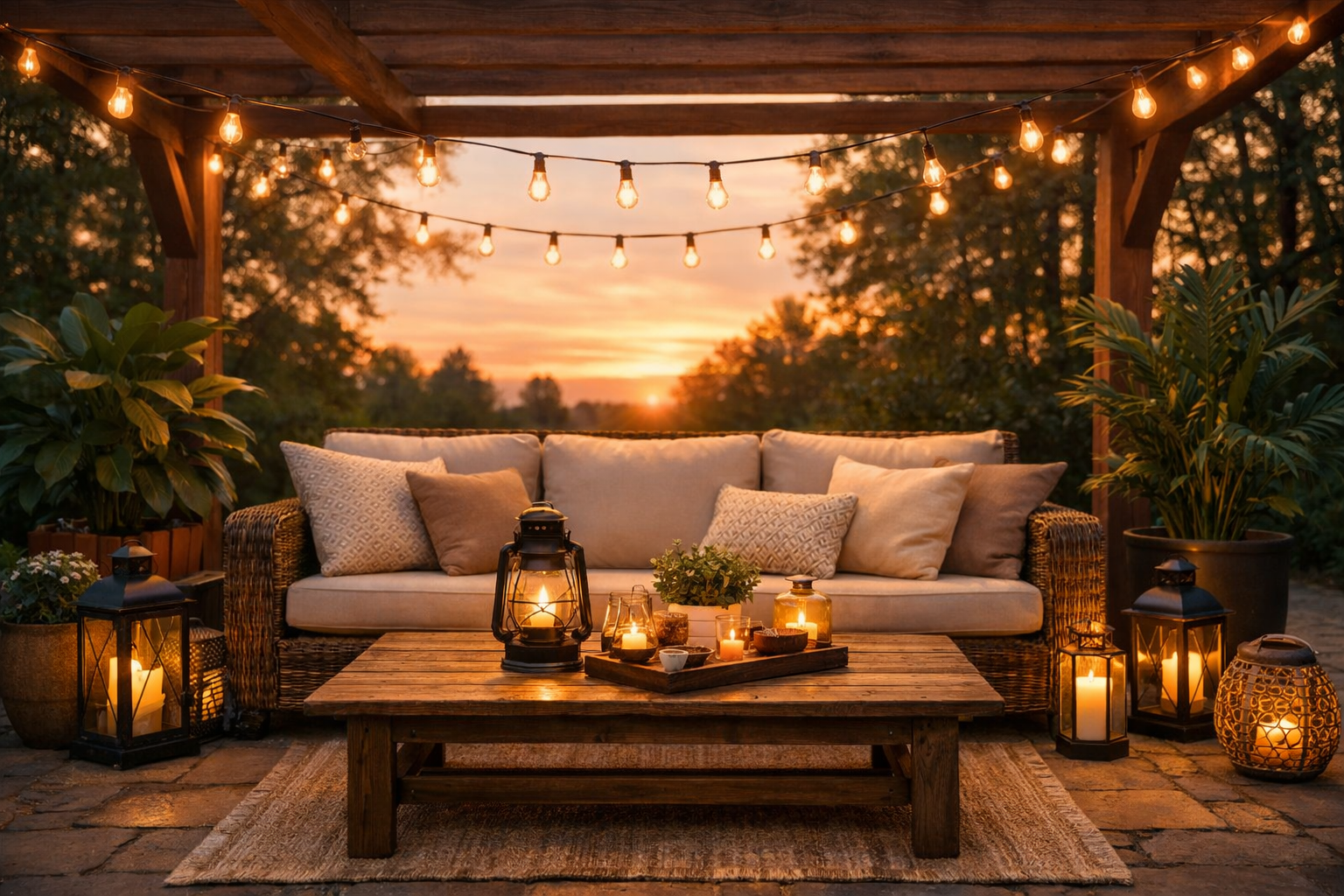
Patio Decor Ideas: How to Style an Outdoor Space So It Looks Finished
As an Amazon Associate I earn from qualifying purchases. Some links in this post go to Amazon and may earn me a small commission at no extra cost to you.
Last Updated on September 6, 2026 by Smarteryouu
⭐ Patio Decor Ideas: How to Style an Outdoor Space So It Looks Finished
There is a specific point where an outdoor space stops looking like furniture sitting on concrete and starts looking like somewhere that was meant to be there. Most patio decor ideas skip straight past what causes that, and talk about individual objects instead. The change almost never comes from one thing. It comes from three arriving together, and none of them is another chair. Something soft underfoot to define where the seating area actually is. Something living at more than one height, so the greenery reads as planting rather than as a row of pots. And warm light low down, so the evening version of the space looks as considered as the afternoon one. Everything else is detail on top of those three. The useful part is that all three are cheap compared with furniture, which means this is the stage of a patio where a small amount of money makes the most visible difference.

⭐ What Makes an Outdoor Space Look Finished?
A rug or something soft under the seating, greenery at three different heights, and warm light below eye level. Those three together are what separate a styled space from a furnished one. Adding more furniture almost never has the same effect, and often has the opposite one.
The reason they work together rather than separately is that each one solves a different problem. The rug tells you where the room is. The planting gives the eye something to travel up. The light makes the space exist after dark. Any one of them alone is an improvement. All three at once is a transformation, and people usually cannot say why.
None of this depends on having good furniture first. A plain set with all three of these around it looks considered. An expensive set with none of them looks like a delivery that has not been unpacked properly.
⭐ Start With the Floor, It Does the Most Work
An outdoor rug is the highest return item in this whole post, and it is the one people leave until last because it seems like a finishing touch rather than a structural decision.
What it actually does is draw a boundary. Slab or decking runs to the edges of a yard with nothing to say where the sitting area stops, and the eye reads that as furniture placed on ground. A rug creates a floor, and a floor implies a room. That is why the same chairs look better the moment one arrives.
Size is where it goes wrong. Almost everybody buys too small, and a rug that floats in the middle with all the furniture standing off it looks like a bath mat. The rule that works outside is the same one that works indoors. The front legs of every seat should sit on it. If that means going a size up, go a size up, because a slightly too large rug still looks right and a small one never does.
Flatweave in a synthetic fiber is the practical choice. It dries quickly, it can be hosed down, and it does not hold damp against the slab the way a thick pile one will. A great deal of this thinking comes straight from indoors, and the home decor section covers rug sizing in more depth if you want the principle behind it.
⭐ Greenery Works at Three Heights, Not One
The most common planting mistake outdoors is a row of pots along the edge of the patio, all roughly the same size, all sitting on the ground. It is a lot of effort and it reads as decoration rather than as a garden.
The fix costs nothing extra. Take the same number of plants and put them at three levels. Something at ground level, ideally one large pot rather than several small ones. Something at table height, on a stool, a plant stand or the wall. And something above head height, hanging or climbing. Suddenly the eye has to travel, and travel is what makes a space feel layered.
Fewer, bigger pots also beat many small ones. Three generous containers look established. Nine little ones look like a shelf at a garden center, and they dry out faster, which means more watering for a worse result.
One evergreen structural plant is worth including even if everything else is seasonal, because it keeps the space from looking abandoned between November and April. What actually survives in a container without much attention is covered in the outdoor garden section.
⭐ How Do You Zone a Patio Properly?
Give the space two clear jobs and mark them with the floor and the seating direction rather than with dividers. One area to eat, one to sit and do nothing. Even a small slab reads better as two small defined zones than as one ring of chairs around an empty middle.
The ring of chairs is the layout everybody falls into and it is the one that makes a patio feel like a waiting area. Furniture pushed to the boundary leaves a hole in the center that nothing ever fills, and puts people slightly too far apart to talk without raising their voices.
Zoning does not need screens or structures. A rug under the lounge chairs and bare ground under the table is enough. Chairs angled towards each other rather than all facing out is enough. What you are doing is giving the eye a reason to read two areas, and it takes remarkably little.
Then leave a walking route between them. The single most useful test is to carry a tray from the kitchen door to the far seat. If you have to turn sideways anywhere, something needs to move.
⭐ Warm Light Low Down Beats Bright Light Overhead
Lighting is the part of styling that changes the most for the least money, and it goes wrong in exactly two ways every time. The light is too cold, or it is too high.
Cold white light makes any outdoor space look like a parking area, no matter how nice the furniture is. Warm light does the opposite, and the difference costs nothing at the point of purchase, since a warm bulb and a cold one sit on the same shelf at the same price. It is purely a matter of checking before you buy.
Height is the other half. Light coming down from above is functional and slightly unforgiving, which is right for a driveway and wrong for a patio. Light at or below seated eye level is what makes a space feel calm. A lantern on the floor, a candle on the table and one run of string lights overhead will beat any single bright fixture.
Solar is fine for gentle background sparkle in midsummer and disappointing by late autumn, when the days are too short to charge it. Anything you actually need to see by is better plugged in. Where lighting sits in the order of buying is covered in the patio essentials guide.
⭐ Texture Does More Than Color Outdoors
Indoors, color carries a scheme. Outdoors it competes with grass, sky, brick and whatever is flowering, and it usually loses. Texture is what actually reads.
That is why a space with wood, woven fiber, stone, canvas and foliage in it looks rich even when everything is broadly the same color. Five different neutral surfaces with genuinely different surfaces beats five colors of the same smooth plastic every time.
Where color does help is in small repeated doses. One accent picked up in two or three places, on a cushion, a planter and a lantern, ties a space together. The same accent used on everything turns into a theme, and themes are what make an outdoor space look staged.
It is also worth resisting the fully matched set. A space where every piece came from the same box reads as a package. Two or three related but different pieces read as somewhere that developed over time, and the guide to patio furniture trends covers how to mix without it looking accidental.
⭐ What Is Worth Changing With the Seasons?
Only the soft things. Cushion covers, throws, one or two planters and the lighting. Everything structural stays put all year, and trying to restyle a patio properly every season is how people end up with three boxes of outdoor decor and a space they no longer enjoy.
The autumn change is the one that pays off most, because it is the moment a patio either keeps being used or quietly gets abandoned. A basket of blankets by the door and the lights switched on earlier in the evening will add several weeks of use, and both take about ten minutes.
Winter is worth a small amount of thought rather than none. A space that is completely stripped looks derelict from the kitchen window for four months. One evergreen container, the lights left up and the furniture covered neatly is enough to keep it looking cared for, and it makes spring much less of a project.
If the space is going unused for reasons that styling cannot fix, that is a different problem, and the guide to making a patio comfortable covers the sun, wind and insect side of it.
⭐ Best Sellers
Top Products and Picks
- A large flatweave outdoor rug, the first thing to buy if the space already has furniture but still looks unfinished. Size up rather than down, since the front legs of every seat need to sit on it.
- Weatherproof string lights with warm bulbs, worth buying before anything decorative. Check the bulb warmth rather than the style, because cold white is the single most common styling mistake outdoors.
- A set of plant stands at varied heights, for anyone who already owns pots but has them all sitting on the ground. This is the cheapest way to turn a row of containers into something that reads as planting.
- A set of outdoor cushion covers with zips, the right seasonal purchase if you want to change the look without changing the furniture. Zips matter, since covers that cannot be washed are what make a set look tired.
⭐ Final Thoughts
Styling an outdoor space is a lot more forgiving than styling a room, because nature does most of the difficult work. The light changes through the day on its own, things grow and fill gaps you were worrying about, and a slightly imperfect arrangement outdoors reads as relaxed rather than as a mistake.
So it is worth doing less than you think, and doing it slowly. Put the rug down and live with it for a fortnight. Add the plants and see which corner your eye keeps going to. Then add the light, and notice how differently the same space feels at nine in the evening.
The outdoor spaces that feel best are almost never the most decorated ones. They are the ones where a few good decisions were made early and then mostly left alone, so that everything in them has had a season or two to settle in and look like it belongs there.
⭐ Additional Resources
Since bulb warmth matters more than fixture style outdoors, the official guidance on certified light bulbs is a useful reference for reading what is on the box, including the numbers that tell you how warm or cold a bulb will look before you get it home.