
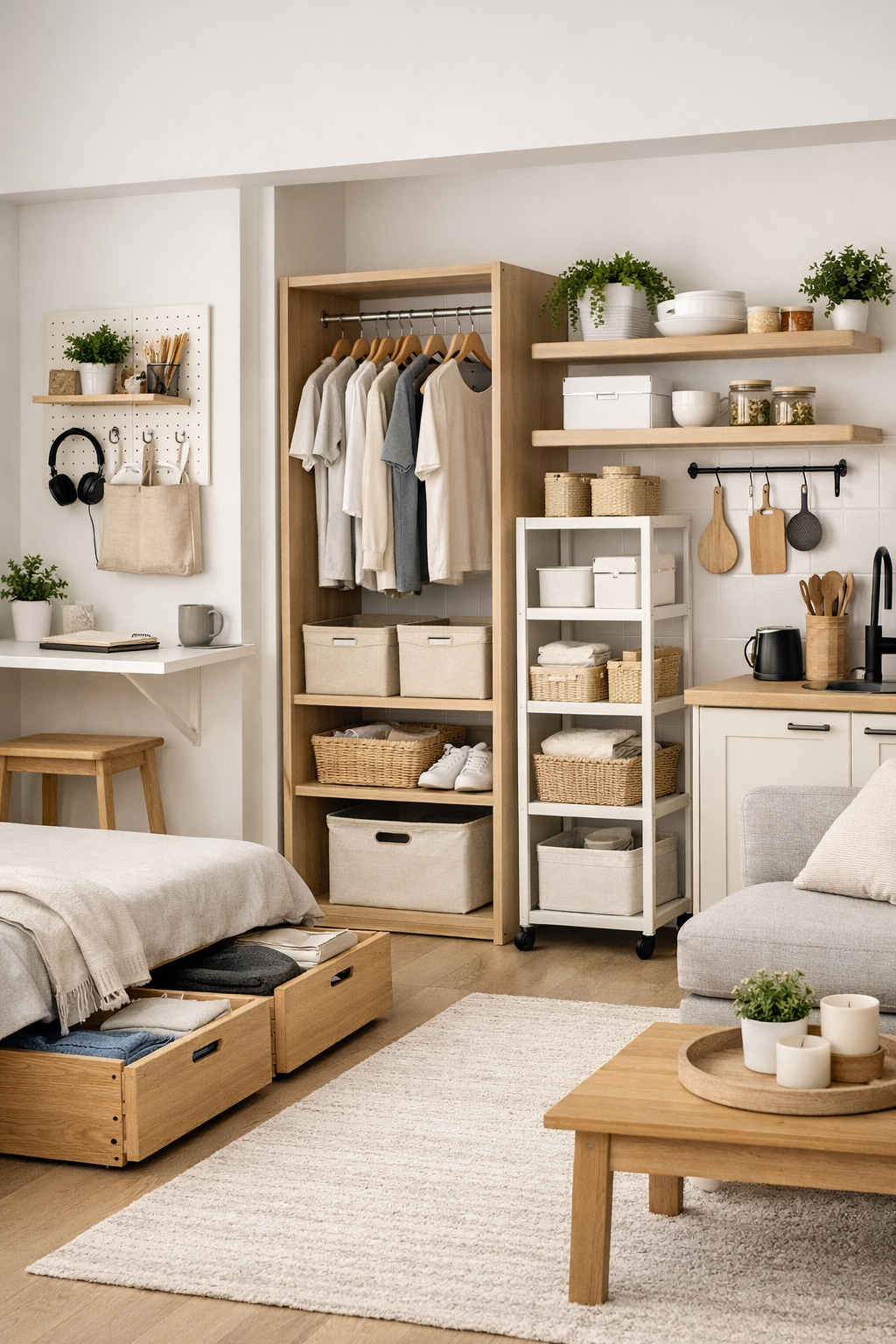
Small Space Storage: Smart Ideas to Organize Any Compact Home
As an Amazon Associate I earn from qualifying purchases. Some links in this post go to Amazon and may earn me a small commission at no extra cost to you.
Last Updated on September 5, 2026 by Smarteryouu
⭐ Small Space Storage: Smart Ideas to Organize Any Compact Home
Small space storage can completely change the way a home looks and feels. Compact homes can be cozy, calm, and surprisingly functional once you learn how to use every inch with intention. Whether you live in a condo, an apartment, or a small house, the right ideas help you stay organized, reduce clutter, and make rooms feel more open without expensive renovations.
The difficulty in a compact home is rarely a shortage of room. It is that the room you have is spread out in awkward places. A few inches above a door, the gap beside the fridge, the dead corner behind a chair. None of it looks like storage until you start treating it that way.
This beginner friendly guide walks through practical ways to open up each room, one at a time. Simple upgrades, clever placement, and a few habits that keep things tidy long after the organizing weekend is over.

⭐ Start by Reading the Room You Already Have
Before buying a single bin, walk through each room and look upward. Most compact homes are organized entirely between knee height and shoulder height, which leaves the top third of every wall completely unused. That band above eye level is where seasonal items, spare bedding, and rarely used equipment belong.
Then look at the gaps. The narrow slot beside a washing machine, the space under a staircase, the few inches between a sofa and the wall. A slim rolling cart or a shallow basket turns each of these into real capacity.
It also helps to notice where clutter naturally lands. If keys always end up on the kitchen counter, that is not a discipline problem. It is a sign that the storage is in the wrong place. Put a small dish or a hook where the habit already exists, and the mess resolves itself.
Three questions cover most decisions. Can this go higher, can this go on the back of a door, and does this need to live in this room at all. If you are still working out what belongs where before buying anything, the rest of our storage and organisation writing is a good place to begin.
⭐ Effective Entryway Storage Solutions
The entryway sets the tone for the whole home, and in a compact place it is usually the first surface to disappear under shoes, bags, and jackets. It is also the hardest working few square feet in the house, so whatever goes there needs to handle daily use.
A wall mounted hook rail is the single best starting point. Look for one with a solid back plate fixed at two or more points rather than individual hooks held by a single screw, since a wet winter coat and a bag will work a lone screw loose within a season.
A slim bench with a hollow base gives you a place to sit and a place to hide shoes at the same time. Check the tier height against the boots you actually own, because many racks are built for flat trainers and will not close over anything taller.
Add one floating shelf above the hooks for keys, mail, and sunglasses. Keeping the floor clear is what makes a narrow entry feel wider, so favour anything that mounts to the wall over anything that stands on the ground.
⭐ Smart Kitchen Organization Techniques
Small kitchens run out of counter before they run out of cupboard. The fastest improvement is moving anything you can off the worktop and onto a wall or the inside of a cabinet door.
A magnetic knife strip frees up a whole block of counter space. Hanging rails for mugs, utensils, and cutting boards do the same for the items you reach for constantly.
Inside the cabinets, shelf risers recover the empty air above a stack of plates, which is often four or five wasted inches per shelf. Metal risers hold their shape where plastic ones flex and crack, and it is worth measuring the internal cabinet height first because a riser one inch too tall simply will not fit.
Stackable containers do the same job in the pantry, with the added benefit that you can see what you own and stop buying a fourth jar of the same spice. For the deep lower cabinets, pull out organizers save you kneeling on the floor to reach a pan at the back.
Under the sink, choose an organizer with a cutaway design or adjustable legs so it sits level around the drain pipe.
⭐ Bathroom Storage Innovations
Bathrooms are usually the smallest room in a compact home and the one with the most unused vertical space. The wall above the toilet is the obvious candidate, and an over the toilet shelving unit adds three or four shelves without touching the floor area at all.
Check the depth against your cistern before ordering. Many units assume a standard depth and will not sit flush if yours sticks out further.
Inside drawers, simple dividers stop small items from migrating into one jumbled layer. Wall mounted baskets hold rolled towels or skincare neatly, and a slim rolling cart tucked beside the vanity handles hair tools and cleaning supplies while staying easy to move.
One thing worth knowing about this room is that humidity shortens the life of everything in it. Chrome plated steel looks fine for a few months and then rusts at the welds. Stainless steel or powder coated finishes cost a little more and last considerably longer.
Ventilation matters more than most people expect. Running the extractor fan for a few minutes after every shower does more for your storage than any coating. It is one of those small daily habits that quietly protects everything else, much like the routines covered in our guide to smart living at home.
⭐ Bedroom and Closet Hacks
A bedroom should feel calm, which means the storage in it needs to be mostly invisible. The largest untapped area is directly beneath the bed, and low profile boxes there hold out of season clothing, spare bedding, and shoes without intruding on the room at all. Measure the clearance under the frame rather than the mattress, and choose wheeled versions if you have carpet.
Inside the closet, labelled shelf bins keep sweaters and accessories from collapsing into a single pile. Foldable fabric drawers let you build a system that suits your own clothes rather than whatever the closet was designed for.
Hanging organizers work well for jewellery, scarves, and belts, though it is worth checking the rail before you load one. An older wooden dowel rail will bow under the extra weight in a way a steel one will not.
Before buying anything for a closet, note three numbers. Internal width, height from rail to floor, and depth from the back wall to the closed door. That last measurement is the one people forget, and it is why so many closet organizers get returned.
⭐ Living Room Storage That Blends In
In a compact home the living room usually does several jobs at once. It is where you relax, where you work, and where guests sit. Storage here has to disappear into the decor rather than announce itself.
Furniture that works twice is the easiest answer. An ottoman with a hollow base swallows blankets and remotes while doubling as a footrest or extra seating. A coffee table with a lower shelf or drawers keeps books and chargers off the surface. A media unit with closed compartments hides the tangle of cables that otherwise dominates the room.
Floating shelves are worth using carefully here. They add display space without floor footprint, but a shelf deeper than about ten inches puts far more leverage on the wall and quietly becomes the place things go to be forgotten at the back. Shallower is better in almost every case, and choosing a unit built to hold its shape matters as much as where you put it, which we went into in our guide to picking racks and organizers that last.
Leaving some visible surface empty matters too. A room reads as spacious based on how much clear space it has, not how much it holds.
⭐ Hidden Spots You Might Be Missing
Once you start looking for overlooked areas, most homes turn out to have more of them than expected.
⭐ Behind Doors
Over the door organizers suit shoes, cleaning supplies, and toiletries. Check the bracket thickness against your door, since modern hollow doors are thinner than older solid ones and a loose bracket will rattle and mark the paint.
⭐ Above Cabinets
The gap between the top of kitchen cabinets and the ceiling is ideal for labelled baskets holding things you reach for twice a year.
⭐ Under the Sink
Two tier sliding drawers turn an awkward plumbing filled cupboard into usable, visible space.
⭐ Corners
Corner shelves and corner desks make use of the angle that square furniture always wastes.
⭐ Under Furniture
Shallow bins slide neatly beneath sofas, armchairs, and dressers, and nobody ever sees them.
None of these require changing your layout, which is what makes them worth doing first.
⭐ Keeping the System Going After the First Week
Any home can look organized for a week. What decides whether it stays that way is how much effort the system asks of you daily.
Containers with lids that need lifting, bins stacked three deep, boxes stored behind other boxes. All of these get abandoned quickly, not because anyone lacks discipline but because putting something away costs more effort than leaving it out. The systems that survive are the ones where returning an item takes a single motion.
Labelling helps for the same reason. When a bin is labelled, you do not have to think, and anyone else in the home can put things back correctly too.
It is also worth accepting that a compact home has a natural limit. Storage buys you room, but it will not absorb an unlimited amount of belongings. Every so often the honest answer is that something needs to leave rather than be contained more cleverly, which is where a broader refresh of the space tends to help more than another bin.
A short pass through one drawer or one shelf every few weeks keeps this manageable and prevents the slow build up that eventually needs a whole weekend.
⭐ Best Sellers
Top Products and Picks
Five items cover most of what this guide describes, and all are widely available on Amazon.
- An over the door organizer, which adds a full wall of capacity in a room where nothing can be drilled or moved.
- A set of low profile under bed storage boxes, ideally the wheeled kind if the room is carpeted.
- A metal cabinet shelf riser, measured against your own cabinet height, for recovering the wasted air above stacked plates.
- A slim rolling cart narrow enough for the gap beside a fridge, a washing machine, or a bathroom vanity.
- An over the toilet shelving unit in stainless steel or a powder coated finish, which holds up far better in a humid room.
⭐ Final Thoughts
Living well in a compact home was never really about owning more clever containers. It is about a handful of things sitting in the right place, easy to reach and easy to return.
That is why the small decisions matter more than the big organizing push. A hook where you already drop your keys. A bin that closes with one hand. A shelf at the height you actually use. These are quiet choices, and they are the difference between a home that stays calm and one that slowly fills back up.
Start with the room that bothers you most, and start with one corner of it. Fix that properly, live with it for a couple of weeks, then move on. There is no finished state to reach here, only a home that works a little more easily than it did last month.
⭐ Additional Resources
Before mounting anything to a wall, the Canadian Centre for Occupational Health and Safety publishes general guidance on working safely with hand and power tools that applies to home projects as well.
For homes dealing with damp or condensation, which shortens the life of any bathroom or closet storage, the United States Environmental Protection Agency offers useful background on moisture and mould control indoors.