
Best Home Exercise Equipment for a Small Space, in Buying Order
As an Amazon Associate I earn from qualifying purchases. Some links in this post go to Amazon and may earn me a small commission at no extra cost to you.
Last Updated on September 5, 2026 by Smarteryouu
⭐ Best Home Exercise Equipment for a Small Space, in Buying Order
Most guides to home exercise equipment for a small space give you a list of eight things and no idea which one to buy first. That is the wrong shape for the problem, because in a small room the question is never what exists. It is what earns the floor space it takes. So this is a buying order instead of a list. Three things cover almost everything a beginner needs, a fourth is worth adding later, and several popular items are honestly not worth owning if your room is small. I have been exercising for over a decade, and the only large piece of equipment in my own house is a power tower, which earns its corner because I use it most weeks. Everything else I own fits in a basket.

⭐ How Much Space Do You Actually Need?
You need the area of a yoga mat plus enough room to stretch your arms out sideways. That is roughly two metres by one metre, which is a corner of a living room rather than a spare bedroom. Almost every bodyweight movement fits inside that footprint.
Knowing that number removes the most common excuse for not starting. People picture a room, and a room is a big commitment. A corner is not, and a corner is genuinely all this needs.
Check the ceiling as well as the floor. If you plan to skip, jump, or ever press anything overhead, you want to stand in the spot and reach up before you buy anything at all. Low ceilings and light fittings rule out more equipment than floor space does.
Everything below is chosen to fit that footprint. If you want the wider view of how a home setup fits together, our home exercising page covers the routines these things support.
⭐ What Should You Buy First?
Buy a non slip mat first, then a set of resistance bands, then adjustable dumbbells. In that order, with a few weeks between each. The mat decides whether you use the floor at all, the bands add everything bodyweight cannot reach, and the dumbbells only matter once the first two feel easy.
The order matters more than the items. Buying all three at once is how people end up with a basket of equipment and no habit, because nothing was bought in response to an actual need.
A better rule is to earn each purchase. Do four consistent weeks with what you have, then buy the next thing. You will buy far less and use much more of it, and the money you do spend goes on things you already know you want.
If you have not started at all yet, none of this is needed on day one. Our morning routine for beginners uses nothing but a floor and a chair.
⭐ The Mat, Which Decides Everything Else
A mat is the least exciting purchase on this page and the one that changes behaviour most. A cold hard floor is a real reason to skip a session, and it is the reason most often given by people who quietly stop.
Around 6mm thick is the useful range. Thinner than that and your knees feel the floor during kneeling work. Thicker and it becomes unstable underfoot, which makes balance movements harder than they should be.
Grip matters more than cushioning. A mat that slides on a wooden floor turns a push up into a small argument, so look at what the underside is made of rather than only the thickness.
Leave it unrolled in the corner rather than putting it away. A mat in a cupboard gets used far less than a mat on the floor, and that single detail decides more routines than motivation does. It also matters at the other end of the day, for our gentle exercises to do before bed.
⭐ Resistance Bands, the Most Useful Thing You Can Own
If you could keep only one purchase, keep the bands. They cost very little, they store in a drawer, and they solve the single biggest gap in bodyweight training, which is that pulling movements are almost impossible without something to pull against.
Buy a set with graded strengths rather than one band. Progress comes from moving to a heavier band, so a single band gives you a few weeks of use and then nothing. A set of four covers a beginner for a year or more.
Loop bands and tube bands with handles do different jobs. Loops are better for legs and for assisting pull ups. Handled tubes are better for rows and presses, since your hands stay comfortable under load.
Anchor them properly. A door anchor costs almost nothing and turns a band into a rowing station, which is the movement most home setups are missing entirely. They also make a power tower usable long before you can do an unassisted pull up.
⭐ Adjustable Dumbbells, and Why Adjustable Matters Here
In a small room, adjustable is not a preference. A rack of fixed pairs takes a wall. One adjustable pair takes the space of a shoebox and covers the same range, which is the whole argument.
The trade off is a few seconds between sets while you change the weight. That is genuinely all it costs, and people who claim otherwise are usually training in a way that a small room does not allow anyway.
Two to ten kilograms per hand covers most beginners for a long time. Buying heavier than you can currently use is a common mistake, since the weight you actually train with is the one you can control for ten slow repetitions.
Check how they store before buying. Some designs sit in a cradle that is wider than the dumbbells themselves, which quietly undoes the space saving you paid for.
⭐ What Is Not Worth Buying for a Small Space?
Skip the step platform, the fixed dumbbell set and the exercise bike unless you already know you will use them. A step platform does little that a bottom stair does not, fixed sets take a wall to cover one range of weights, and a bike becomes expensive furniture for most people within three months.
Foldable treadmills are the harder call. They genuinely do fold, but a folded treadmill is still a large object leaning somewhere, and folding it away every day is a chore people stop doing by week three. Buy one only if walking indoors is the thing you will definitely do.
Heavy kettlebells are worth a thought too. One is useful, a set is not, and in a small room a single moderate weight covers swings and squats without a row of iron along a skirting board.
None of these are bad pieces of equipment. They are simply poor value per square metre, which is the only measure that matters when the room is small.
⭐ The Cardio Question, and the Neighbours
Cardio is where small space setups usually run into other people. A skipping rope is the cheapest and most effective option, and it is also the loudest thing you can possibly do in an upstairs flat.
Check the ceiling height before buying a rope, since most rooms need about half a metre above your head. Then check the floor. Skipping on a suspended wooden floor above someone else is worth thinking about before you start rather than after.
A walking pad is the quieter answer, and it is the one thing on this page worth buying purely for the noise reason. The motor is soft and the footfall is much gentler than skipping or jumping, particularly with a mat underneath it.
They also slide under a sofa, which no treadmill does. If your day is mostly sitting and your evenings are mostly indoors, this is the cardio purchase that actually gets used. Our post on easy routines for busy people covers the calls and quiet hours it fits into.
⭐ Where Do You Keep It All?
Keep everything in one basket in the corner where you train, with the mat unrolled beside it. Anything stored in another room gets used noticeably less, because fetching it becomes a decision. The rule is simple. If it lives where you train, it gets used.
Under the bed works for flat things like a walking pad or a folded mat. It does not work for bands and small items, which disappear and stay disappeared.
A hook on the back of a door holds bands and a rope neatly, keeps them visible, and costs almost nothing. Visible is the important part, since equipment you can see is equipment you remember to use.
Pick the corner before you buy anything, and choose one you walk past rather than one out of the way. A spare room at the end of a hallway sounds ideal and gets used far less than a corner of the living room you pass twelve times a day. Stand in it, reach up, reach sideways and lie down, and if all four work you now know what will fit.
Do not build the tidy version first. A basket and a hook is enough to start, and you will know within a month which things you actually reach for and therefore what deserves a proper home. Add a lamp if the corner is dim, since that costs less than any equipment on this page and makes a seven in the morning session considerably less unappealing.
⭐ Best Sellers
Top Products and Picks
These four are the shortlist from everything above, in the order to buy them. Leave a few weeks between each rather than buying all four at once.
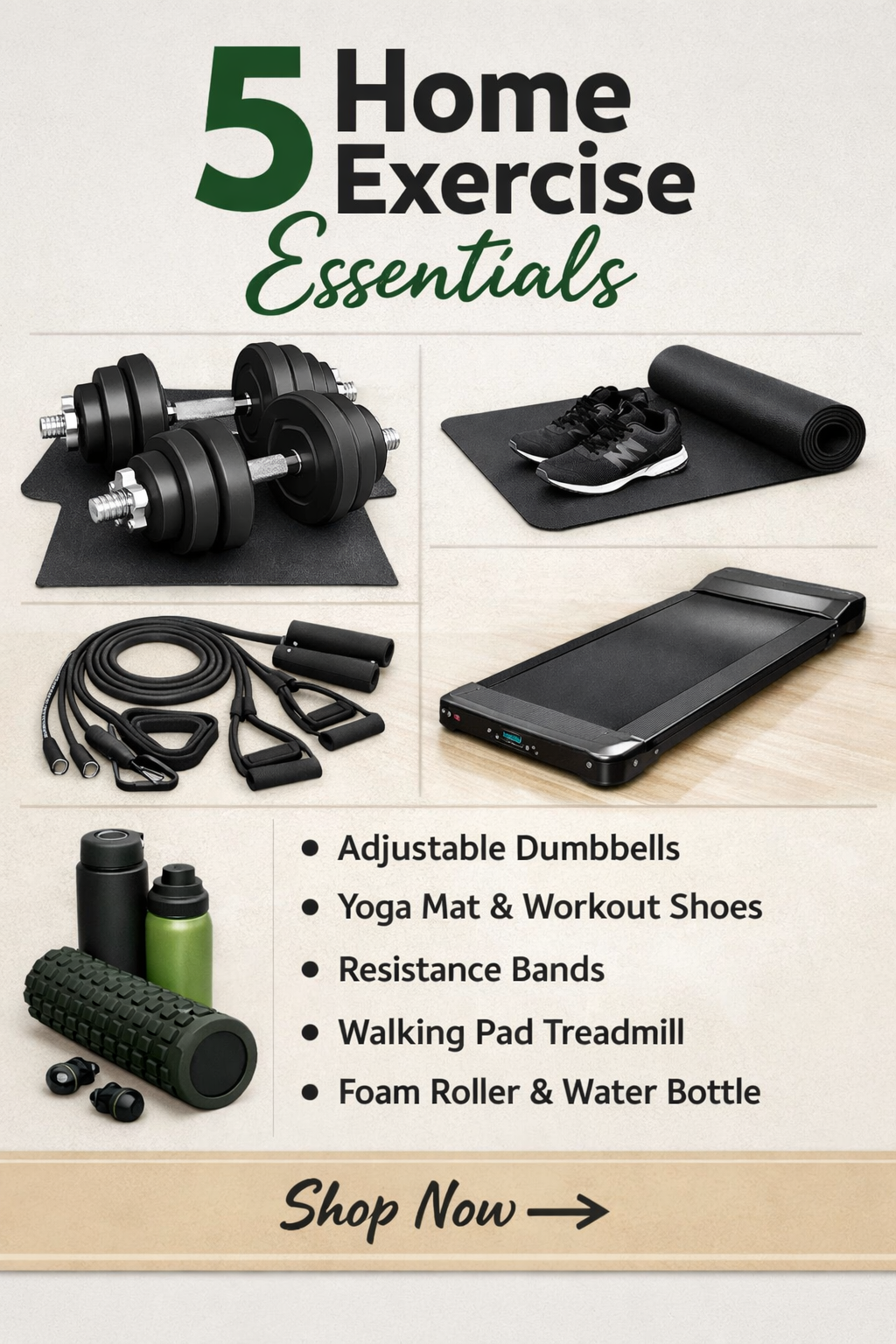
- A non slip exercise mat around 6mm thick. The first purchase for anyone training on a hard or cold floor, which is most people. Look at the underside grip as closely as the thickness, since a sliding mat is worse than a thin one.
- A set of resistance bands in graded strengths, ideally with a door anchor. Buy this second, around week four. It is the one item that adds pulling movements, which nothing else in a small room can do.
- A pair of adjustable dumbbells. The third purchase, once bodyweight and bands stop feeling like effort. Two to ten kilograms per hand suits most beginners, and check the storage cradle size before ordering.
- An under desk walking pad. Only for people whose main problem is a day spent sitting rather than a lack of workouts. It is also the quietest cardio option if anyone lives below you.
⭐ Final Thoughts
A small space is not the obstacle it looks like. A mat, a set of bands and a corner you walk past every day covers more than most people manage in a room full of equipment they bought in one afternoon.
Buy in order and buy late. Four consistent weeks before each purchase means you spend less, store less, and end up owning only the things you already know you reach for.
The one large item I own earns its corner because I use it most weeks, and that is the only test worth applying to anything big. If you cannot say the same about something before you buy it, wait.
Start with the corner rather than the shopping. Stand in it tomorrow morning, do five minutes on the floor, and let what you buy follow from what you find yourself wanting. There is more across Smart Living Essentials.
⭐ Additional Resources
For how much activity is generally recommended by age group, the World Health Organization publishes a fact sheet on physical activity that gives the numbers without prescribing a program.
The Canadian Society for Exercise Physiology takes a wider view across the whole day in its 24 hour movement guidelines, which cover activity alongside sitting time and sleep for each age group.