
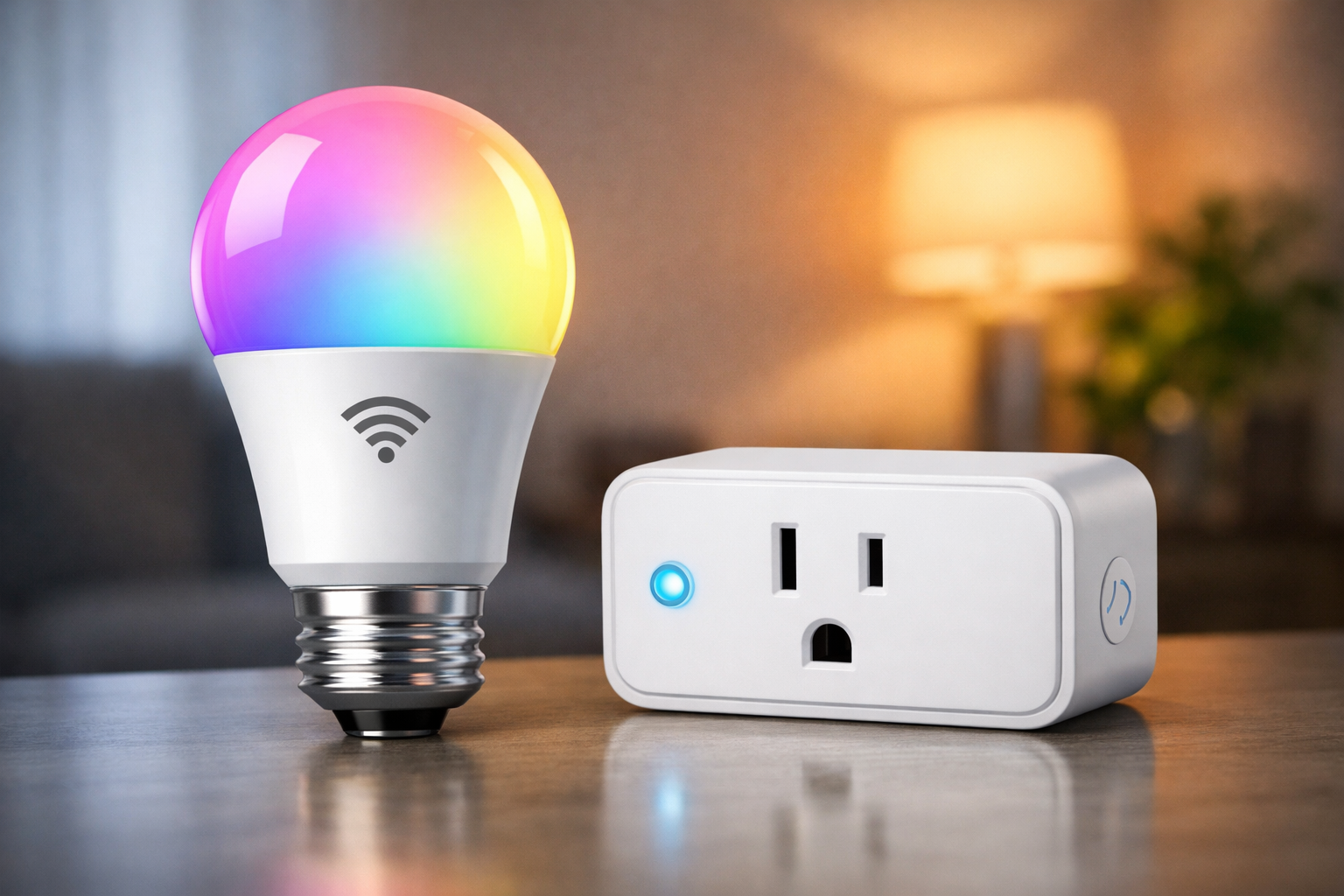
Smart Bulbs and Smart Plugs: The Cheapest Way Into a Smart Home
As an Amazon Associate I earn from qualifying purchases. Some links in this post go to Amazon and may earn me a small commission at no extra cost to you.
Last Updated on September 10, 2026 by Smarteryouu
⭐ Smart Bulbs and Smart Plugs: The Cheapest Way Into a Smart Home
If somebody asks me where to start, the answer is always the same. Smart bulbs and smart plugs, one room, and nothing else until you have lived with them for a month. They cost very little, they need no wiring and no hub, they work on day one, and within a few weeks they will have told you something no article can, which is whether you actually enjoy this or find it faintly irritating. That matters, because the way people end up with a drawer of abandoned gadgets is not buying a bad device. It is buying six good ones at once, across four apps, before knowing whether any of it suits how they live. Both of these have been running here for years. This is what I would tell a friend, including the part about light switches that nobody mentions until it is too late.

⭐ Which Should You Buy First?
Plugs, and it is not close. A plug works with anything you already own, has no downside, and cannot be broken by somebody flicking a wall switch. Bulbs are lovely and they come with one complication that catches almost every beginner, which is worth understanding before you spend anything.
The other reason is that plugs teach you the habit. Once a lamp comes on by itself at dusk you start noticing other things that could happen on their own, and that noticing is the actual skill in this hobby. Devices are easy. Working out which parts of your day are repetitive enough to automate is the part that takes a while.
A pack of four plugs is a genuinely small amount of money for a real trial of the whole idea. If you decide none of it is for you, you have lost very little and learned something worth knowing.
⭐ What a Smart Plug Is Actually For
It sits between the outlet and whatever you plug into it, and it turns that thing on and off on a schedule, from your phone, or by voice. That is the entire product. Its usefulness comes from what you attach to it rather than from anything clever it does.
The best uses in this house are dull and constant. Lamps that come on before it gets dark and off at bedtime. A fan in summer. Christmas lights, which is the one nobody predicts and everybody loves, because the annual routine of crawling behind a tree simply stops. And a lamp that runs on a rough schedule while the house is empty, which is a more convincing absence than a light left on all week.
The uses that disappoint are the ones needing you to decide something. If you have to open an app to enjoy a device, you will do it for a fortnight. Anything on a schedule keeps working forever because nobody has to remember it, which is the test the honest audit of what earns its place applies to every device in the house.
⭐ Bulbs, and the Switch Problem
Here is the thing nobody tells you. A smart bulb needs power to be smart, so if somebody turns the wall switch off, the bulb is not off in a clever way. It is simply off, unreachable by app or voice until a person walks over and flicks the switch back on.
This is the single most common reason households abandon smart lighting, and it is not a fault. It is how electricity works. But it means the correct instruction to everybody in the house is to stop using that switch, which is a genuinely annoying thing to ask of people and does not survive visitors, children or your own hand at two in the morning.
There are three sane responses. Put smart bulbs only in lamps, where the switch is on the lamp itself and nobody touches the wall. Fit a smart switch instead of a smart bulb where a room has a wall switch that gets used. Or accept it in a room where the switch is never touched anyway, like a hallway.
Choosing between a smart bulb and a smart switch is genuinely the fork in the road here, and it is worth deciding room by room rather than buying twelve bulbs and finding out.
⭐ Do You Need a Hub?
Not to start. WiFi bulbs and plugs connect straight to your router and work with a phone and a voice assistant on their own. A hub becomes worth having later, when you have a lot of devices or you want them to work together reliably, and by then you will know whether you are the kind of household that gets there.
What a hub buys you is fewer things depending on WiFi and better behavior when devices need to talk to each other. What it costs you is money and one more box, so the sensible order is to start without and add one if the mess arrives.
The one thing worth doing early is sticking to a single ecosystem, so everything answers to the same assistant and lives in the same app. Mixing brands works and it means several apps, which is death by small annoyance. The foundation guide covers ecosystems, hubs and the network underneath all of it.
⭐ The Schedules Worth Setting on Day One
Three, and they take about ten minutes between them.
Lamps on at sunset rather than at a fixed time. This is the one that feels like magic for a week and then becomes invisible, which is exactly what you want. Sunset moves by hours across the year and a fixed schedule is wrong for most of it.
Everything off at bedtime, as one action. Not because leaving a lamp on matters much, but because a single off is a nicer end to the day than a lap of the house.
And something on a rough schedule while you are away, varied rather than identical each evening. Beyond that, resist building anything complicated for a few months. Elaborate routines set up in week one are almost always wrong, because you do not yet know your own patterns. The guide to automations that save time covers the ones worth building once you do.
⭐ What Goes Wrong With the Cheapest Ones
Cheap is mostly fine in this category, which is unusual, but there are three specific ways the bottom of the market disappoints.
The app is the first. Budget devices often come with software that is slow, translated oddly, or asks for more permissions than a light switch should need. You will use that app most days, so it is worth a minute of reading reviews about the app rather than the hardware.
Physical size is the second, and it is the one people do not think about. A chunky plug covers the second socket in a double outlet, so you buy four and can only use two. Look for a compact body if your outlets are paired, which most are.
The third is abandonment. Small brands stop updating apps, and a device whose app has been retired is a device that stops working eventually. Sticking to brands likely to exist in five years is worth a small premium here.
⭐ What Should Never Go on a Smart Plug?
Anything with a heating element, anything that must not switch off unexpectedly, and anything drawing close to the plug’s rated limit. Space heaters, hair appliances and irons are the obvious ones. Fridges, freezers and anything somebody depends on are the less obvious ones.
The reason for heaters is straightforward. They pull a lot of current continuously, many smart plugs are rated well below what a heater wants, and an accessory quietly running at its limit for hours is not where you want to find out. Check the rating on the plug against the rating on the appliance, and if it is close, do not.
The reason for fridges is different. A smart plug can lose connection, get switched off by a routine somebody forgot about, or be reset by a power cut in an unhelpful state. Nothing that matters should sit behind a device whose whole job is switching off.
Everything else is fair game, and once the basics are running the rest of the sequence is in the smart home section.
⭐ Best Sellers
Top Products and Picks
- A compact smart plug multipack, the first thing to buy if you own nothing yet. Compact matters more than the feature list, since a bulky body covers the second socket in a double outlet.
- A set of smart bulbs for lamps rather than ceiling fittings, which sidesteps the wall switch problem entirely. Buy these for one room first and see whether the household takes to it.
- A smart wall switch, the right answer instead of bulbs in any room where people actually use the switch. Slightly more work to fit and it removes the one thing that makes households give up on smart lighting.
- A plug with energy monitoring, worth one of your four if you are curious what an appliance actually costs to run. It answers the question once and then you stop wondering.
⭐ Final Thoughts
The reason these two are the right starting point is not that they are cheap, though they are. It is that they are the only devices in this category that ask nothing of you after the first evening.
A lamp that comes on before dusk is not impressive. Nobody visits and admires it. But months later you will notice that you have not walked into a dark house all winter, and that you stopped thinking about the Christmas lights entirely, and that is what a house working well actually feels like. Quiet, and slightly hard to point at.
So buy a pack of plugs, put them on the three most obvious things, and leave it alone for a month. If you find you would miss them, you have your answer about everything else.
⭐ Additional Resources
On the point about what not to plug in, the electrical safety guidance on cords and loads explains how ratings work and why high draw appliances belong in a wall outlet directly. The same reasoning applies to any accessory sitting between the outlet and the appliance.