
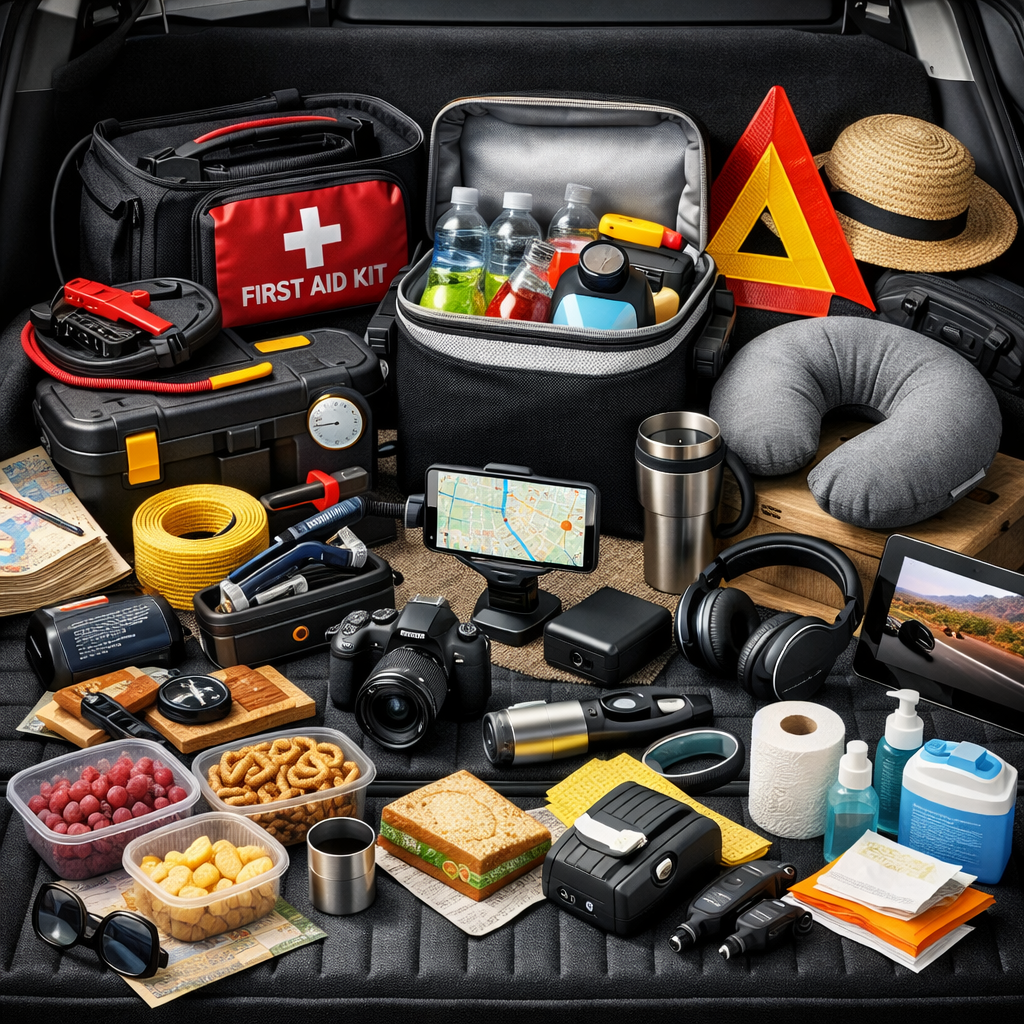
Road Trip Must Haves After 20 Years of Canadian Driving
As an Amazon Associate I earn from qualifying purchases. Some links in this post go to Amazon and may earn me a small commission at no extra cost to you.
Last Updated on September 27, 2026 by Smarteryouu
⭐ Road Trip Must Haves After 20 Years of Canadian Driving
I have been driving long distances in this country for more than twenty years, and the road trip must haves below are not a checklist assembled for the sake of having one. They are what has actually been packed, used and occasionally relied on across a lot of highway, some genuinely bad weather and a couple of situations that were more than an inconvenience. Canadian driving has its own character. The distances are longer than people expect, the weather turns faster than the forecast suggests, and there are stretches where the phone simply stops working for an hour at a time. What follows is built around those three facts, and it ends with the things I used to pack and gave up on.

⭐ Why the Distances Here Change the Packing List
A long drive in a small country is a different activity from a long drive here, and the difference is how far you can be from help.
Outside the main corridors there are stretches with no service, no fuel for a long way, and weather that can change while you are in it. None of that is dramatic on a normal trip. It only matters on the trip where something else has also gone wrong, and preparation is entirely about that overlap.
So the list below is weighted toward self sufficiency for a few hours rather than comfort. Comfort is on it too, because six hours in a seat is its own problem, but the ordering is deliberate.
⭐ The Safety Layer, Which Goes In First
These are not optional in my car regardless of how new it is or how short the trip looks on a map.
A jump pack, charged. A flat battery is the most common roadside problem there is, and being able to deal with it without flagging someone down has mattered every single time it happened.
An inflator for a slow leak, which is far more common than a blowout and is often enough to reach a garage. A first aid kit. Warning triangles, which matter more than anything else if you end up stopped on a shoulder after dark. A light that is not your phone.
Then the boring one. Check the spare actually exists and holds air before leaving, along with the jack and the wrench. A spare that has sat for four years is not a spare. Our full roadside emergency kit goes through each of these and where they should physically sit in the car.
⭐ Comfort Over Six Hours Rather Than Six Minutes
Comfort stops being a luxury somewhere around hour three and I no longer skip any of this.
A neck pillow for whoever is not driving, which makes the difference between a passenger who sleeps and a passenger who arrives tired. A blanket for early starts, since a car at six in the morning outside summer is colder than anyone plans for.
A seat cushion has genuinely helped with back discomfort on the long stretches, something I noticed more as the years went on. Window shades cut glare and keep the cabin cooler, which helps the driver as much as the passengers.
And the simplest one. Stop every two hours whether or not anyone wants to. Twenty years in, that has done more for how a long drive feels than every item in this section combined.
⭐ Keeping It Organised in a Full Car
A cluttered car makes a long drive feel more chaotic than it needs to be, and a full car is always more cluttered than you expected when you packed it.
A boot organiser stops tools, snacks and gear sliding on every corner. I stopped tolerating that particular noise a long time ago. Seat back pockets keep the things people actually reach for within reach, which cuts down on the turning round that nobody should be doing at highway speed.
Waterproof bags have saved more than one trip involving wet clothes or muddy boots, which given the weather here is not a rare scenario. A small bin prevents the wrapper accumulation that otherwise makes a car unpleasant by day three.
The wider set of things that live in the car year round, rather than getting packed per trip, is covered in what actually stays in mine.
⭐ Power, and the Backup for the Backup
Navigation running all day will flatten a phone faster than a car charger replaces it, particularly with the screen bright in daylight. That surprises people the first time.
So a proper car charger with enough output to actually gain ground rather than hold steady. And a power bank on top of that, which is the backup for the moment the charger fails or the socket turns out to be switched off with the ignition.
The reason this matters more here than elsewhere is the dead zones. A flat phone in an area with no service and no flat phone is the same thing, but a flat phone in an area that has service is a problem you created.
A dash cam is worth mentioning here too. Not for the drive itself, but because it settles an argument about an incident in a way nothing else does.
⭐ When the Signal Drops
This is the section I would keep if I had to delete every other one.
Download offline maps before leaving, for the whole route and a margin either side. It takes two minutes on the driveway and it has saved me from being genuinely lost more than once. Live navigation stops working the moment the bars go, and it stops working exactly where a wrong turn costs the most.
Write the route down as well, or print it. That sounds dated and it is a thirty second insurance policy against a dead phone.
A roadside assistance membership is the other half of this. CAA is the usual answer here and after twenty years I would call it close to essential, not because self sufficiency fails often, but because there are situations where being self sufficient is not enough and you need a truck.
Tell someone your route and roughly when you expect to arrive. Free, and it is the single most useful thing on this page.
⭐ Food, and Why the Cooler Earns Its Space
Snacks are close to mandatory on a long drive, and keeping them decent over two or three days is what the cooler is for.
An insulated bag with reusable ice packs beats loose ice, which melts into a bag of cold water by the afternoon and ruins whatever is at the bottom. Containers rather than open packets, so nothing ends up across the back seat on the first hard brake.
The real argument for it is not money, though it does save some. It is that being able to eat without stopping means stopping when you want to rather than when you have to, and on a long day that changes the shape of the whole drive.
A travel mug if coffee is part of your morning. A proper one that does not leak when it goes over on a corner, which is a lesson everybody learns once.
⭐ What I Stopped Packing
Four things went in for years and no longer do.
A dedicated satellite navigation unit. Offline maps on a phone do the same job, and the unit was one more thing to charge and mount. It made sense once and stopped making sense somewhere around 2018.
A full toolkit. A small one covers what can actually be fixed at the roadside, and everything past that needs a garage regardless of what is in the boot.
Reusable cutlery, which sounded sensible and simply never got used, because every stop that involved food also involved somewhere to eat it.
And spare fuel in a can, which I carried once, worried about the whole way, and never carried again. Plan the fuel stops instead. Before a long trip it is also worth doing the basics on the car itself, which our beginner maintenance guide covers, and checking the tyres properly, which this guide goes through.
⭐ Best Sellers
Top Products and Picks
Three that have earned their space across a lot of trips. Ratings and review counts were read from each listing on the day this was written, and they move.
So you stop when you want to
Lifewit Collapsible Insulated Cooler Bag
Folds flat when empty, which is the reason it stays in the car rather than the garage. Around thirty one dollars, rated 4.4 from 4,774 reviews. Use reusable ice packs, not loose ice, or you will have a bag of cold water by mid afternoon.
Check price on AmazonFor whoever is not driving
Memory Foam Travel Neck Pillow
The difference between a passenger who sleeps and one who arrives tired. Around seventeen dollars, rated 4.4 from 5,470 reviews. Not for the driver, for obvious reasons, and worth having one per passenger rather than one shared.
Check price on AmazonThe backup for the car charger
Anker Zolo Power Bank, 20,000mAh
Navigation all day drains a phone faster than a car socket refills it, and this is what covers the gap when the charger fails. Around fifty dollars, rated 4.6 from 1,883 reviews. Built in cables, so there is one fewer thing to forget.
Check price on Amazon⭐ Final Thoughts
After twenty years this is not a generic list. It is what has proved itself through real breakdowns, real weather and a lot of highway with nothing on either side of it.
None of it has to go in at once. If you are building up to a first long drive, do the safety layer first and the comfort second, because the comfort items are the ones you can buy at any stop along the way and the safety ones are not.
The two things that cost nothing are the two that matter most. Download the maps before you leave. Tell someone the route and when you expect to arrive.
Everything else on this page is a convenience or an insurance policy. Those two are the ones I would not set off without, and neither needs buying.
⭐ Additional Resources
Transport Canada’s guidance on staying safe when driving covers winter conditions, fatigue and what to do at the roadside, all of which apply more on a long drive than on a commute.