
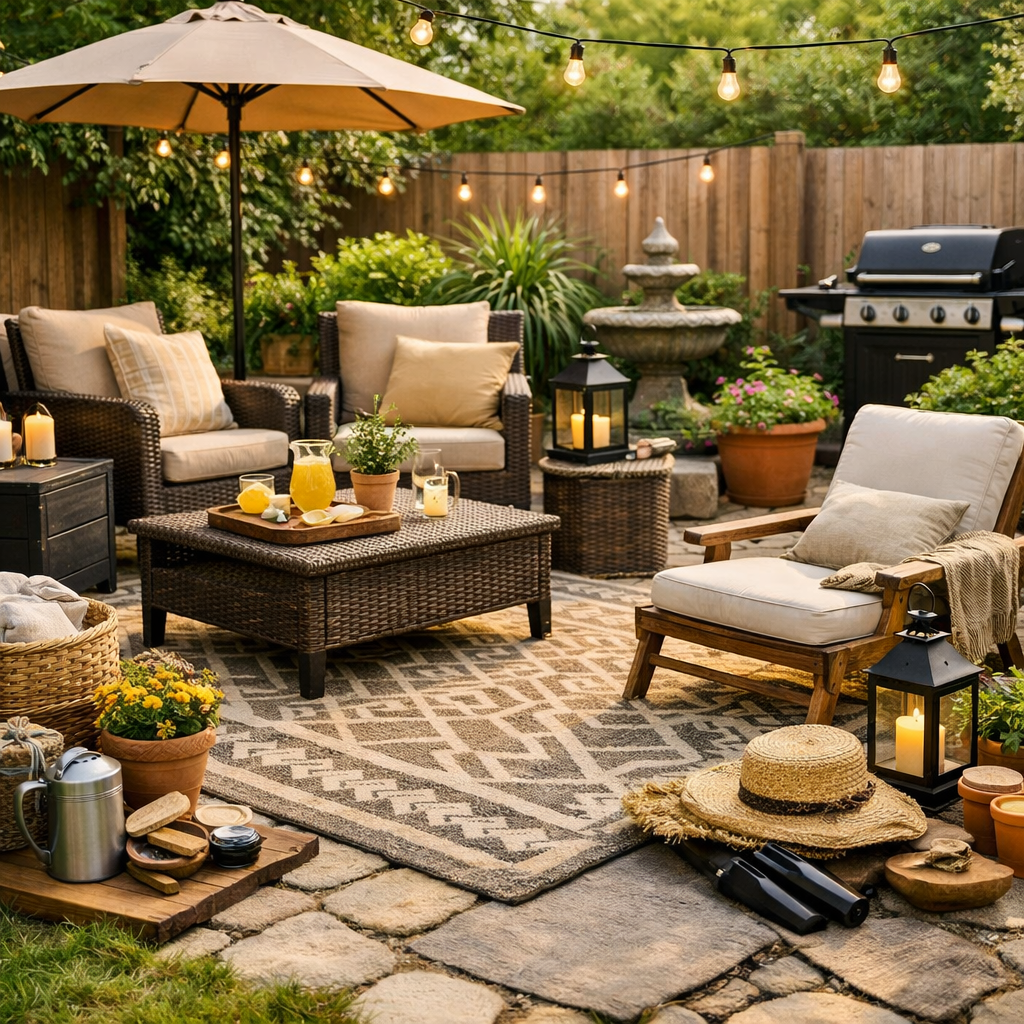
Outdoor Patio Essentials: What to Buy First and What Can Wait
As an Amazon Associate I earn from qualifying purchases. Some links in this post go to Amazon and may earn me a small commission at no extra cost to you.
Last Updated on September 6, 2026 by Smarteryouu
⭐ Outdoor Patio Essentials: What to Buy First and What Can Wait
Almost every list of outdoor patio essentials is written as though you are buying everything on the same afternoon, and that is not how anybody actually does it. Most people start with a bare slab or a deck, spend some money in April, and then spend more in June fixing the thing the April money did not solve. The order turns out to matter more than the list, because the wrong first purchase makes the second one necessary. This post is the order, worked out the slow way over several seasons of getting it wrong. What genuinely needs to arrive in the first few weeks, what is much better bought in the second year once you know how you use the space, and the short list of things that get bought every spring by hopeful people and then sit in a shed. None of it requires a big budget. It mostly requires doing three cheap things before four expensive ones.

⭐ What Should You Buy First for a Patio?
Shade first, then somewhere to sit, then light. Those three in that order turn a bare slab into a usable space within a weekend. Rugs, planters, side tables, heaters and cushions are all worth having, but they improve a space you already sit in rather than getting you outside in the first place.
That order surprises people, because shade is easily the least exciting item on the list and it never appears first in a photograph. It is also the one that decides whether the space is usable between noon and five, which for most households is the only stretch when somebody is home and free.
The common sequence runs the other way and it fails in a predictable pattern. Furniture arrives first. It sits in full sun. Nobody uses it. The next purchase is a cushion set, on the theory that the seat is uncomfortable, which does not help because the seat was never the problem. Then the third purchase is a parasol, by which point the money is gone.
⭐ Shade Comes Before Furniture, Every Time
Shade is the difference between a patio that gets used on a hot day and one that gets looked at through the kitchen window. It is worth working out where you need it before deciding what kind to buy.
Go outside at two in the afternoon and again at five, and note where the sun actually lands. Most people are surprised, because the spot that feels obviously right in the morning is often the harshest one later. Sun moves further across a yard in a day than anybody remembers.
A parasol is the cheapest answer and it is genuinely fine, as long as the base is heavy enough that you are not chasing it across the lawn. A wall mounted awning covers the area nearest the house, which is usually where people sit anyway. A pergola is the most expensive of the three and the only one that changes the space rather than just covering it, because a frame overhead gives the seating area an edge and makes it read as a room instead of part of the lawn.
Shade is also the part of a patio where comfort and sense overlap, since the middle of the afternoon is when sun exposure is strongest. The guide to making a patio comfortable goes into sun angles, wind and evening bugs in far more detail, which is worth reading before you commit to a spot.
⭐ Buy Seating for How You Actually Sit
The second purchase is somewhere to sit, and the useful question is not how many people you might one day host. It is what you do out there on an ordinary Tuesday.
Most households eat outside a handful of times a summer and sit outside with a drink or a phone several times a week. Yet almost everybody buys the dining set first, because that is what a patio is supposed to have. The result is a large table that gets used six times and no comfortable chair for the other ninety evenings.
Two good chairs and a small table between them will out earn a seven piece set in almost every yard. They cost less, they leave room to walk, and they are easy to move into the shade as it shifts. If it turns out you do host more than you expected, you can add a table in year two, and by then you will know exactly where it should go.
What to look for in the chairs themselves, including frame materials and the cushion foam that decides how a set ages, is covered in the outdoor furniture buying guide.
⭐ Light Is the Cheapest Thing on the Whole List
The third purchase is light, and it gives the biggest return per dollar of anything you will buy for a patio. A space you only see in daylight gets used at weekends. A space that looks inviting at eight in the evening gets used after work.
Two things decide whether it works, and neither costs more than getting it wrong. The first is warmth. Cold white light makes any outdoor space look like a parking area, and it is the single most common mistake. The second is height. Light at eye level or below feels calm. Light pointing down from above feels like a security floodlight, because that is what it is.
String lights across the space, a couple of lanterns on the ground and something low near the seating will do more for the atmosphere than any furniture upgrade. Solar is fine for gentle background light in summer and disappointing in late autumn, when the days are too short to charge it properly, so anything you actually need to see by is better plugged in.
⭐ What Can Safely Wait Until Year Two?
A dining table, a heater, a fire pit, a full planting scheme and any built structure can all wait. None of them makes an unused patio used. All of them are much better bought once you know which corner you sit in, how late you stay out and how often anybody eats outside.
The storage box is the interesting exception, because it moves up the list the moment cushions become a chore. Usually that happens about a month in, on the third evening you carry everything indoors because the sky looked doubtful. A box outside is what keeps a patio set up rather than packed away.
Everything decorative also belongs in this second wave, and it works better there. Rugs, planters, lanterns and cushion covers are cheap, easy to change and much more satisfying to choose once the bones of the space are settled. The patio styling guide covers that layer properly, and it is the fun part rather than the useful part, which is exactly why it should not come first.
⭐ What Gets Bought Every Spring and Never Used?
Outdoor heaters bought in April, decorative solar stakes, hanging egg chairs in yards with nowhere to hang them, oversized dining sets, and citronella candles bought by the box. All five sell enormously in spring and all five sit unused by August.
Heaters are the biggest single waste, and the reason is timing. They are bought in spring, when the evenings are still cool, and they are needed in October, by which point most people have already stopped going outside. Buying one in late summer, when you are still in the habit of sitting out, is the version that gets used.
Decorative solar stakes are the second. They look charming in the package and produce roughly the light of a birthday candle, and after one winter about half of them stop charging at all. A single decent string of lights beats a dozen of them.
The last one is buying for guests rather than for yourself. It is the same instinct that fills kitchens with equipment for meals nobody cooks. Buy for the ordinary evening and borrow chairs for the party.
⭐ A First Season Order That Works
If you want the whole thing as a sequence, it runs like this. Shade over the spot you sit in. Two comfortable chairs and a small table. Warm light, low down. Then a storage box, once carrying things indoors starts to annoy you.
After that, stop for a few weeks and use the space. The next purchase should come from something you noticed rather than something you planned, and it usually will. A windy corner, nowhere to put a cup, a view of the neighbor’s bins that you would rather screen off.
Plants are the one thing worth adding early even though they are not strictly essential, because they take time to fill out and everything else can be bought instantly. A few pots in the first month will look established by the time the rest of the space is finished, and the outdoor garden section covers what survives in containers with very little attention.
⭐ Best Sellers
Top Products and Picks
- A cantilever parasol with a weighted base, the right first purchase for anyone whose seating area bakes between two and five. The base is the part worth paying attention to, since a light one turns the whole thing into a weekly chore.
- Weatherproof string lights with warm bulbs, worth buying before any furniture upgrade. They cost less than a single chair and they are what decides whether the space gets used after eight in the evening.
- A pair of deep seat lounge chairs rather than a dining set, if you are furnishing from scratch and are honest about sitting outside far more often than you eat outside.
- A weatherproof deck box, which becomes worth it the week carrying cushions indoors starts to feel like a chore, usually about a month in. It is the difference between a patio that stays set up and one that gets packed away in August.
⭐ Final Thoughts
There is no version of this where you get it all right in the first spring, and it helps to stop trying. A patio is one of the few spaces in a house that tells you what it needs, as long as you go out and sit in it long enough to hear.
So buy the small useful things early and leave the large satisfying ones until you have evidence. Sit outside at the hour you would most like to be out there and notice what sends you back indoors. Too bright, too breezy, nowhere to put a cup down, nothing pleasant to look at. Whatever that turns out to be is the next thing to buy, and it is usually cheaper and duller than whatever you had in mind.
The spaces that end up feeling right were almost never planned in one go. They were assembled slowly by somebody who kept going outside, noticed one thing at a time, and dealt with only that.
⭐ Additional Resources
Since shade is the first thing on this list, the public guidance on sun safety and the UV index is a useful companion. It explains which hours are strongest and how to check the day’s index before planning an afternoon outside.