
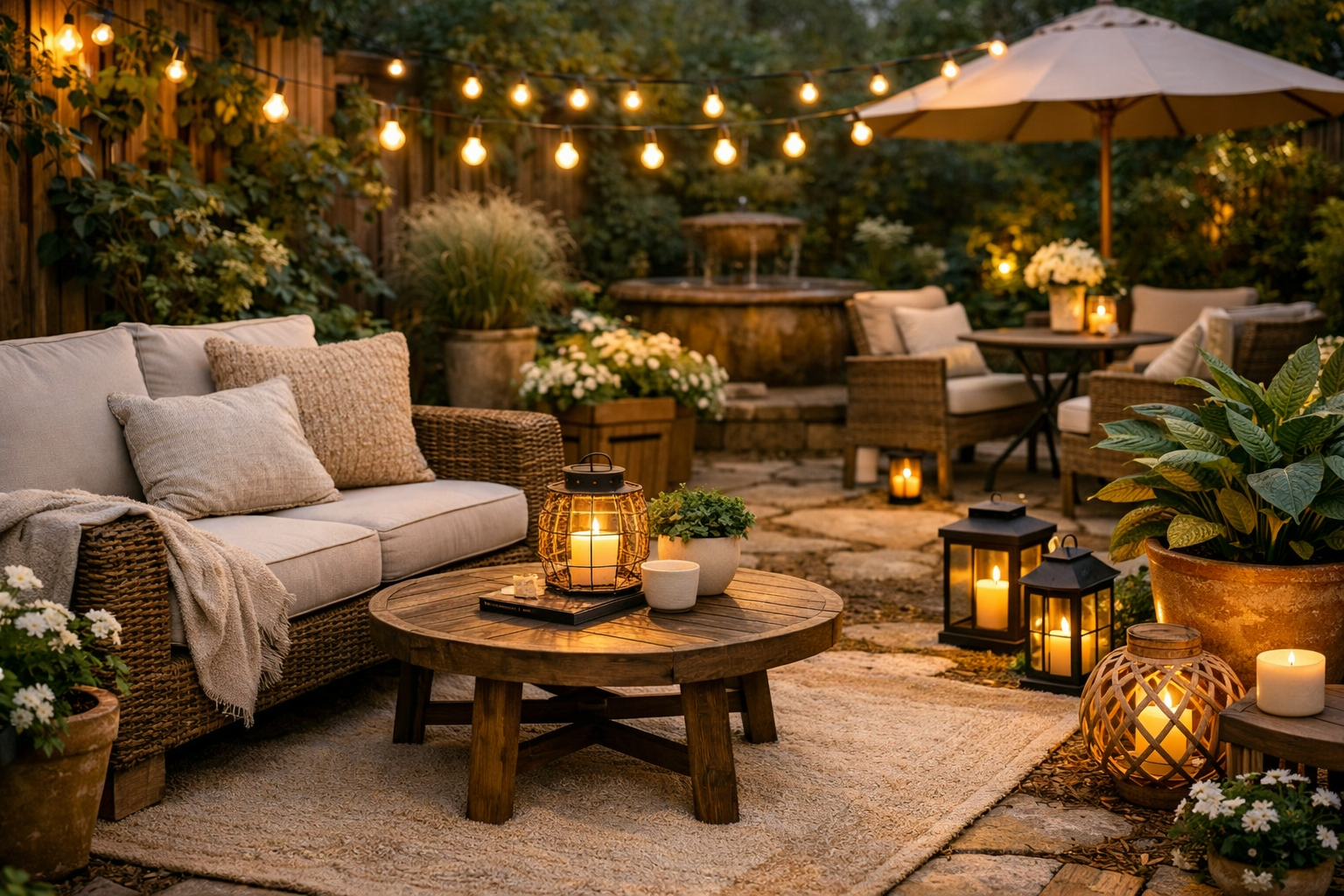
Small Patio Ideas That Make a Balcony or Backyard Corner Feel Like a Room
As an Amazon Associate I earn from qualifying purchases. Some links in this post go to Amazon and may earn me a small commission at no extra cost to you.
Last Updated on September 6, 2026 by Smarteryouu
⭐ Small Patio Ideas That Make a Balcony or Backyard Corner Feel Like a Room
Most small patio ideas are just normal patio advice with the word small added, and that is why so much of it makes a tight space worse rather than better. A balcony, a side return or one corner of a yard is not a shrunken backyard. The rules genuinely change. Things that are optional in a large space become the whole design in a small one, and things that look generous on a big slab, like a low table in the middle or a set of matching chairs facing inward, are exactly what makes a small area feel cramped and slightly silly. The good news is that small spaces are far cheaper to get right, and they come together much faster. Two or three correct decisions is usually the whole project, and you can be sitting in the finished thing by the end of a weekend.

⭐ A Tight Space Is Not a Shrunken Big One
The instinct in a small area is to find miniature versions of everything a large patio has. A tiny table, tiny chairs, a tiny parasol, arranged the same way. It rarely works, and the reason is that the layout was the problem, not the scale.
A big patio can afford to waste space. It can have a hole in the middle, a walking route around the outside and furniture that only does one job, because there is enough room for all of it. A small one cannot afford any of that, so every piece has to justify the floor it stands on.
The mental shift that helps most is to stop thinking of it as a patio and start thinking of it as one piece of furniture, arranged against a wall or into a corner rather than floating. Almost every small outdoor space that works is built along an edge, not around a center.
⭐ How Do You Make a Small Patio Feel Bigger?
Keep the floor visible. The amount of uninterrupted ground your eye can see is what it reads as size, so furniture on visible legs, one larger rug rather than several small mats, and nothing bulky in the middle will all make the same area feel noticeably larger.
Legs are the detail nobody mentions and the one that does the most work. A bench with a solid base reads as a block, while the same bench on visible legs lets the floor run underneath it and the eye keeps going. It is the identical footprint and a completely different feeling.
The rug is the other lever, and the mistake is going too small. Several little mats chop the ground into pieces and make everything feel crowded. One rug that sits under the front legs of everything pulls the whole area together and reads as a single defined room rather than a scattering of objects.
Color helps at the margins. Pale walls and floors bounce light around a narrow space, and a mirror or a pale panel on the shaded side genuinely opens it up. But none of that matters as much as simply leaving floor visible.
⭐ Smaller Furniture or Less Furniture?
Less, almost always. Two properly comfortable chairs will do more for a small space than four narrow ones, because nobody enjoys a chair they can only perch on, and a space with four bad seats gets used less than a space with two good ones.
Where scale does matter is depth rather than width. A lounge chair three feet deep eats a balcony no matter how narrow it is, while a chair with a slimmer profile can be full size across the seat and still leave a walking route. Measure the depth before the width, since that is the dimension that tends to fail.
Then make everything you do buy earn its place twice. A bench with storage inside it. A stool that becomes a side table when nobody is on it. A folding chair that hangs on the wall between uses. A narrow console against the rail instead of a coffee table in the middle. Dual purpose is not a compromise in a small space, it is the whole strategy.
Frame materials still matter as much as they do anywhere, and light frames are worth choosing deliberately here since you will be moving things. The outdoor furniture buying guide covers which frames and cushions survive a winter outside.
⭐ Go Upward Before You Spread Outward
This is the single biggest difference between small space design and everything else. In a large yard, vertical elements are decoration. In a small one they are how you get any greenery, storage or atmosphere at all without losing floor.
Rail planters, wall mounted pots, a trellis against the fence and a hanging basket at head height give you the planting of a much larger space using none of the ground. Two or three heights matter more than quantity. A single row of pots at floor level reads as decoration, while the same number of plants staggered from the floor to above eye level reads as planting.
Light works the same way. A lantern on the floor and a string of lights overhead cost very little and give the space a top, which is what makes a corner feel enclosed. Anything overhead helps, and in a small area you rarely need more than one run of it.
Containers are their own small skill, since pots dry out faster and need more thought than beds. The outdoor garden section covers what survives in a container with very little attention, which matters more here than anywhere.
⭐ What Should You Leave Out Entirely?
A dining table, a large parasol with a floor base, a fire pit, a coffee table in the middle and any matching set of four. All five are standard in a big yard and all five will swallow a small one, usually while making it look like a showroom display rather than a place to sit.
The parasol is the one worth explaining. A floor standing base needs a heavy weight to be safe, and that weight sits in the middle of your only walking route. A wall mounted or clamp fitted shade does the same job and takes no ground at all, which in a small space is the difference between usable and not.
The coffee table is the other one. In a large space it anchors a seating group. In a small one it becomes the thing everybody edges around, and a narrow side table beside each chair does the job better while leaving the center of the floor clear.
If you find you genuinely want to eat outside, a folding bistro table that lives against the wall between meals is the version that works, and it is worth reading where a table sits in the patio buying order before committing to one.
⭐ Balconies Have Rules of Their Own
A balcony is the tightest version of all of this, and it comes with practical constraints a backyard corner does not have. Worth knowing them before buying anything.
Weight is the first. Soil is heavy once it is wet, and a row of large planters holds a surprising amount of it. Lighter growing mixes and smaller pots in greater numbers are the sensible route, and it is worth checking what your building allows before loading up a rail.
Water is the second. Whatever you pour into a pot on a balcony eventually finds the floor, and then a neighbor’s floor. Saucers under everything, and pots pulled slightly back from the edge, saves a conversation nobody wants to have.
Wind is the third and it is much stronger a few floors up than it is at ground level. Anything light will move. And most buildings restrict grills on balconies, which is worth checking rather than assuming, since the rules differ by building and by local code.
⭐ Making One Corner Genuinely Worth Sitting In
If your small space is a corner of a larger yard rather than a balcony, the advantage is that you get to choose which corner. That decision is worth more than anything you buy.
Pick the one that is pleasant at the hour you are usually free, which for most people is late afternoon rather than midday. Pick one with something behind it, a fence, a hedge or a wall, because a seat with its back to open space never feels settled. And pick one you can reach easily from the door, since the number of steps between the kitchen and the chair quietly decides how often anyone bothers.
Then treat that corner as the whole project rather than as the first phase of a bigger one. A single small area that is genuinely comfortable gets used every week. A half finished plan spread across the whole yard gets used for photographs. The patio styling guide covers pulling the last layer together once the corner is chosen.
⭐ Best Sellers
Top Products and Picks
- A storage bench that doubles as seating, the single best first buy for a balcony or a corner, since it removes the need for a separate box and gives you somewhere to sit in the same footprint.
- A set of railing planters, for anyone who wants greenery and has no floor to spare. Get these before any freestanding pot, because floor level pots are the first thing to go when a small space gets crowded.
- A wall mounted or clamp fitted shade instead of a parasol with a base, worth it the moment you realize the base would sit in your only walking route.
- A folding bistro set that hangs or stacks flat, for the small space that occasionally has to become a place to eat. Buy it only once you know you actually eat out there, which is usually a year in.
⭐ Final Thoughts
There is a quiet advantage to a small outdoor space that nobody mentions. It is finishable. A large yard is always partly unresolved, always one project behind, and there is always another corner asking for attention. A balcony or a single corner can genuinely be done, and then simply enjoyed.
So it is worth resisting the urge to fit in one more thing. The version of a small space that people love is almost always the emptier one, with two good seats, something growing above head height and a warm light in the evening. Everything beyond that tends to be subtraction disguised as addition.
Sit in it for a few evenings before buying anything else. If nothing is missing, nothing is missing, and a finished corner you actually use is a better outcome than a bigger one you are still working on. The outdoor patio section has the rest of the decisions if you do want to take it further.
⭐ Additional Resources
If a grill is part of the plan on a balcony or a tight corner, the fire safety association guidance on grilling covers required clearances from walls and railings, which is where most balcony restrictions come from.